
Livraison le jour même ou le lendemain

Qualité garantie

Débloquez vos offres de bienvenue: Livraison GRATUITE | Jusqu'à -80 % | 30 jours d'essai gratuits à JoyPlus
Téléchargez l'application
Choosing an ergonomic Momcozy baby carrier is about more than comparing colours and prices. For everyday outings, public transport journeys or long walks, comfort depends above all on fit, weight distribution and the child’s position.
Some marketing claims can nevertheless be misleading. Here are the most common pitfalls, the points to check and a selection of models suited to different types of parents in France.
A lightweight baby carrier is convenient to carry when it is not in use. However, a low weight does not guarantee effective load distribution. For carrying your child over extended periods, it is better to check for a waistband or lumbar support panel, as well as the design of the shoulder straps.
The Momcozy models featured here generally weigh between 760 and 811 grams, depending on the version. Their X-shaped or cross-back construction is designed to distribute the load across the shoulders and back. The comfort achieved will nevertheless depend on the wearer’s body shape and the quality of the adjustment.
A breathable baby carrier, or one made from Air Mesh fabric, can encourage airflow, particularly in summer. This does not mean that the baby will not sweat. Outdoor temperature, clothing and journey duration remain decisive factors.
Cotton provides a soft touch and a natural feel. Mesh focuses more on ventilation. In both cases, the child’s face must remain visible and their airways completely clear.
The statement “baby from 3 to 20 kg” does not mean that every child can be positioned in the same way at every age. Several models indicate approximate use from 3 months, with a minimum weight of around 3.18 kg and a maximum close to 19.96 or 20 kg.
Before buying, consult the instructions for the model you have chosen. An infant who cannot yet hold their head up without assistance requires particular care and must not be positioned in a way that contradicts the manufacturer’s instructions.
An ergonomic baby carrier should allow the baby’s knees to sit slightly higher than their bottom while supporting their legs across their full width. This configuration is commonly known as the M-position. The back panel should also follow the natural curve of the child’s back without forcing them into an upright position.
According to the product specifications, the relevant Momcozy carriers feature a wide, padded seat and C-shaped support. These elements are designed to support the baby’s position, but correct adjustment remains essential.
An adjustable baby carrier should adapt as the child grows and suit the body shape of the adults carrying them. In particular, check for the following features:
Several Momcozy models offer three adjustment positions and are designed primarily for front carrying. Before each use, gently pull on the straps and make sure that all buckles are fully fastened.
A cotton baby carrier may suit parents looking for a soft material that is easy to wash. Versions advertised as being made from 100% cotton mention OEKO-TEX Standard 100 certification for the fabric, according to the information provided in the product specifications. This refers to textile certification and does not constitute a medical guarantee.
Air Mesh and Mesh versions are better suited to situations where ventilation is a priority. In both cases, being able to use a machine-washable baby carrier makes cleaning easier after meals, journeys or outdoor activities. Always follow the temperature and washing instructions provided in the manual.
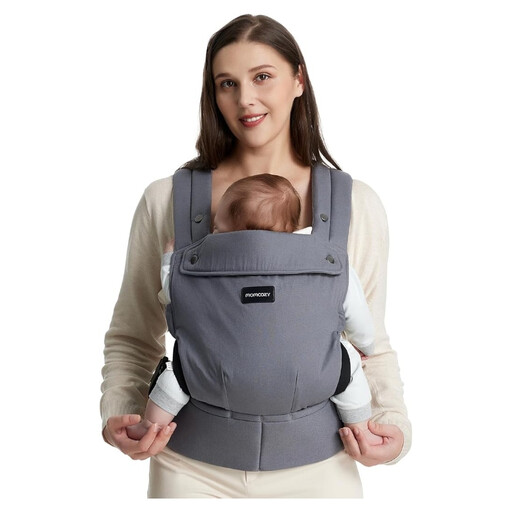
Why this model suits this profile: A cotton option for parents looking to start with a straightforward front carrier designed for children weighing approximately 3.18 to 19.96 kg.
The product listing mentions an M-shaped seat, adjustable shoulder straps and an EVA panel for lumbar support, rather than a simple, unstructured fabric design.
100% cotton, stated weight of 771 g, front carrying and care instructions indicating machine-wash compatibility.
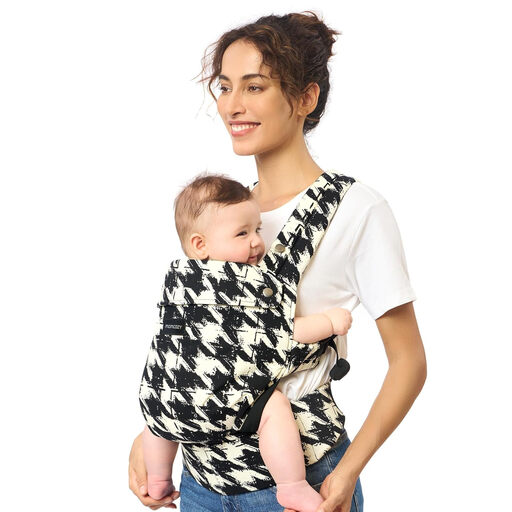
Why this model suits this profile: According to the product listing, its OEKO-TEX Standard 100-certified cotton fabric may appeal to parents who pay close attention to materials and care requirements.
The product listing details the dimensions, adjustable buckles and X-shaped construction, making it possible to check the key features before ordering.
Cotton described as breathable, a wide padded seat, three size adjustments and a stated weight of 0.81 kg.
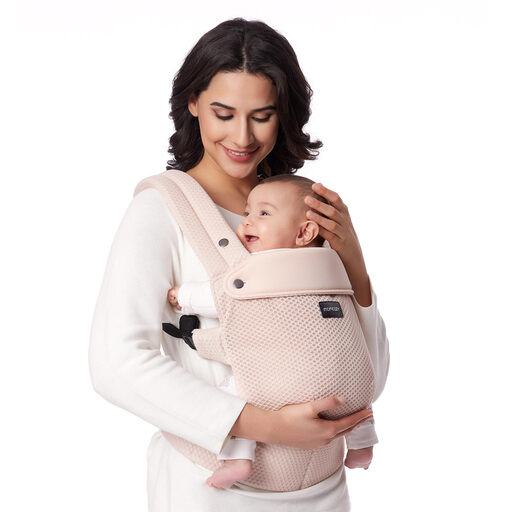
Why this model suits this profile: Mesh fabric and a cooling neck-contact panel are designed for summer walks, urban travel and hands-free carrying every day.
The fabric has been selected to promote airflow without presenting breathability as protection against overheating. Supervision remains essential.
Air Mesh panels, EVA lumbar support, three adjustment positions, front carrying and a stated weight range of 3.18 to 19.96 kg.
We have put together an up-to-date selection of products that meet these criteria, with useful information for carrying little ones in France.
To use a baby carrier with lumbar support safely and comfortably, always follow the same order:
A baby carrier is not protective equipment against falls. It must not be used while running, cycling, cooking near a flame or taking part in any activity involving a risk of falling. If pain or discomfort occurs, stop carrying the child and readjust the product.
The models featured generally indicate approximate use from 3 months and for a minimum weight of 3.18 kg. However, make sure that the baby can hold their head properly and follow the instructions for the model in question.
Several cotton and Mesh models are advertised as machine-washable. Fasten the buckles before washing and follow the temperature, drying and care instructions provided on the label.
The appropriate duration depends on the child’s age, weight and the temperature, as well as the comfort of both the baby and the wearer. Take regular breaks, monitor the child’s position and stop carrying them as soon as you notice discomfort, poor posture or difficulty breathing.