
Livraison le jour même ou le lendemain

Qualité garantie

Débloquez vos offres de bienvenue: Livraison GRATUITE | Jusqu'à -80 % | 30 jours d'essai gratuits à JoyPlus
Téléchargez l'application
Whether you're a professional taking notes in meetings, a student organising your coursework, or a creative sketching ideas on the fly, choosing a notebook is a significant decision. A good notebook becomes an extension of your thoughts. Yet, with slick marketing, it's easy to end up with a disappointing product. Some notebooks promise a premium writing experience but prove impractical for daily use.
To avoid falling into this trap, let's review the common pitfalls and the criteria that truly matter for making an informed choice.
To avoid these disappointments, there are a few objective technical specifications to keep a close eye on. These are the details that distinguish a simple notepad from a true work tool designed to last.
Paper weight, expressed in grams per square metre (g/m? or gsm), is a key indicator of the paper's thickness and opacity. For daily use with ballpoint or gel pens, a 70?g/m? ivory-coloured paper, like that found in Moleskine notebooks, offers an excellent balance between thinness and durability. This acid-free paper is also designed to last for years without yellowing, preserving your notes for posterity.
A notebook's durability largely depends on its cover. A Moleskine hard cover provides robust protection against bumps and bends in a bag. It also serves as a stable surface for writing anywhere, even without a desk nearby. Paired with a stitched binding that allows for a 180° lay-flat opening, it ensures optimal writing comfort across the entire page, from the beginning of the notebook to the end.
For consumers mindful of their purchasing impact, the paper's origin is a deciding factor. The FSC (Forest Stewardship Council) certification of Moleskine notebooks guarantees that the paper comes from responsibly managed forests and other controlled sources. It's a hallmark of sustainable forest resource management.
There's a notebook for every need. To help you find the one that's right for you, here is our 2026 Moleskine selection, curated for different user profiles.
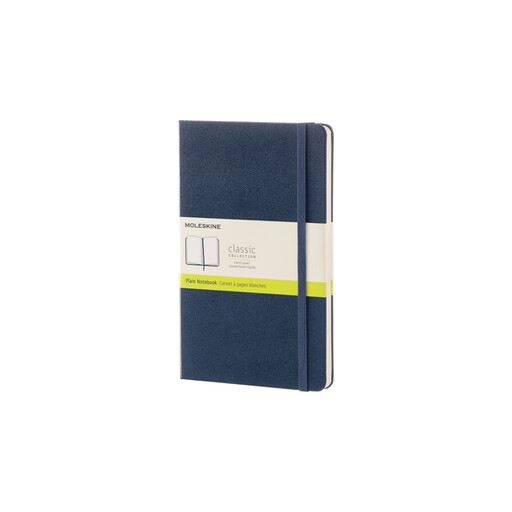
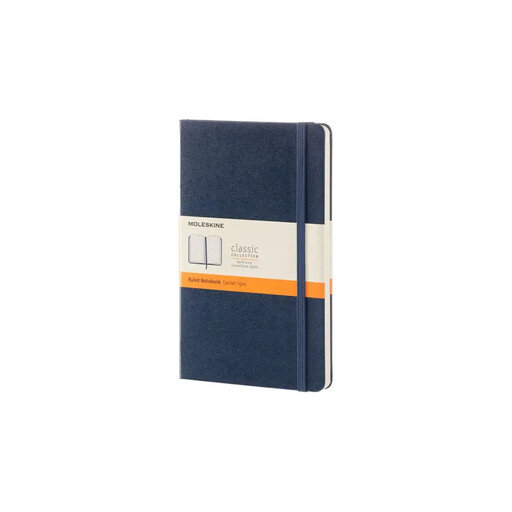
Why we chose it: Perfect for structuring notes during meetings or planning projects. Its hard cover and Large size (similar to A5) make it the quintessential professional notebook, while the sapphire blue colour adds a touch of understated elegance.
Its stitched binding and hard cover are a safeguard against premature wear and tear. They ensure a perfectly flat opening, which solves the problem of bindings that break or bulge in the middle of the notebook.
Hard cover for stable note-taking in any situation. Ruled pages for clear and neat organisation.
Why we chose it: Perfect for fans of *bullet journaling* (or *bujo*), drawing, or visual organisation. The dotted grid offers a subtle guide without the rigidity of lines, making it an ideal canvas for mixing writing and sketches.
The 70 g/m? ivory-coloured paper is designed to minimise *ghosting* with most pens, allowing you to confidently use both sides of the page for your creative layouts.
Dotted grid for maximum flexibility. It includes the brand's signature details: expandable inner pocket, ribbon bookmark.
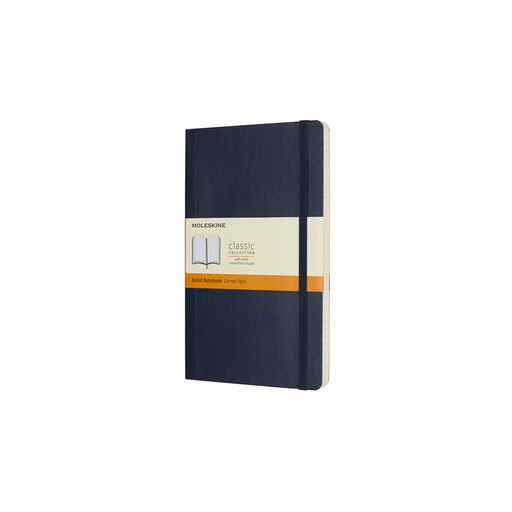
Why we chose it: For those who are always on the go, the soft cover version offers more flexibility and is lighter. It slips easily into a bag without adding weight, all while maintaining the quality that the classic range is known for.
Although flexible, its cover remains durable and the stitched binding holds strong. This helps you avoid the problem of a low-quality notebook that falls apart after a few weeks of nomadic use.
Soft cover for maximum lightness and flexibility. Retains all the key Moleskine features (lay-flat opening, quality paper).
Explore our full selection of products that meet our quality criteria and current standards.
This is a common question that deserves clarification. The Moleskine Large (L) size measures 13?x?21?cm. It is slightly narrower and taller than a standard A5 size (14.8?x?21?cm). This dimension is often praised for its portability and comfortable feel in hand, while still offering a generous writing area.
The 70?g/m? paper in classic Moleskine notebooks is optimised for ballpoint pens, fine-liners, and pencils. For fountain pen users, especially those with very wet inks or broad nibs, some light ghosting can be expected. Our advice: test your pen on an inconspicuous page (like the last one) or consider ranges with heavier paper weight if a fountain pen is your tool of choice.
For both hard and soft covers, a simple dry cloth is usually enough to remove dust. For a small stain, a very lightly damp cloth can be used, making sure to dry the surface immediately. Avoid prolonged exposure to sunlight, which could fade the colour, as well as excessive moisture. The elastic closure, when used, helps to maintain the notebook's shape and protect the pages.