
Livraison le jour même ou le lendemain

Qualité garantie

Débloquez vos offres de bienvenue: Livraison GRATUITE | Jusqu'à -80 % | 30 jours d'essai gratuits à JoyPlus
Téléchargez l'application
Choosing a new motorcycle helmet? It can be a daunting task. Between marketing promises and often opaque technical jargon, it's easy to make a mistake. On paper, the modular motorcycle helmet offers the ideal compromise between the security of a full-face and the convenience of an open-face helmet. But be warned: certain design flaws can turn this investment into a costly and, worse, dangerous disappointment.
Before you decide, here are the most common pitfalls to avoid:
To avoid these traps, simply focus on the objective criteria that separate a good helmet from a bad one.
To make an informed choice, examine these three points closely. They are the foundation of a reliable and comfortable helmet for daily use.
Since 2023, the ECE 22.06 standard has become THE benchmark for motorcycle helmet safety in Europe. It replaces the old 22.05 standard by imposing much more demanding tests.
In practical terms, what does this change for you?
Demanding an ECE 22.06 motorcycle helmet isn't an option; it's the minimum requirement for effective protection.
Juggling sunglasses and a clear visor is a hassle every rider knows. A motorcycle helmet with an integrated sun visor solves this problem simply and safely.
A good dual visor system is recognisable by:
This feature provides undeniable riding comfort, whether you're facing the low morning sun in the city or on long rides where the light changes constantly.
Even if you don't plan to install a communication kit right away, choosing a Bluetooth-ready helmet is a future-proof decision. These models integrate dedicated spaces for the speakers and microphone, most often in the cheek pads and chin bar.
This will save you from a risky "DIY" job that could not only compromise comfort but also damage the internal polystyrene (EPS) liner, which is essential for your safety. A manufacturer-designed slot guarantees a clean installation and optimised acoustics.
Rather than an endless list, we've selected models that cater to specific user profiles. The goal: to help you find the one that truly matches your needs.
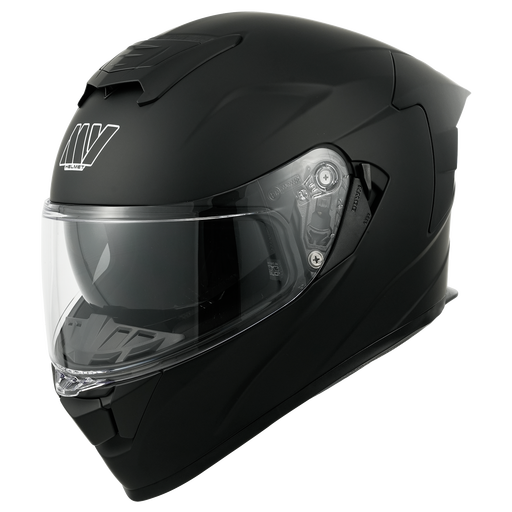
Who is it for? Ideal for urban commutes and occasional rides. This helmet gets straight to the point: safety and practicality, without the frills that drive up the price. Its understated look as a matte black motorcycle helmet makes it a unisex model, perfect as a men's motorcycle helmet or a women's motorcycle helmet.
It sidesteps the #1 safety trap by being ECE 22.06 homologated. Its ABS shell construction with a high-density EPS liner ensures shock absorption that meets the latest standards.
The integrated sun visor is a real asset for city riding, where you constantly move from shadow to light. Its interior is removable and washable, ensuring hygiene and longevity.
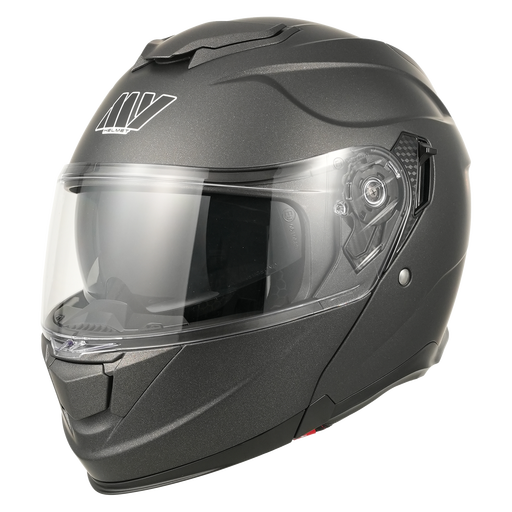
Who is it for? Designed for high-mileage riders who clock up the miles. For them, long-term comfort and connectivity are not optional. A helmet built for touring.
It avoids the pitfall of discomfort and lack of preparation by offering a refined interior for long journeys and a dedicated slot for a Bluetooth-ready helmet kit.
The dedicated intercom slot radically simplifies installation. Combined with its dual visor design and ECE 22.06 homologation, it stands out as a prime ally for long journeys.
Discover our complete selection of helmets that all meet our safety and quality criteria, in accordance with current regulations.
No, absolutely not. To ride legally and safely with the chin bar in the raised position, the helmet must have dual P/J homologation. The letter "P" (Protective) certifies protection in full-face mode, while the letter "J" (Jet) validates protection in open-face mode. A helmet that is only "P" homologated must be used with the chin bar locked in the down position whenever you are riding.
A helmet must be perfectly snug without creating painful pressure points. To find your size, measure the circumference of your head with a tape measure, passing it about 2.5 cm (1 inch) above your eyebrows. Then, refer to the manufacturer's size guide. A new helmet should feel slightly tight on the cheeks (the foam will compress over time) but should absolutely not move when you shake your head.
Generally, yes. A "ready" or "pre-disposed" helmet simply means it has internal spaces designed to accommodate speakers and a microphone. Most universal intercom kits (from brands like Sena, Cardo, etc.) are designed to fit into these standard slots. This makes installation much simpler and comfort far better than with a helmet not designed for it.