
Livraison le jour même ou le lendemain

Qualité garantie

Débloquez vos offres de bienvenue: Livraison GRATUITE | Jusqu'à -80 % | 30 jours d'essai gratuits à JoyPlus
Téléchargez l'application
As scorching summers become the norm, the mobile air conditioner stands out as the go-to solution for cooling your home without major installation work. But be warned: the market is flooded with models making misleading claims, and it's easy to make a costly mistake. Our mission? To help you cut through the noise. This guide breaks down the essential criteria and highlights the pitfalls to avoid, ensuring a smart purchase and a cool summer.
Before we dive into the technical specs, let's review the most common mistakes that turn a promising purchase into an expensive disappointment.
1. The Myth of the "Vent-Free" Mobile Air Conditioner This is the most deceptive marketing claim on the market. Let's be clear: a REAL air conditioner works by exchanging heat. It captures heat from the ambient air and expels it outside through an exhaust hose. Devices marketed as "vent-free" are not air conditioners but simple evaporative coolers. Their principle? Water evaporation, which lowers the temperature by a few degrees while increasing the room's humidity. This solution is completely ineffective during a heatwave. For cooling worthy of the name, a mobile air conditioner must have an exhaust hose.
2. Underestimating Noise Levels (in dB) An overly noisy unit can quickly turn your cool oasis into a source of stress, especially at night. Be wary of the figures advertised by manufacturers, which are often measured in lab conditions. The only reliable indicator is the sound level in decibels (dB):
3. Choosing the Wrong Power for Your Space (BTU) This is the classic, costly mistake. An undersized air conditioner will run constantly at full power without ever reaching the desired temperature. The result: poor efficiency and a skyrocketing electricity bill. The cooling power, expressed in BTU (British Thermal Unit), must be perfectly matched to the size of your room.
To ensure you make the right decision, focus on these key parameters.
Power is the most critical factor. A 9000 BTU air conditioner is often a solid all-rounder, but the ideal choice ultimately depends on your room size. Here are some simple guidelines to help you:
These estimates apply to a room with a standard ceiling height (2.50?m) and decent insulation. Of course, if the room is poorly insulated, south-facing, or located in an attic, you will need to opt for a higher power rating.
To avoid a massive electricity bill, a Class A mobile air conditioner (or higher) is a prerequisite. This information is mandatory on the energy label.
Certain features can also be a real game-changer:
Instead of an endless list, here is our curated selection, designed for specific needs.
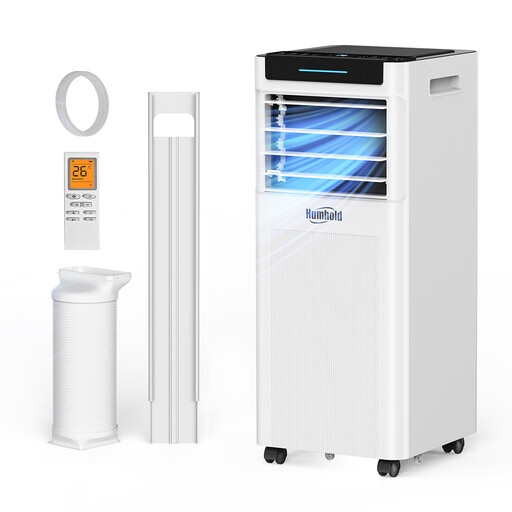
Why we recommend it: It's the ideal companion for studios, student rooms, or small offices. Compact and relatively lightweight, it's easy to move and store. It provides effective cooling without taking up too much space.
Its 7,000 BTU power is perfectly calibrated for small areas (up to 28 m? according to the manufacturer), preventing unnecessary oversizing. With a night mode rated below 49 dB, it remains discreet enough not to disturb your sleep.
Its strong suit: an excellent compactness-to-efficiency ratio for small rooms, all at an affordable price. The window kit is included for simplified installation.
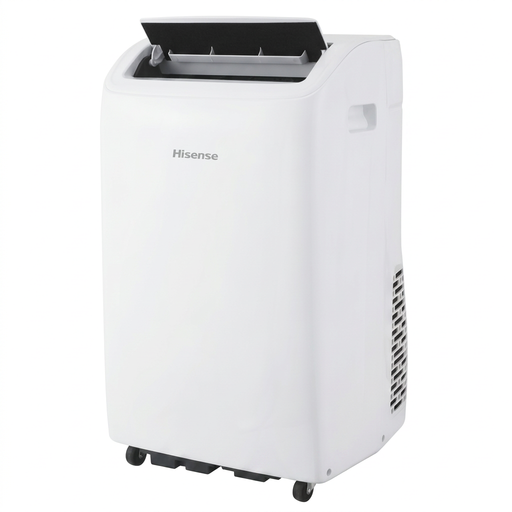
Why we recommend it: For those who want more than just a cool breeze. Its reversible function makes it useful year-round, while its Wi-Fi control offers maximum flexibility for managing the temperature of a living room or large bedroom.
With its 9,000 BTU, it is well-sized for standard living spaces. Its controlled noise level (50 dB in night mode) makes it perfectly suitable for nighttime use. And of course, it's a true air conditioner with an exhaust.
The combination of a reversible and smart air conditioner makes it a four-season appliance that is as practical as it is modern.
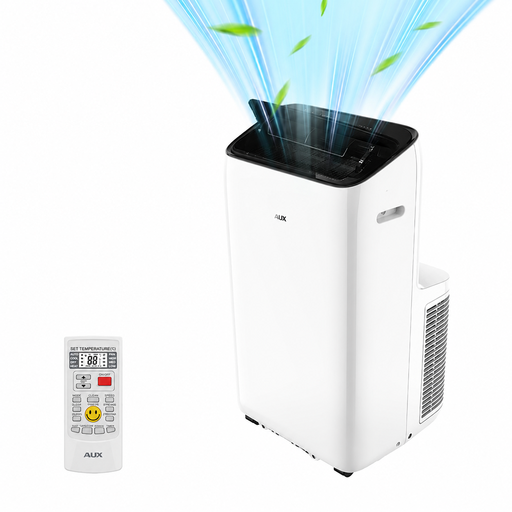
Why we recommend it: Built for those who need raw power. It can quickly cool large living rooms or open-plan living areas where less powerful models would throw in the towel.
Its 12,000 BTU power is designed for large spaces, eliminating any risk of being undersized. Despite its performance, it remains competitive on noise (52 dB in night mode), and its Class A rating ensures controlled energy consumption.
Its firepower: a high cooling capacity (450 m?/h airflow) combined with smart Wi-Fi control for tailored comfort in large rooms.
We have curated a complete selection of products that meet our selection criteria and current safety standards.
What is the difference between a mobile air conditioner and an evaporative cooler? A mobile air conditioner uses a refrigeration circuit (like a refrigerator) to capture heat from the room and expel it outside through a hose. It therefore genuinely lowers the temperature. An evaporative cooler, on the other hand, simply passes air through a wet filter. The effect is a very limited sensation of coolness, accompanied by an increase in humidity. It is absolutely not an air conditioning system.
How do I properly install the exhaust hose? The golden rule: the hose should be as short and straight as possible for optimal hot air exhaust. Use the provided window sealing kit to fit it to your window (sliding or casement). A good seal is crucial to prevent hot outside air from seeping in and to ensure your unit's performance.
How much does it cost to run a Class A mobile air conditioner? The cost depends on the power, duration of use, and your electricity plan's rate. As a guideline, a 9,000?BTU (approx. 1000?W) Class A model, used 4 hours a day, will cost you between €0.80 and €1.00 daily (based on average 2026 rates). Choosing a well-sized, Class A unit remains the best way to control this expense.