Whether you're an artist or a crafting enthusiast, who hasn't been frustrated by paper that buckles under gouache or a marker that bleeds through the page?? Juggling different papers for each medium quickly becomes a costly headache. This is where multi-technique paper, also known as mixed-media paper, comes in?: a versatile surface designed to handle both dry and wet media.
This guide reveals the key criteria for choosing the right mixed-media paper and presents our selection of the best products. The goal?? To let you focus on what truly matters?: your creativity.
How to Choose Your Mixed-Media Paper??
Choosing your paper is a crucial step. Three main criteria will guide you in finding the perfect surface for your artistic projects.
1. Paper Weight?: The #1 Factor for Wet Media
Paper weight, expressed in grams per square metre (g/m?), defines the paper's thickness and sturdiness. It's the number one criterion for assessing its resistance to moisture.
- Under 200 g/m??: Perfect for dry media (pencil, charcoal, dry pastels) and alcohol markers applied with a light hand. It will quickly show its limits when it comes into contact with water and is likely to buckle.
- Between 200 g/m? and 300 g/m??: This is the most versatile weight by far. A 250g paper is an excellent middle-ground. It's sturdy enough to handle light washes, ink, gouache, or acrylics without excessive warping, while still being very pleasant for drawing.
- Over 300 g/m??: Essential for very wet media, such as watercolour or applying multiple layers of paint. This type of paper guarantees unbeatable stability.
2. Tooth and Surface?: For Detail or Texture??
The "tooth" is the texture of the paper's surface. Your choice will influence not only the final result but also how it feels to create on it.
- Fine or Smooth Grain?: Its very smooth surface is perfect for precision work, technical drawing, and illustration with markers or pens. Colours flow and blend with ease.
- Medium Grain?: The most common for mixed-media paper. Its light texture has just enough tooth to grab pigments from dry media (pencil, pastel) while being smooth enough not to interfere with the application of ink or paint.
- Rough Grain?: With its very pronounced texture, it is especially prized for watercolour and techniques that play on textural effects.
3. Composition and Colour?: Beyond Classic White
Most mixed-media papers are made of pure cellulose and are acid-free, a combination that ensures excellent preservation of your work over time. Beyond its composition, the paper's colour is a true creative choice. An extra-white paper will make colours pop, while black or coloured paper provides a contrasting background to highlight light, metallic, or opaque media.
Our Mixed-Media Paper Recommendations
To move from theory to practice, here is our selection of pads that have won us over with their versatility and quality.
1. Paint'ON Black Pad, 250 g/m? - Clairefontaine
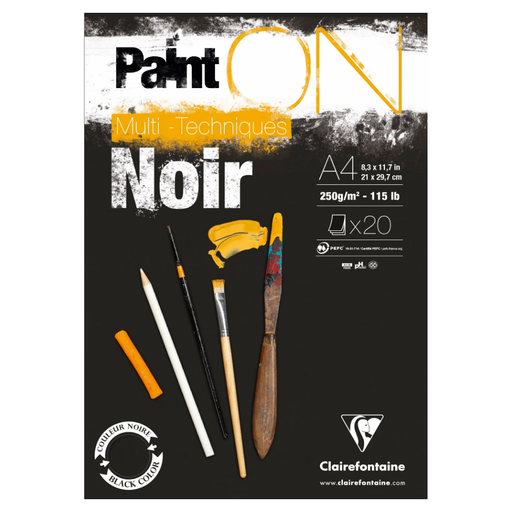
- Key Feature?: A deep black colour and a subtly textured grain. It's perfect for making light colours, metallic inks, and opaque paints pop with spectacular contrast.
- Highlights?: Its 250 g/m? weight ensures excellent stability with wet media like gouache or acrylics. Its 100% cellulose composition offers excellent absorbency and allows for "lifting"—the ability to scratch or erase to correct a mistake.
- Who is it for?? For artists and illustrators who want to explore the play of contrasts on a dark background, create light effects, or use media with high opacity.
2. XL Mix Media Pad, A4 - Canson
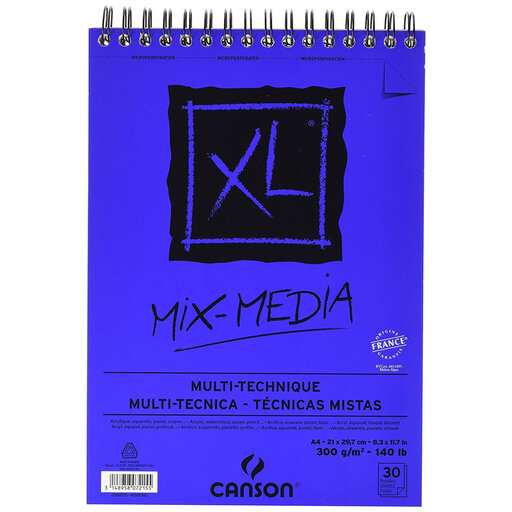
- Key Feature?: The Canson XL range is a staple in fine art supplies. This A4 drawing pad is praised for its versatility and its spiral-bound format, which is incredibly practical for working flat.
- Highlights?: The 300 g/m? version offers impressive sturdiness for wet media, while the 160 g/m? is a more budget-friendly option, ideal for sketches and dry media. The medium grain is an all-rounder that suits most media.
- Who is it for?? For art students and creatives looking for a reliable paper for their daily practice, from sketching to colouring. The spiral binding is a real bonus for working on the go or for easily detaching your creations.
3. Paint'ON White Pad, 250 g/m? - Clairefontaine
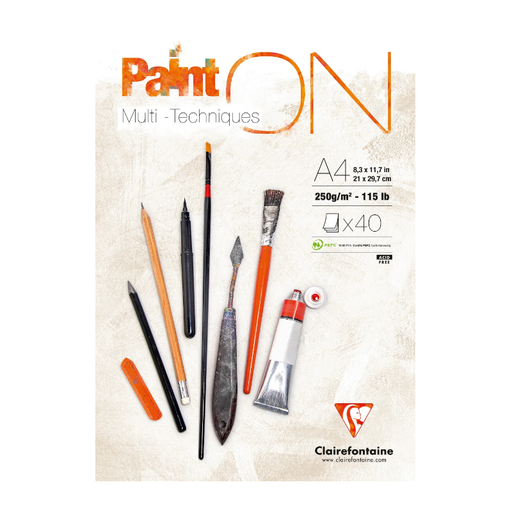
- Key Feature?: From the same Clairefontaine Paint'ON family, this paper stands out for its bright whiteness and very fine grain. A smooth surface ideal for all precision work.
- Highlights?: Its 250 g/m? weight guarantees perfect stability. Its extra-white surface enhances the vibrancy of colours. It handles layering and corrections without issue, whether with pencil, ink, or paint.
- Who is it for?? For illustrators, drawers, and all artists who love precision and sharp lines. It's the go-to surface for alcohol markers, India ink, and other markers.
4. Paint'ON MIX11 Pad, 250 g/m? - Clairefontaine
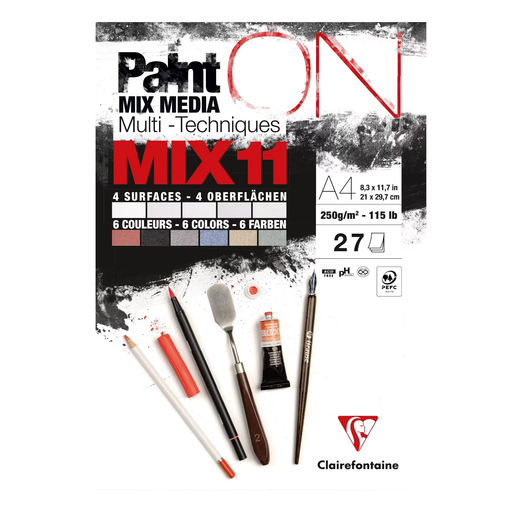
- Key Feature?: This pad is a true swatch book in itself. It brings together an assortment of 11 papers from the Paint'ON range, with varying shades (warm, cool) and textures.
- Highlights?: The perfect solution for experimenting without investing in multiple pads. The single 250 g/m? weight ensures consistent performance with both dry and wet media. It's ideal for seeing for yourself how the paper colour impacts an illustration.
- Who is it for?? For curious minds, the undecided, and anyone who loves to explore. It's also a fantastic educational tool for art students who want to discover different creative approaches.
Explore Other Formats and Brands
Our selection is just a starting point. Every artist has their preferences, and the best way to find the paper of your dreams is still to experiment. Don't hesitate to explore other formats, brands, and weights.
Discover our full range of sketchbooks and drawing papers to find the perfect surface for your projects.
Mixed-Media Paper?: Your Questions, Our Answers
What is the ideal weight for a mixed-media paper??
For maximum versatility, aim for a weight between 250 g/m? and 300 g/m?. This is the perfect balance to handle both dry media like pencil and wet media like gouache or ink washes, without buckling at the first drop. For use focused on drawing, a 160 g/m? paper can be a smart and budget-friendly choice.
Can you use watercolour on mixed-media paper??
Yes, it's entirely possible, especially with a heavy weight (300 g/m? and up). However, be aware that the result won't be identical to what you'd get on pure watercolour paper. The water and pigments will spread less, which can be an advantage for detail work but a drawback if you're looking for the blends and halos typical of watercolour.
What's the difference between mixed-media paper and watercolour paper??
The main difference lies in their manufacturing. Watercolour paper is "sized" both internally and on the surface. This special treatment allows it to absorb water slowly and evenly, giving the artist time to work the pigments. Mixed-media paper, on the other hand, is a master of compromise?: its surface is treated to react well to moisture but also to provide good tooth for pencils and pastels. It's a talented generalist versus a specialist.


