Finding a surface that adapts as well to the precision of a felt-tip pen as it does to the opacity of gouache can be a real challenge. Paper that is too thin will buckle at the slightest hint of moisture, while an unsuitable grain can ruin the details of an illustration. This guide is here to help you see clearly, without unnecessary jargon, and choose the mixed-media paper that will elevate your creations. We'll break down the key criteria and present a selection of tried-and-true products.
How to Choose the Right Mixed-Media Paper?
Before comparing products, there are three essential criteria to understand to avoid making a mistake.
1. Paper Weight: The Crucial Factor
Paper weight, expressed in grams per square metre (gsm), defines the paper's thickness and rigidity. For mixed-media use, a high paper weight isn't an option—it's a necessity.
- Below 200 gsm: These lighter papers should be reserved for dry media (pencil, charcoal). When they come into contact with ink, gouache, or acrylic, they are likely to buckle or even tear.
- Around 250 gsm: A 250 gsm paper represents the perfect compromise. It's thick enough to handle light wet media without too much warping, yet it remains very pleasant to work on for drawing. This is the benchmark weight for a truly versatile drawing paper pad.
- Above 300 gsm: Here we enter the heavyweight category, designed for watercolour and very wet techniques. They offer maximum stability but can be less flexible for some very fine drawing work.
2. Paper Grain: A Matter of Finish
The texture of the surface has a direct impact on the final look of your artwork. There are three main types of grain:
- Fine-grain paper: Its lightly textured surface is incredibly versatile. It grips just enough of the pigments from pencils and pastels while ensuring a perfect glide for technical pens and markers. The top choice for detailed drawing.
- Rough grain: This more pronounced texture is ideal for creating textural effects, especially with dry pastels, charcoal, or paint applied in thick layers.
- Smooth (or satin) surface: Perfect for high-precision work, such as illustration on paper for alcohol markers or with India ink. It guarantees absolutely sharp lines without any bleeding.
3. Format and Composition
Format is primarily a matter of practicality and space. An A3 drawing pad offers a large surface for ambitious works, while a more portable A4 format is perfect for studies and sketches. In terms of composition, 100% cellulose paper is a mark of quality for fine art papers. It ensures excellent preservation over time (without yellowing) and very good absorption capacity.
Recommended Mixed-Media Paper Picks
Based on these criteria of versatility, weight, and quality, here are some reliable choices from the Clairefontaine Paint'ON range.
CLAIREFONTAINE Paint'ON A3 Glued Pad with Grain, 20 sheets, 250 gsm
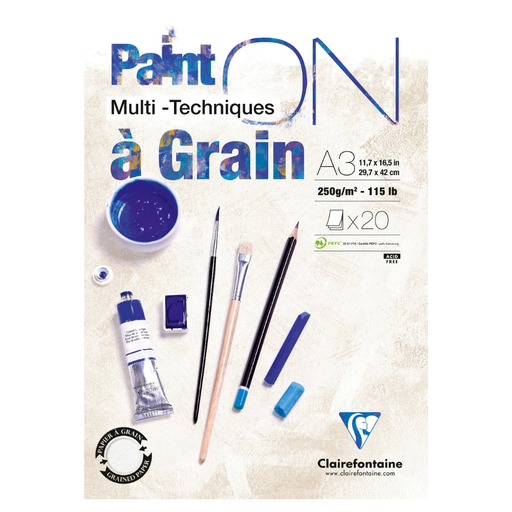
- Its key feature: The unique characteristic of this pad is its double-sided surface. One side has a rough grain, ideal for techniques that require grip and texture; the other side is a fine-grain paper, better suited for precision work. A true Swiss Army knife.
- Strengths:
- Extreme versatility: Works well with both dry media (pencil, marker) and wet media (paper for gouache, acrylic, ink).
- Dual texture: Maximum creative flexibility without changing pads.
- Excellent absorption: The 250 gsm weight and 100% cellulose composition handle moisture perfectly.
- Forgiving: The paper holds up very well to corrections (scraping, erasing) without pilling.
- Who is it for?: For artists and students who love to experiment and switch between techniques on the same project. The A3 format is ideal for finished pieces.
CLAIREFONTAINE Paint'ON MIX11 Assorted Pad, 27 sheets, A4, 250 gsm
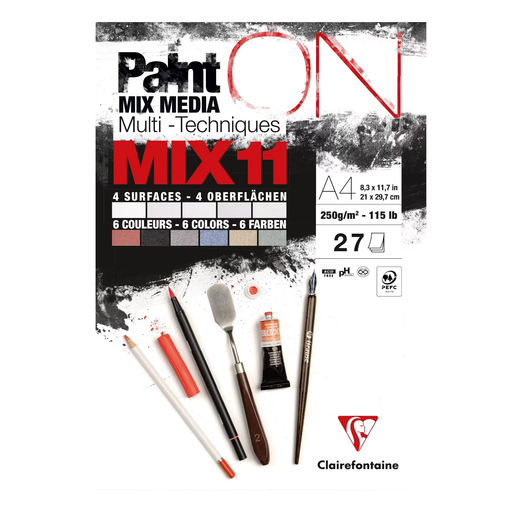
- Its unique concept: More than just a pad, this is a true discovery kit. It brings together 11 types of paper from the Paint'ON range, with various shades and grains (5 warm tones, 6 cool tones). The perfect solution for testing different surfaces before investing in a full pad.
- Strengths:
- Ideal for discovery: Allows you to find the Paint'ON paper that best suits your practice.
- Richness of tones: Perfect for creations on coloured backgrounds, which add instant depth.
- Consistent weight: All sheets are 250 gsm, ensuring uniform performance with mixed media.
- Portable format: The A4 format is easy to carry and store.
- Who is it for?: For curious creatives, illustrators who love to play with coloured backgrounds, and anyone still undecided on the grain or shade for their next drawing paper pad.
CLAIREFONTAINE Paint'ON White Glued Pad, A3, 40 sheets, 250 gsm
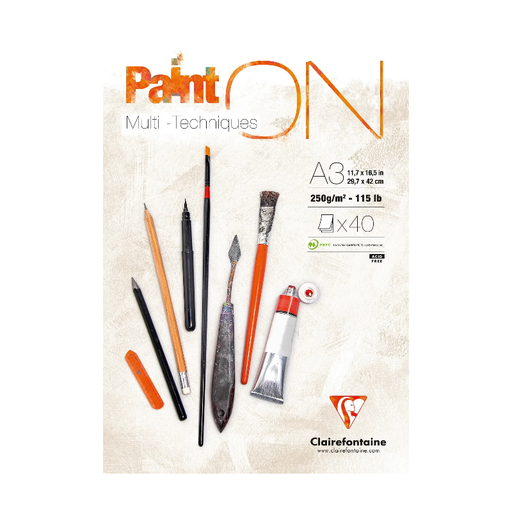
- The choice for precision: This pad stands out for its very fine-grain surface and brilliant whiteness. It is designed for artists seeking precision and maximum colour contrast. Its high weight makes it compatible with wet media while ensuring a very sharp finish.
- Strengths:
- Extra-fine surface: Ideal for technical illustrations, pen drawing, and on paper for alcohol markers.
- Absolute whiteness: Enhances the vibrancy of pigments and simplifies the digitisation of artworks.
- Very good absorption: Limits ink bleeding and holds up well to light washes.
- Generous format: With 40 sheets, this pad offers excellent value for money for prolific artists.
- Who is it for?: For illustrators, technical drawers, and artists who prioritise fine lines and colour purity. A first-rate surface for work intended for publication or exhibition.
Different Needs, Different Papers?
Our selection highlights versatile choices, but every artistic project is unique. If you're looking for a different weight, a specific format, or simply want to explore other textures, the possibilities are endless.
We invite you to browse our complete category of painting pads to discover an even wider range of surfaces suited to all creative practices.
Frequently Asked Questions about Mixed-Media Paper
What paper weight should I choose for mixed-media paper?
Aim for a paper weight of around 250 gsm. This is the ideal balance: robust enough to handle wet media like gouache or ink without excessive buckling, while remaining pleasant for drawing with a pencil or marker. For very heavy water washes, however, a paper of 300 gsm or more is still preferable.
Can you use watercolour on mixed-media paper?
Yes, but in moderation. A 250 gsm mixed-media paper will handle light washes or touches of watercolour. However, it is not internally sized like a true watercolour paper. For techniques that are very heavy on water (wet-on-wet, multiple layers), it will quickly show its limits: the paper may buckle and the pigments may bleed.
What is the difference between Paint'ON paper and classic drawing paper?
It's all about versatility. A classic drawing paper (usually between 120 and 180 gsm) is optimised for dry media. The Clairefontaine Paint'ON range, with its 250 gsm weight and specific composition, was designed to better resist moisture, offer excellent absorption, and allow for corrections. It is therefore capable of handling a much wider variety of media, including paint and ink.


