
Livraison le jour même ou le lendemain

Qualité garantie

Débloquez vos offres de bienvenue: Livraison GRATUITE | Jusqu'à -80 % | 30 jours d'essai gratuits à JoyPlus
Téléchargez l'application
A MIPS ski helmet is designed for skiers and snowboarders looking for protection featuring a layer engineered to accommodate certain rotational movements during an impact. However, the mere presence of the term “MIPS” does not guarantee that a model will be right for you. Size, fit, certification and goggle compatibility are equally important.
Whether you are heading to the Alps, the Pyrenees or a family-friendly resort, three mistakes occur time and again: choosing a helmet that is too large, confusing ventilation with thermal comfort, or failing to check compliance markings. Here are the key points to review before placing your order.
The MIPS system is designed to manage certain rotational movements during specific types of impact. It does not make a helmet invulnerable and, above all, does not replace a precise fit. No helmet can protect against every type of impact.
A correctly sized model should remain securely in place when you gently shake your head, without exerting excessive pressure on your forehead or temples. The chin strap should be fastened and adjusted beneath your chin, without hanging loose.
Labels such as “adult”, “child” or “junior” do not replace an accurate head measurement. Use a tape measure positioned above your eyebrows and ears, then compare the result with the product’s size guide.
For example, the OutdoorMaster Diamond II MIPS helmet is available in size S for a head circumference of 51 to 54 cm, size M for 55 to 58 cm and size L for 59 to 61 cm. The child-oriented Reindeer model is available in XS for 48 to 52 cm and S for 52 to 56 cm. These differences demonstrate why taking an accurate measurement is essential before buying.
A ski helmet, whether for adults or children, must work properly with your goggles without leaving a significant gap between the two. Goggles that are too small may allow cold air through; if they sit too high, they can create uncomfortable pressure on the forehead.
Anyone who wears prescription glasses should look for the OTG (“Over The Glasses”) designation. These models provide more room for frames. You should still check the shape of your glasses and the width of the helmet.
For skiing and snowboarding in Europe, look for the marking and documentation corresponding to the CE EN 1077 standard, which applies to helmets intended for alpine skiers and snowboarders. Certification should appear on the product or in its documentation; a simple mention in the product title is not sufficient.
In the selection presented here, the product pages for the OutdoorMaster Diamond II MIPS helmets state ASTM F2040 and CE EN 1077 certification. Before buying, also review the compliance information specific to the model you select.
A rear adjustment dial allows you to fine-tune the fit, particularly when wearing a thin balaclava or technical beanie. Avoid overly thick accessories, however, as they can alter the helmet’s position and reduce its effectiveness.
In this category, polycarbonate shells combined with EPS foam are common. Some models use an in-mold construction, which bonds the outer shell and foam together to reduce weight. These features describe the helmet’s construction; they do not guarantee identical performance in every situation.
A ski helmet with ventilation can help prevent heat build-up during uphill sections or on mild days. The Diamond II has eight adjustable vents, while the child-sized Reindeer features twelve and, according to its product page, a liner designed to wick away moisture.
In cold weather, a removable liner and ear pads provide additional warmth. Their care should not be overlooked: removable components can generally be hand-washed with a mild detergent and then left to air-dry.
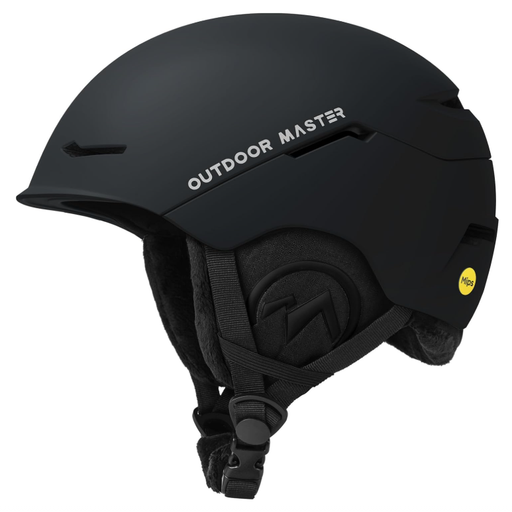
Why this model matches the profile: a MIPS solution for users looking to gear up for skiing, snowboarding or ice skating, with a size S fit and adjustment dial.
The adjustment dial and straps enable a precise fit, rather than compensating for the wrong size with a thick beanie.
MIPS system, eight ventilation openings, removable liner and ear pads, goggle-retention system.
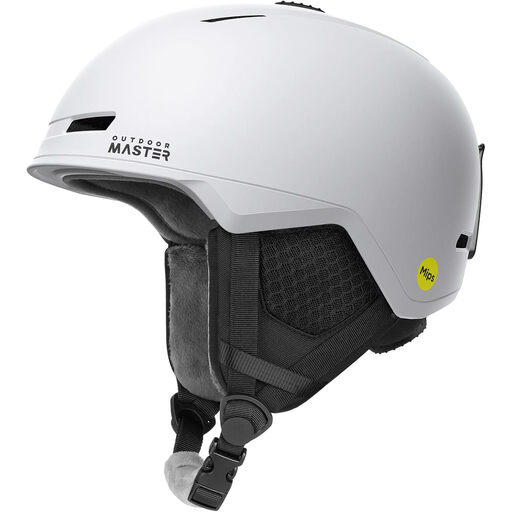
Why this model matches the profile: designed for adults looking for an adjustable ski helmet with a warm liner, adjustable ventilation and clearly stated compliance information.
The eight adjustable vents let you tailor airflow to the weather, so you do not have to choose between ventilation and protection from the cold.
Polycarbonate shell, EPS foam, MIPS, stated ASTM F2040 and CE EN 1077 certifications, washable liner.
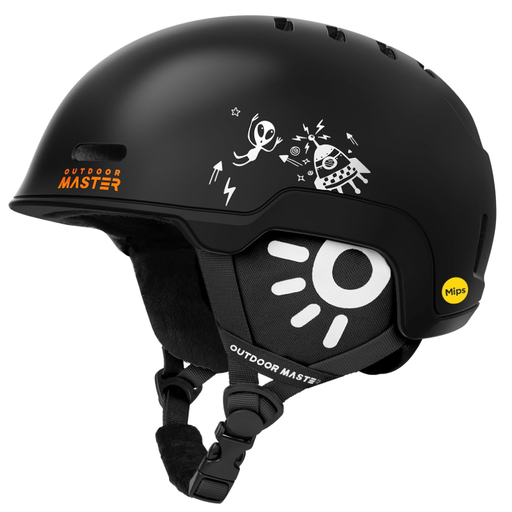
Why this model matches the profile: this children’s MIPS ski helmet is designed for young users aged 5 and over, with a head-circumference range of 48 to 52 cm.
The XS size avoids choosing an adult helmet that is too bulky. The adjustment dial and soft chin strap make daily fitting easier for a parent.
PC shell, EPS foam, MIPS system, twelve vents, removable wool liner and washable ear pads.
To complete a MIPS snowboard helmet or ski helmet, your goggles should provide sufficient facial coverage without interfering with the chin strap. The OutdoorMaster Falcon ZEISS models feature an OTG design, a dual lens with anti-fog treatment and a magnetic lens-change system. Depending on the version, the main lens has a visible light transmission of 18%, 18.6% or 27%, while the yellow lens is rated at 91%.
These values, expressed as VLT, indicate the amount of light that passes through the lens: a low value is generally suitable for very bright conditions, while a high value allows more light through in overcast weather. The visual performance advertised for lenses developed with ZEISS should be treated as a technical specification, not as a guarantee of visibility in every condition.
Another option is the OutdoorMaster ULTRA pack with a clear replacement lens. It includes OTG compatibility, three-layer anti-fog foam and a MagKlick magnetic system. Avoid rubbing the inside of the lens: use the supplied cloth and store the goggles in their case to help prevent scratches.
Explore an updated selection of products that meet these selection criteria and the safety requirements applicable in France.
Yes. Manufacturers generally recommend replacing a helmet after a significant impact, even if the shell shows no apparent signs of damage. The EPS foam may have absorbed part of the impact energy and may no longer offer the same properties. Also inspect the straps, adjustment dial and liner before every outing.
The helmet alone does not determine compatibility. Choose OTG ski goggles or a model designed to be worn over glasses, then check the available space around the forehead and temples. Try the complete setup with your balaclava before heading to the resort.
Its lifespan depends on usage, impacts sustained, storage conditions and the condition of its materials. The Reindeer child model recommends replacement every three to five years, as the materials may deteriorate over time. In all cases, replace the helmet immediately after a significant impact, if you find a crack or deformation, or if the adjustment system is damaged.