Older people who enjoy mint sweets
For an occasional treat, a roll may be suitable if the person wants sweets containing sugar and can swallow them without difficulty. Check that the product you choose is sold as an individual roll.


For an individual snack, first check whether the person can safely have a solid sweet. If they have dysphagia, are at risk of choking or have been prescribed a particular food texture, ask their care team before offering a sweet or chewing gum. Otherwise, a roll of mint sweets and a pack of sugar-free chewing gum suit different preferences. Compare the sugar content, sweeteners and number of packs rather than relying on the word ‘mint’ alone.
For an occasional treat, a roll may be suitable if the person wants sweets containing sugar and can swallow them without difficulty. Check that the product you choose is sold as an individual roll.
A small pack of chewing-gum pellets serves a different purpose from a roll of sweets. Compare the ingredients, polyols, stated allergens and number of pellets in each pack.
A small, solid mint is not automatically suitable. The French National Authority for Health recommends assessing the risk of choking and adapting food textures. A guide from the Brittany Rare Disability Support Team also lists sweets as a potential risk for people with swallowing difficulties.
For an individual snack, first consider whether a solid texture is suitable, then compare the ingredients and packaging of the specific product.
| What to consider | What to check | Who is this for? |
|---|---|---|
| Chewing and swallowing | If the person has dysphagia, is at risk of choking or has been prescribed a particular food texture, ask their care team before offering a solid sweet. | If a small mint might not be suitable for swallowing, I need to check this before choosing a flavour or format. Around 42% of consumers would make suitability of the texture their top priority. |
| Sugars and sweeteners | Compare the sugars per 100 g, then check the ingredients, polyols and warnings for each product. | I prefer to know what a sweet contains before choosing between a sugary sweet and sugar-free chewing gum. Ingredients would be the first thing around 33% of consumers look at. |
| Packaging | Check the number of packs or boxes and how much each contains; also consider how easy they are to open. | When getting a snack ready for one person, I look for a pack that’s easy to take out rather than a larger format to split up. Around 25% of consumers would prioritise the packaging first. |
The size of a sweet alone doesn’t mean it can be swallowed safely. The Brittany Rare Disability Support Team lists sweets as a potential risk for people with swallowing difficulties, and the French National Authority for Health highlights the possible consequences of choking.
If the person coughs during meals, has diagnosed dysphagia or follows a prescribed food texture, ask their care team for advice before offering a solid mint.
Sugar-free chewing gum can contain polyols and other sweeteners. For example, Mentos France states that Pure Fresh Menthe Douce contains 70 g of polyols per 100 g, despite having a stated sugar content of 0 g.
Check the ingredients and warnings for the product you choose. The ingredients in one Mentos product don’t tell you what’s in a Freedent or Hollywood product.
A multipack of small packs or boxes makes it easy to separate snacks, but each pack contains several pellets. Carrefour, for example, lists a pack of 5 Freedent packs of 10 pellets and a multipack of 3 Hollywood boxes of 17 g.
Check what each pack or box contains and whether the person can open it easily. Don’t assume that ‘handy size’ means a single sweet.
The range includes mint sweets and mint-flavoured chewing gum, so it’s best to compare specific products rather than the brand as a whole.
The brand offers sugar-free mint chewing gum, including small packs sold in multipacks.
Some Hollywood mint chewing gums are available in multipacks of small boxes.
These products let you compare a multipack of mint chewing gum, a box of pastilles and a box of sweets. For an individual snack, check how much each pack contains before choosing: a box or multipack isn’t necessarily a single portion.
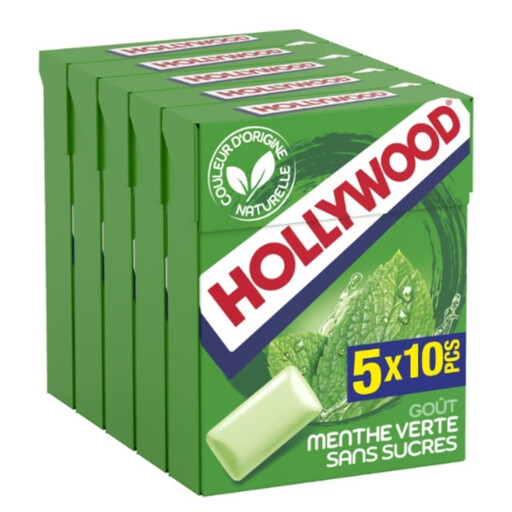 Image unavailable
If you want to take several small packs of mint chewing gum with you, this multipack makes it easy to set aside separate snacks.
The stated format is 5 × 14 g. Check the contents of each pack, as well as the ingredients and warnings for this product. If the person has difficulty swallowing, ask their care team before offering chewing gum.
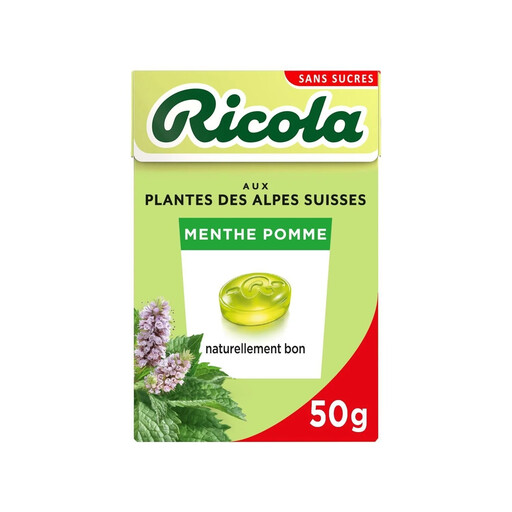 Image unavailable
If you’re looking for an apple and mint sweet to take out, consider this box instead of a pack of chewing gum.
The pack is listed as 50 g. Check the number of pastilles, how they’re packaged inside the box and the ingredients. A box doesn’t mean the portions are individually wrapped. If the person has difficulty swallowing, ask their care team before offering a solid pastille.
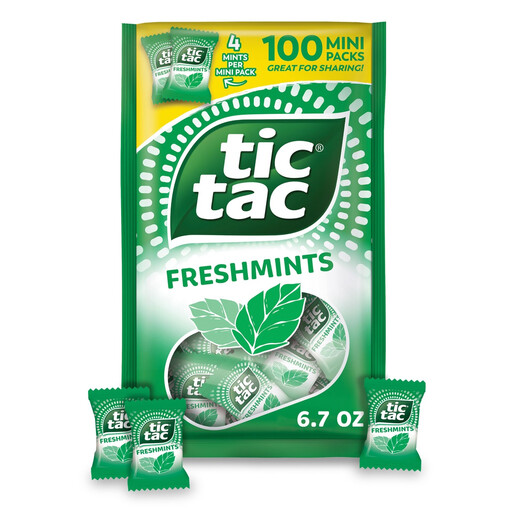 Image unavailable
If the person prefers a mint sweet to chewing gum, this box is a format worth comparing with an individual roll.
The box is listed as 49 g; check its ingredients and how many sweets it contains. Don’t mistake this pack for an individual portion. If the person has difficulty swallowing, ask their care team before offering a solid sweet.
Don’t automatically offer a solid mint in this situation. The French National Authority for Health stresses the importance of assessing the risk and adapting food textures; a guide from the Brittany Rare Disability Support Team lists sweets as a potential risk for people with swallowing difficulties. Ask the person’s care team before choosing a sweet, pastille or chewing gum.
No: ‘sugar-free’ doesn’t mean ‘sweetener-free’. Mentos France states that Pure Fresh Menthe Douce contains 0 g of sugars and 70 g of polyols per 100 g; Carrefour lists sorbitol, xylitol and other sweeteners among the ingredients in Freedent Menthe Verte. Check the ingredients for the specific product you’re thinking of buying.
Compare the nutritional information on the same basis, particularly per 100 g, then check the ingredients and how much each pack or box contains. For prepacked foods sold in the European Union, the rules set out by Your Europe require a nutrition declaration that includes energy, fat, carbohydrates, sugars, protein and salt, among other details. The pack weight can then help you tell a small pack from a single portion.