People in a hurry before a workout
You want something easy to take with you and eat without any preparation. You’ll also need to consider how long you have before exercising and how well you usually tolerate this type of food.


Choose a mini pot if you want to portion out the spread yourself and decide what to eat it with. An individually wrapped wafer is a better fit if you’re after a ready-to-go portion. But a small size alone doesn’t tell you whether a snack is suitable before exercise: look at the whole portion, its ingredients and how long you have before your activity.
You want something easy to take with you and eat without any preparation. You’ll also need to consider how long you have before exercising and how well you usually tolerate this type of food.
You’d rather have a separate portion so you can choose what to eat it with and know how much spread you’re having.
You want to compare nutritional values per 100 g and per portion, as well as ingredients and allergens, rather than judging by pack size alone.
A mini pot lets you portion out the spread on its own; a wafer or tartlet is already a complete bite-sized snack. First choose the format that best suits your main need, then compare the portion you’ll actually eat.
| What to consider | What to check | Who this may suit |
|---|---|---|
| Portion and portability | Weight per item and individual packaging. | If I’m heading straight to my workout, I want a set portion I can take with me without needing a pot or utensil. Around 36% of consumers put this convenience first. |
| How it feels before exercise | Fat per portion and how long there is before activity. | When my workout is coming up, I’d rather consider what I usually tolerate than choose based only on the size of the snack. This is the top priority for around 29% of consumers. |
| Ingredients and allergens | Values per 100 g and per portion, ingredients and allergens; Nutri-Score, if displayed. | If I’m comparing different recipes or need to avoid an ingredient, I want to check what’s in them before choosing. Around 21% of consumers prioritise this check. |
| Choice of what to eat it with | Weight of the mini pot and the food you plan to eat the spread with. | I want to choose what to spread it on myself, rather than buying a ready-made snack. This flexibility is the top priority for around 14% of consumers. |
For pre-packed products, the DGCCRF says that nutrition information is compulsory in most cases, while Nutri-Score is voluntary. If it appears on the packaging, it can help you interpret the nutrition information, but it doesn’t replace checking the ingredients or the portion you eat.
The DGCCRF explains that displaying Nutri-Score is voluntary. So, if a pack doesn’t show the logo, you can’t infer the product’s score.
If it is displayed, use it as a guide, but also compare the nutrition information, ingredients and allergens.
One 22 g Nutella B-ready wafer contains 5.9 g of fat, according to Nutella. That figure alone can’t predict how comfortable you’ll feel during exercise. The IRBMS guidance on eating before a competition also recommends taking hard-to-digest foods into account.
Check how long you have before your workout, and try a familiar snack during training rather than sampling a new product on the day of an important event.
A pot contains spread to serve with another food, while a wafer or tartlet already has its own recipe and weight.
Start by comparing like with like: either the amount of spread you’ll portion out or a complete snack to take with you.
Nutella B-ready contains ingredients including hazelnuts, milk, soya, wheat and barley. The Nocciolata mini tartlets mentioned by Auchan also contain eggs. Ingredients vary by product.
Check the label of the exact product before buying, especially if the snack is for someone else.
Nutella B-ready is a filled wafer available from the brand in several pack sizes.
Carrefour lists an assortment of seven 30 g mini pots of spread.
Auchan lists organic mini tartlets filled with hazelnut spread.
Two ways to plan a portion: a ready-to-eat Nutella B-ready wafer, or a portion of Nutella spread to pair with the food of your choice.
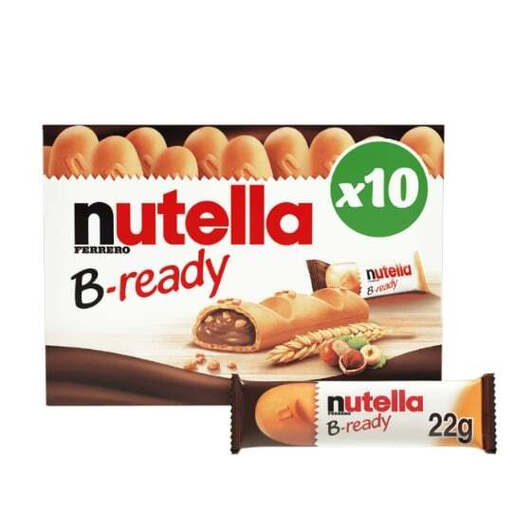 Image unavailable
Worth considering if you want to take a ready-to-eat snack with you rather than make a slice of toast. This pack contains 10 pieces weighing 22 g each. According to Nutella, each piece is individually wrapped and contains 5.9 g of fat. It’s a filled wafer, not a portion of spread on its own, so check the ingredients and consider how long you have before your workout.
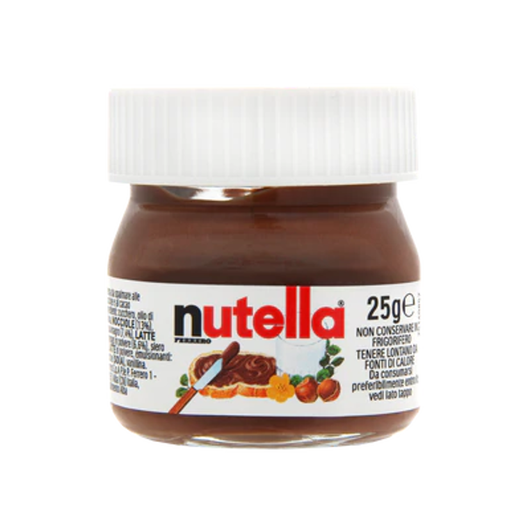 Image unavailable
Worth considering if you want to plan how much spread you’ll have while choosing separately what to eat it with. This product comes in a 25 g portion; you’ll need something to spread it on. To compare recipes, check the nutrition information and ingredients on the packaging.
No. The DGCCRF describes Nutri-Score as a voluntary label. Nutrition information is compulsory for pre-packed foods in most cases, so check it to compare things such as fat and sugar content.
Compare their nutrition information per 100 g, then consider how much you plan to eat and check the ingredients. If the logo is missing, you can’t infer the product’s Nutri-Score.
The size of the snack alone isn’t enough to tell you: consider the portion, how long you have before exercising and what you usually tolerate. For match preparation, the IRBMS advises avoiding hard-to-digest foods, including foods containing fat, and having your last meal two to three hours before the match. This guidance applies to a pre-match meal, not to every snack or workout.