For a mini white chocolate treat after exercise, choose a portion that’s easy to count, then check the sugar and energy content of the amount you’ll actually eat. If you also want to take protein into account, check the nutritional information for the snack as a whole: a small format doesn’t tell you everything about its nutritional content, and a biscuit covered in white chocolate isn’t the same as a white chocolate bite.
Who are these formats suitable for?
People who want to plan their portion
A bite you can count or an individually wrapped pack can help you decide how much to have before opening a large pack. The formats listed by Lindt France and Carrefour France show why it’s important to distinguish between the amount you eat and the whole pack.
People keeping an eye on sugar
If the word “mini” isn’t enough to help you choose, compare the sugar and energy figures per 100 g, then work out what they mean for the amount you plan to eat.
People who consider the snack as a whole
If you also want to take protein into account, check the nutritional information for each food you plan to have, without attributing the nutritional value of the whole snack to a single chocolate bite.
What should you look for first?
Start by deciding how much you plan to eat. The label can then help you assess that portion, whether it’s a white chocolate bite or another product covered in white chocolate.
| What to consider |
What to check |
Who is this for? |
| A portion that’s easy to count |
The weight of one piece or pack, and how many pieces you plan to eat. |
After a workout, I want to set aside a specific amount rather than graze from the pack; around 42% of consumers prioritise having a clearly defined portion. |
| Sugar and energy |
The sugar and energy figures per 100 g, then for the amount you actually plan to eat. The Nutri-Score can also help if it’s displayed. |
When choosing a treat, I want to know the sugar and energy content of what I’ll eat; around 33% of consumers put this label information first. |
| What’s in the snack |
Protein per portion, as well as the ingredients and allergens in each product you’re considering. |
If I also want my snack to include a source of protein, I distinguish between the chocolate bite and the other foods I plan to have; around 25% of consumers prioritise the snack’s overall composition. |
What should you avoid confusing?
-
Assuming “mini” means low in sugar
The format describes the size or packaging, not the nutritional values. For example, Lindt France lists 45 g of sugar per 100 g of LINDOR Blanc.
Check the weight of your chosen portion and the figures per 100 g before comparing two products.
-
Using the soft drinks levy to choose white chocolate
The French Ministry of the Economy describes this levy as applying to sugary drinks, so it isn’t a useful comparison point for a solid white chocolate bite.
For this product, check its product name, ingredients and nutritional information instead.
-
Rejecting a product because it doesn’t display a Nutri-Score
Santé publique France explains that displaying the Nutri-Score is voluntary. Its absence alone therefore doesn’t tell you the product’s nutritional values.
Check the nutrition table and the portion you plan to eat, whether or not the logo is shown.
-
Confusing a chocolate-coated biscuit with a white chocolate bite
Carrefour France describes Milka Mini Stars White as biscuits filled with milk and coated in white chocolate. The whole recipe matters when comparing products, not just the coating.
Check the product name and ingredients list if you’re specifically looking for a white chocolate bite.
Brands and product categories to explore
Lindt
Lindt France sells LINDOR Blanc as white chocolate truffles, including in a 1 kg bag.
- The truffles make it easy to count how many pieces you plan to eat.
- The large bag doesn’t define an individual portion; Lindt France lists 45 g of sugar and 4.1 g of protein per 100 g of LINDOR Blanc.
Milka
Carrefour France lists Mini Stars White as milk-filled biscuits coated in white chocolate, in a box of four individual packs weighing 150 g in total.
- The individual packs give you a packaging size to consider.
- These are chocolate-coated biscuits, not bites made entirely of white chocolate. Check the recipe and how much each pack contains.
Carrefour
Carrefour France has categories including “Mini chocolates” and “Chocolate balls and sweets”.
- These categories can help you find formats worth looking at.
- The category itself won’t tell you the ingredients or portion size of a specific product; check its product listing.
A white chocolate wafer on Joybuy
This twin pack may suit people looking for a wafer coated in white chocolate to take with them after exercise, rather than a white chocolate bite on its own.
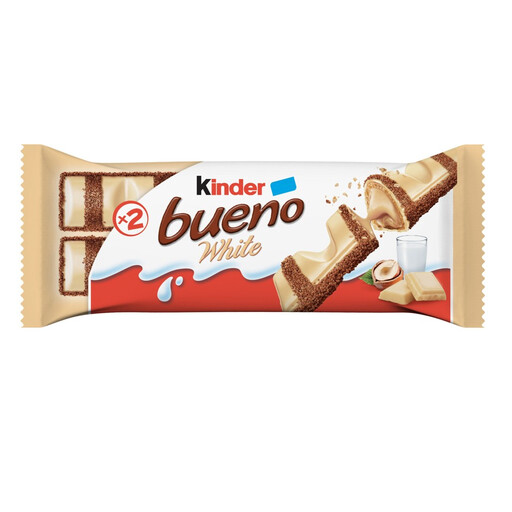 Image unavailable
Kinder Bueno White, twin pack 39 g
The twin pack can help you plan what to take with you after exercise. This 39 g format is a coated wafer, not a white chocolate bite on its own; check the pack for nutritional information that matches the amount you’ll eat.
View on Joybuy
Frequently asked questions
Is solid white chocolate covered by the soft drinks levy in France?
No. The French Ministry of the Economy describes this levy as applying to sugary drinks. To choose a solid white chocolate bite, check its ingredients and nutritional information instead.
Is a Nutri-Score compulsory on mini white chocolate?
No. Santé publique France says producers can choose whether to display the Nutri-Score. Compare the nutritional values for the product you’ve chosen even if the logo isn’t shown.
Which allergens should you check?
Check the allergens listed for the specific product, as a white chocolate bite and a chocolate-coated biscuit may have different recipes. Carrefour France’s listing for Milka Mini Stars White mentions a milk filling, among other details.
How do you decide on a portion when the bites come in a large bag?
Decide how many pieces you want before opening the bag, then set them aside. Counting the bites makes it easier to see how much you plan to eat, without changing the product’s nutritional values.


