Parents following nursery rules
Before planning a shared snack, you need to check what the nursery allows and take account of allergens and any individual care plans (PAIs).


For a nursery snack, first choose a format that lets you control the amount served, then check the recipe, allergens and the nursery’s rules. A filled mini bite, a chocolate-coated biscuit and an assortment are not all handed out in the same way; the word “mini” alone is not enough to decide.
Before planning a shared snack, you need to check what the nursery allows and take account of allergens and any individual care plans (PAIs).
You want to decide how much each child gets, whether it’s a bite, a mini egg or a packet. The name of the format is no substitute for a weight or unit count.
You may prefer to distinguish a filled white chocolate bite from a chocolate-coated biscuit or an assortment, especially when several recipes make the ingredients harder to check.
Start with the nursery’s rules and the product label, then decide how much to serve and which type of recipe you want.
| What to consider | What to check | Who is this for? |
|---|---|---|
| Allergens and nursery rules | Confirm the nursery’s rules and any individual care plans (PAIs); check the “contains” and “may contain” statements on the packet you buy. | If a child has an allergy or an individual care plan, I want to check that the recipe meets the requirements in place for them; around 42% of consumers put this compatibility at the top of their list of concerns. |
| Portion size and distribution | Check the number of units and the weight per unit or portion; distinguish individually wrapped packets from loose products. | When sharing out snacks, I want to decide how much each child gets rather than rely on the word “mini”; around 33% of consumers prioritise this control over portion size. |
| Type of recipe | Read the product description to distinguish a filled white chocolate bite from a chocolate-coated biscuit or an assortment. | If I’m looking for a white chocolate bite, I don’t want to accidentally choose a coated biscuit or a mix of recipes; around 25% of consumers prioritise this distinction. |
A small product may be sold loose, in a packet or as part of an assortment. Its packaging alone won’t tell you how much each child will be given.
Look for the weight per portion or the number of units, then decide how much to serve before choosing a product.
An assortment may contain different fillings and ingredients. For the assorted Lindor box described by Joybuy France, the allergen list includes milk, hazelnuts, soya and cereals containing gluten.
Check every variety and the “may contain” statements on the packet you plan to take to nursery.
The Ministry of Health describes Nutri-Score as a recommended label. If it appears on a product, it doesn’t replace checking the nutrition information or considering how much is actually served.
When comparing similar products, pay particular attention to the sugar per 100 g and the portion you have in mind.
The Ministry of the Economy describes this levy as applying to sugary drinks, so it isn’t a factor when choosing solid white chocolate.
Focus your comparison on the recipe, labelling and the nursery’s rules for bringing in food.
Auchan France describes the 152 g Galak mini eggs as white chocolate sweets with a milk filling, available as part of a seasonal offer.
Carrefour France describes Mini Stars White as milk-filled biscuits coated in white chocolate, in a 150 g box containing four packets.
Auchan France describes Lindor Blanc 200 g as filled white chocolate bites. Lindor assortments are separate products, and each recipe should be checked individually.
E.Leclerc describes 128 g mini round biscuits coated in white chocolate, worth considering if you’re specifically looking for a biscuit.
These products are a chocolate-coated wafer bar and a white chocolate biscuit. They’re worth considering if the nursery allows these types of snack, rather than if you’re looking specifically for a mini white chocolate bite.
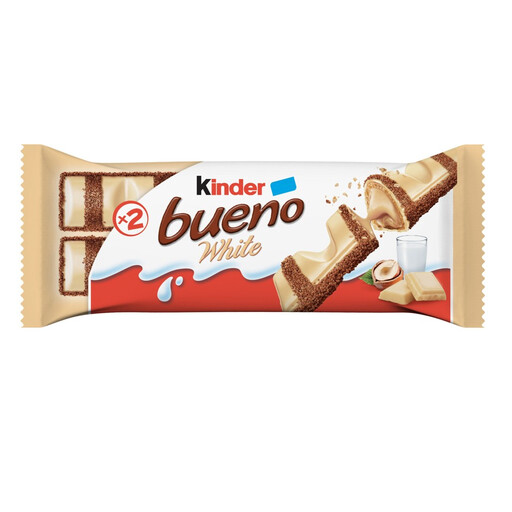 Image unavailable
Worth considering if a white chocolate-coated wafer bar suits the planned snack; the 39 g bipack lets you decide how much to hand out. The recipe contains hazelnuts, wheat, milk and soya, among other ingredients. Check the nursery’s rules, any individual care plans (PAIs) and the label on the packet you buy.
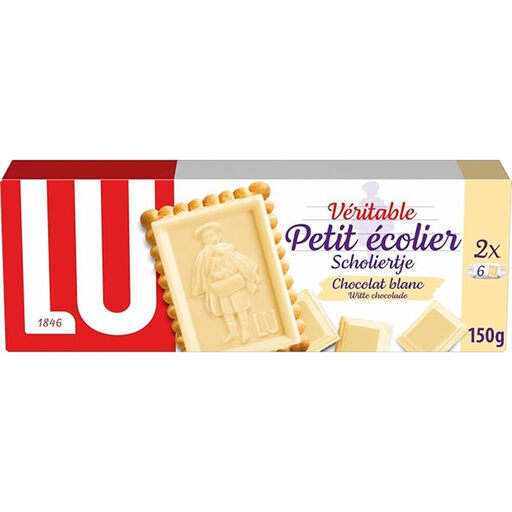 Image unavailable
Worth considering if you’re looking for a white chocolate biscuit rather than a bite. The packet is listed as 150 g; if you need to set a precise portion, check the number of biscuits and their weight. The recipe contains wheat, milk and soya, among other ingredients. Check the nursery’s rules, any individual care plans (PAIs) and the label on the packet you buy.
No, not under the levy on sugary drinks described by the Ministry of the Economy. This levy applies to drinks, not solid white chocolate.
No. The Ministry of Health describes it as a recommended label, not a general requirement under the European regulation on the provision of food information to consumers. Check the nutrition information and ingredients list on the packet you buy.
No. The term describes a size; it doesn’t specify how much to give or mean that the nursery will allow it. For example, Auchan France’s listing for Galak mini eggs gives nutrition information for 19 g. Agree on the amount with the nursery before bringing the product in.
Read the full ingredients list and the “may contain” statements for the specific product you’re buying, taking the nursery’s rules and any individual care plans (PAIs) into account. The recipes described by Carrefour France, Auchan France and Joybuy France have different allergen profiles. Depending on the product, these may include milk, soya, wheat, nuts or egg.