Parents preparing several snacks
A multipack of mini packs makes it easy to plan separate portions before an outing or the end of the school day. You’ll still need to decide how many packs to hand out each time.


If you’re preparing several snacks, mini packs let you decide in advance how many to hand out. With bite-sized sweets in one larger bag, an adult needs to portion them out before giving them to a child. In either case, ‘mini’ doesn’t describe the ingredients: compare the sugars per 100 g and check the ingredients and allergens. Use the Nutri-Score when it’s displayed, but don’t assume that its absence tells you anything about the product.
A multipack of mini packs makes it easy to plan separate portions before an outing or the end of the school day. You’ll still need to decide how many packs to hand out each time.
The size of the sweets alone isn’t enough to compare their ingredients. For similar confectionery, sugars and energy per 100 g provide a common basis for comparison; the Nutri-Score may not be displayed.
If gelatin, wheat or milk could be an issue, check the exact product. A ‘gelatin-free’ claim doesn’t, on its own, tell you about the other ingredients or allergens.
First decide how you’ll portion out the sweets, then compare the labels of products that suit your needs. Manger Bouger recommends offering children sugary products in limited quantities.
| Priority | What to check | Who is this for? |
|---|---|---|
| Preparing portions | Count the mini packs and check the net weight; if you have one larger bag, portion out the sweets before snack time. | When you’re preparing several snacks in advance, being able to separate the portions you’ll hand out is especially useful. Around 45% of consumers prioritise this kind of organisation. |
| Comparing ingredients | Compare sugars and energy per 100 g across similar confectionery, then read the ingredients. | If the small format alone doesn’t help me choose, I want to be able to compare the labels. This nutritional information is the main consideration for around 33% of consumers. |
| Meeting an ingredient requirement | Check the ingredients list, highlighted allergens and any ‘may contain’ statements on the specific pack. | If an ingredient needs to be avoided, the exact recipe matters more than the format. Around 22% of consumers prioritise this compatibility. |
According to Santé publique France, displaying the Nutri-Score is voluntary. The DGCCRF explains that the nutrition declaration for relevant prepacked foods is given per 100 g or 100 ml. So, even if a product has no logo, you can still compare the nutritional information shown on the pack.
Small sweets may come in one larger bag, while a mini pack can contain several sweets. The format doesn’t determine how much you give a child.
Decide how many packs to hand out or portion out the sweets before snack time, rather than leaving the whole pack within reach.
Santé publique France says this logo is voluntary. Its absence doesn’t mean the product has either a better or worse nutritional profile.
If it’s displayed, use it to compare similar products. Otherwise, check the nutritional information per 100 g and the ingredients.
The Haribo products mentioned here have different recipes: Pocket contains gelatin and wheat flour, while the brand describes Bubble P!K as gelatin-free. However, the latter recipe contains wheat and may contain traces of milk.
Check the ingredients and allergen statements on the exact product you’re buying.
Two products illustrate different choices: Pocket, a multipack of mini packs, and Bubble P!K, bite-sized sweets that Haribo describes as gelatin-free.
Bubblizz Mini Surf is a 180 g bag of mini sour sweets listed by Carrefour.
The Auchan listing for the 380 g HARIBO Pocket documents an assortment of eight mini packs, which is different from the 340 g product on Joybuy.
The E.Leclerc catalogue lists a 500 g Copains Copines assortment of mini packs.
These products include a multipack of mini packs and two types of individually sized confectionery to portion out before snack time. Their weights and recipes vary, so choose the serving style you prefer, then check the label of the product you select.
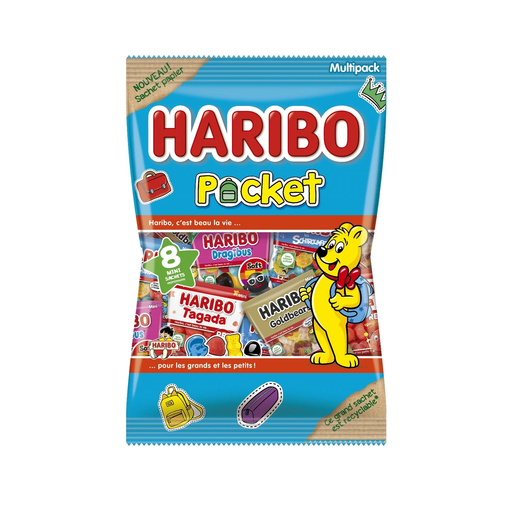 Image unavailable
The individual packs make it easy to plan several portions. This product contains 55 g of sugars per 100 g; it contains gelatin and wheat flour, and may contain milk. Check the weight of each mini pack if you want to prepare a precise amount.
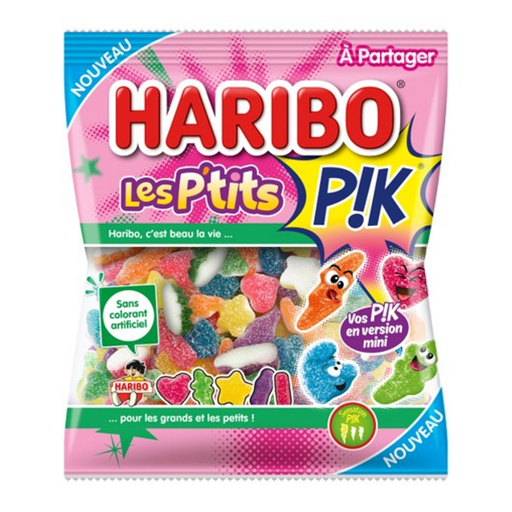 Image unavailable
These bite-sized sweets come in one bag, so an adult should portion them out before serving. The listing states that they contain 51 g of sugars per 100 g and include gelatin. It also warns that the small sweets are not suitable for very young children.
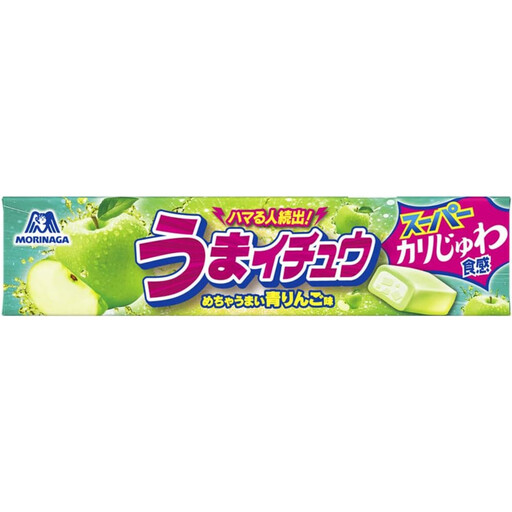 Image unavailable
The 12 bars weighing 4,6 g each make it easy to count how many to hand out, but don’t assume they’re individually wrapped. The listing mentions soya. To compare sugars with other confectionery, check the per-100 g value on the pack.
No. Santé publique France explains that producers display the Nutri-Score on a voluntary basis. For the relevant prepacked foods, the nutrition declaration is compulsory, as the DGCCRF explains.
Compare similar confectionery using the nutritional information per 100 g, particularly energy and sugars, then read the ingredients. Values per serving are directly comparable only when the servings are the same size.
They can make preparation easier if an adult counts the mini packs or portions out the sweets before snack time. However, their small size doesn’t determine how much is eaten or change the product’s ingredients.
Read the ingredients and allergen statements on the exact pack. HARIBO Pocket contains gelatin and wheat; Lutti Bubblizz Mini Surf contains gelatin. Haribo describes Bubble P!K as gelatin-free, but this recipe contains wheat and may contain traces of milk.