Hosts who want to serve a few at a time
If sweets are just one of several nibbles on offer, bite-sized treats are easy to arrange in small bowls. Keep the rest of the bag aside so you can decide how much to put out.


For a drinks party, choose sweet mini sweets if you want a single flavour, an assortment if variety matters more, or a tangy option if your guests enjoy that taste. Their small size makes them easy to serve one at a time, but doesn’t by itself limit how many people eat. Compare the nutrition information and ingredients for the exact product, then serve the sweets in small bowls.
If sweets are just one of several nibbles on offer, bite-sized treats are easy to arrange in small bowls. Keep the rest of the bag aside so you can decide how much to put out.
An assortment of small sweets lets you offer different shapes or flavours in one container. Check the ingredients of the specific product before putting it out for everyone to share.
When comparing two confectionery products, look in particular at the sugars per 100 g and the ingredients list. Santé publique France explains that displaying Nutri-Score is voluntary, so its absence isn’t enough to judge a product.
First decide whether your priority is how much to put out, having a variety to choose from or being able to check the labels. Then choose a sweet or tangy flavour to suit your guests.
| What to consider | What to check | Who is it for? |
|---|---|---|
| How much to serve | Look for a mini or bite-sized format and decide how many to put in the bowls. | When sweets are served alongside other nibbles, I prefer to put out just a few at a time; around 44% of consumers prioritise controlling serving quantities. |
| Variety to share | Check that the product is an assortment and see which shapes or flavours are included. | If I want to offer several flavours without opening multiple packs, a mix of small sweets fits the bill; variety is the priority for around 33% of consumers. |
| Nutrition and ingredients | Compare the sugars per 100 g, then read the ingredients and allergen information for the exact product. | Before serving confectionery to a group, I want to know what it contains and be able to compare the label; around 23% of consumers put this check first. |
The size of an individual sweet tells you about its serving format, not what it contains. For two different products, Haribo France’s product information lists 73 g of sugars per 100 g for La P’tite Tagada and 51 g per 100 g for P!K Les P’tits.
Compare the nutritional values on the same 100 g basis, rather than assuming anything about the ingredients from the size of the sweets alone.
In France, Santé publique France describes Nutri-Score as a voluntary label. The DGCCRF says that nutrition declarations are generally mandatory for prepacked foods, subject to some exceptions.
If the logo isn’t shown, check the nutrition table and ingredients list rather than assigning the product a score yourself.
Ingredients vary from one product to another. Auchan’s product information for Lutti Mini Flexi Bubblizz lists wheat flour, among other ingredients; the DGCCRF reminds producers that allergens must be highlighted in the ingredients list.
Check the packaging for the batch you’re serving, including whether it contains gelatine and any allergen information. Keep it handy for guests who want to check it.
Small sweets can be taken more than once: their size doesn’t determine how much is ultimately eaten.
Put the amount you want to offer into small bowls and keep the rest aside.
Haribo France describes La P’tite Tagada as a mini version, P!K Les P’tits as a mix of seven mini sweets, and Dragolo as bite-sized treats to share.
Bubblizz Mini Surf and Mini Flexi Bubblizz are two mini products with a tangy flavour profile, as described in Auchan’s product information.
Carrefour’s product information can help you check the Nutri-Score for a product when it is displayed.
Some of Auchan’s product pages for mini confectionery list the ingredients and nutrition values per 100 g.
E.Leclerc outlines its Nutri-Score labelling policy for eligible Marque Repère products.
If you want to offer a variety of small sweets from one bag, Dragolo is an assortment you can serve one piece at a time. If you’re choosing based on a sweet or tangy flavour, check the flavour listed for the product you have in mind.
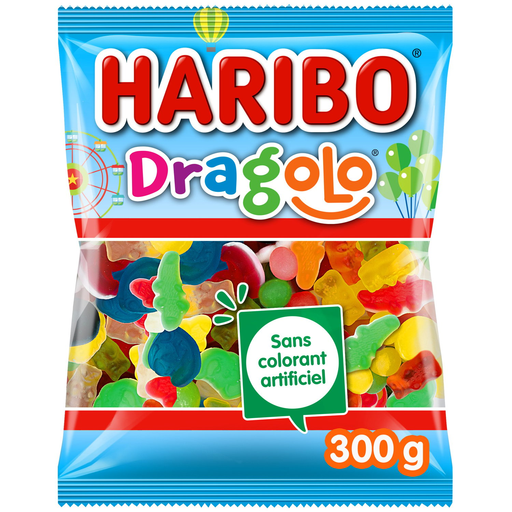 Image unavailable
Worth considering if you want to portion an assortment of small sweets into bowls: Haribo describes Dragolo as a bite-sized format to share. The bag contains 300 g. Decide how much to serve independently of the bag size, and check the packaging for the nutrition values, ingredients and allergens for this product.
No. Santé publique France explains that displaying it is voluntary. The DGCCRF says nutrition declarations are generally mandatory on prepacked foods, subject to some exceptions; the absence of Nutri-Score therefore doesn’t amount to an assessment of the sweet.
Compare their nutrition values on the same 100 g basis, particularly the sugars, then read their ingredients lists. Don’t assume anything about a sweet’s ingredients from its small size or from the score of a different product.
Read the ingredients list and allergen information on the packaging of the product you’re serving, and leave the packaging where guests can check it. The DGCCRF reminds producers that allergens must be highlighted in the ingredients list for prepacked foods. Also check whether it contains gelatine if that matters to your guests.
No. Their size makes it easy to serve them one at a time, but doesn’t stop people going back for more. For a drinks party, put the amount you want to offer into small bowls and keep the rest of the bag aside.