Those who want to control how much they open
A stated number of mini bags lets you choose one before opening the pack, unlike a large bag that you dip into. However, this packaging doesn’t define a recommended nutritional portion.


If you want to decide in advance how many sweets to open, choose a pack that states how many mini bags it contains rather than a large bag of mini sweets. Then check the sugar content per 100 g and the ingredients: a smaller pack doesn’t change French guidance to limit sugary products. If displayed, Nutri-Score can help you compare similar products, but its use is voluntary, according to Santé publique France.
A stated number of mini bags lets you choose one before opening the pack, unlike a large bag that you dip into. However, this packaging doesn’t define a recommended nutritional portion.
Sugar content per 100 g lets you compare sweets on a like-for-like basis. According to Santé publique France, Nutri-Score is voluntary; you should still read the nutrition declaration, even when there’s a logo on the pack.
Recipes can vary within an assortment. Carrefour and E.Leclerc product listings, for example, mention wheat or pork gelatine in some products. Check the ingredients and allergen information on the pack you choose.
If you’re considering mini sweets for breakfast, distinguish the pack format from the size of the sweets, then check the nutritional information and ingredients.
| What matters | What to check | Who it matters to |
|---|---|---|
| Amount opened | The number of individually wrapped mini bags and the net weight; “mini” may refer only to the size of the sweets. | If I don’t want to start with a large open bag, I look for an individual pack I can choose before serving myself. Around 38% of consumers prioritise this kind of portion control. |
| Nutrition label | Sugar content per 100 g for comparable products; check Nutri-Score only if it appears on the packaging. | To compare what I buy, I need to read the nutrition values rather than rely on the size of the sweets. This is the main consideration for around 37% of consumers. |
| Ingredients and allergens | The ingredients in the different sweets in the assortment and the allergen information on the pack. | If there’s an ingredient I need to avoid, checking each recipe comes before having a variety of sweets. This is the priority for around 25% of consumers. |
According to Santé publique France, displaying this logo is voluntary. EUR-Lex states that a nutrition declaration is part of the mandatory information for relevant food products, subject to applicable exemptions. So, the absence of Nutri-Score doesn’t in itself mean the labelling is non-compliant.
Read the nutrition declaration, ingredients and allergen information, whether or not there’s a logo.
A smaller sweet or an individually wrapped bag doesn’t change the ingredients. For example, Carrefour lists HARIBO Pocket 340 g as containing 55 g of sugar per 100 g; Manger Bouger recommends limiting sugary products.
Choose how much you plan to open and compare sugar content per 100 g. Don’t treat the packaging as a nutritional guide.
Carrefour and E.Leclerc product listings describe assortments containing different sweets; some ingredients lists mention pork gelatine or wheat.
If you need to avoid an ingredient or allergen, check the information on the exact pack before buying.
Carrefour lists the 340 g pack as a multipack of 8 mini bags; HARIBO also describes a 380 g Pocket format containing a selection of mini bags.
According to Carrefour, this 500 g assortment brings together several mini sweets in one large bag. The small size of the sweets doesn’t determine how much to serve.
E.Leclerc lists a 500 g assortment of mini bags and displays a Nutri-Score E based on the previous calculation method.
These products show two ways to buy mini sweets: open a mini bag from a multipack, or help yourself from a bag of mini sweets.
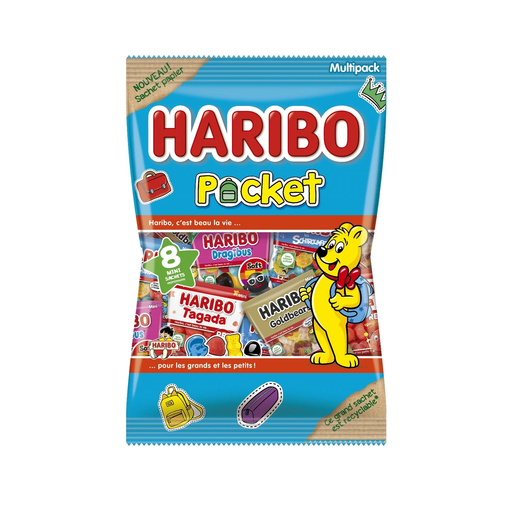 Image unavailable
Worth considering if you’d rather choose one pack to open than help yourself from a large bag. The multipack contains 8 mini bags, weighing 340 g in total; this doesn’t define a recommended nutritional portion. Carrefour’s listing for this format states 55 g of sugar per 100 g, and mentions wheat and the possible presence of milk. Check the label on the pack you buy.
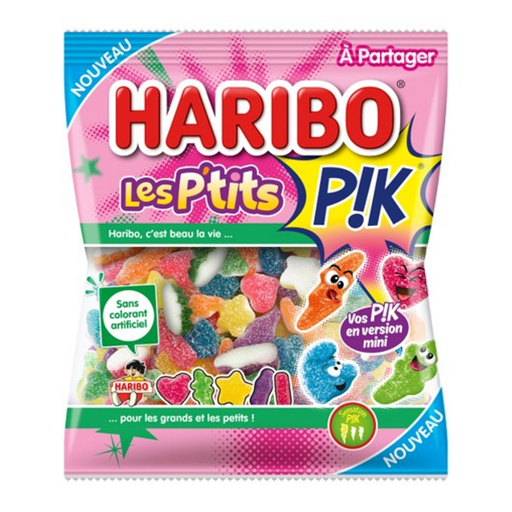 Image unavailable
Worth considering if you’re looking for mini sweets to serve from a 180 g bag. Decide how much to take out rather than treating “mini” as a guide to portion size; check the ingredients and nutrition information on the packaging.
No. Santé publique France says displaying it is voluntary. As EUR-Lex explains, a nutrition declaration is part of the mandatory information for relevant food products, subject to the exemptions set out in the regulations.
No. It mainly lets you control what you open when it contains an individually wrapped pack. It doesn’t change the ingredients in the sweets; Manger Bouger recommends limiting sugary products.
Compare sugar and other nutrition values per 100 g across similar products, then read the ingredients and allergen information. E.Leclerc says the Nutri-Score E shown on its Copains Copines listing is based on the previous calculation method. Check the current packaging before comparing logos.
Read the ingredients for each sweet in the assortment and check the allergen information on the exact pack. Carrefour and E.Leclerc product listings show that recipes may include wheat or pork gelatine, among other ingredients; the mini format doesn’t tell you what’s in them.