Choose mini pralines if you want to count out whole pieces and distribute them through your biscuits. If your recipe calls for pieces of a particular size, a bar of chocolate you can chop gives you more control. In either case, check the ingredients, allergens and net weight of the exact product you choose; a small format alone doesn’t guarantee that it will be suitable for baking.
Which format is right for you?
For those who like to count out each piece
For a small or medium batch, ready-to-use pieces save you from having to chop the chocolate first. However, their size is fixed by the product. If your recipe specifies an exact weight, use the net weight as a guide too, rather than relying on the number of pieces alone.
For those who want to choose the size of the pieces
If you want small chunks to mix into cookies or shortbread, a bar you can chop gives you more control than using whole chocolates. Lindt’s cookie recipe, for example, uses cooking chocolate chopped into pieces; that doesn’t tell you how every praline bar will behave when baked.
For those who check the ingredients
If you’re making biscuits to share, check the exact product you’ve bought before adding it to the dough. The chocolates reviewed here include products that list tree nuts, milk and soya. In France, the Directorate-General for Competition Policy, Consumer Affairs and Fraud Control says that allergens must be highlighted in the ingredients list of pre-packed foods.
What should you check before choosing?
First decide whether you want to add whole chocolates or choose the size of the pieces yourself. Then check the packaging and the label of the specific product you plan to use.
| Criteria |
What to check |
Who it matters to |
| Portioning without chopping |
Number of pieces or packets, and total net weight. Counting the pieces won’t replace weighing them if your recipe calls for a precise amount. |
When I’m adding chocolates to a small batch, I want to count them out before making the dough; around 28% of consumers prioritise quick portioning. |
| Size and texture |
Size of the chocolates and whether they contain a filling, a whole hazelnut or crunchy pieces; whether the chocolate can be chopped into the size you want. |
If I want small chunks in my biscuits, I’d rather choose their size than add a whole praline; this is the priority for around 36% of consumers. |
| Ingredients and allergens |
Ingredients list and highlighted allergens on the exact packet, as well as any ‘may contain’ statements. |
Before making biscuits to share, I need to know which ingredients will go into the dough; around 36% of consumers prioritise this check. |
To compare the quantities in two formats, check the net weight rather than just counting the chocolates. To compare their nutritional information on a like-for-like basis, use the per 100 g nutrition declaration, as recommended by the Directorate-General for Competition Policy, Consumer Affairs and Fraud Control.
Mistakes to avoid
-
Treating a filled praline like a plain piece of chocolate
A mini praline cluster may contain a filling, a whole hazelnut and crunchy pieces. It won’t add the same texture to your dough as chocolate chopped into small pieces.
Read the product name and ingredients. Keep the chocolates whole if that’s the format you want; if you need to control the size of the pieces, start with a bar you can chop.
-
Assuming all products from a brand have the same allergens
Ingredients vary from one product to another, including between assortments and praline chocolates. The Côte d’Or Mini Roc reviewed here, for example, carries a ‘may contain wheat’ statement.
Check the ingredients list and any ‘may contain’ statements on the exact packet before making biscuits to share.
-
Planning your recipe around a single product
The Lindt mini praline assortment featured by Carrefour was listed as unavailable on its product page. If your recipe calls for a precise number of chocolates, you may need to use a different format.
Check that the product you want is available from your retailer, and have an alternative in mind whose quantity you can adjust.
Brands to know
These products show a range of formats for baking; a brand name alone doesn’t tell you what a particular product contains or how best to use it.
Lindt
The mini praline assortment featured by Carrefour contains twenty chocolates in a 100 g box. Lindt also publishes a separate cookie recipe using chopped cooking chocolate.
- Whole chocolates make it easy to count out the pieces before adding them.
- The assortment includes products with different ingredients, so check the ingredients and allergens before use. The cookie recipe mentioned uses cooking chocolate, not this assortment.
Côte d’Or
The products reviewed include Mini Roc chocolates in a box of 29, weighing 279 g, and milk chocolate praline bites in a box of eight packets, weighing 200 g.
- The stated number of chocolates or packets helps you work out how many pieces to add.
- Mini Roc chocolates contain praline, a whole hazelnut and crunchy maize, among other ingredients. This texture isn’t a substitute for evenly sized chocolate chunks. Check the allergens for each product.
Marque Repère / Tablette d’Or (E.Leclerc)
E.Leclerc offers a 200 g Tablette d’Or praline cooking chocolate bar, which is worth considering if you want to chop the pieces yourself.
- A bar lets you choose the size of the pieces before adding them to the dough.
- Check the packaging of the product you choose for its ingredients and any guidance relevant to your recipe.
A praline bar on Joybuy
If you’re considering a praline bar rather than whole mini pralines, this product is worth a look depending on the size of the pieces you want in your biscuits.
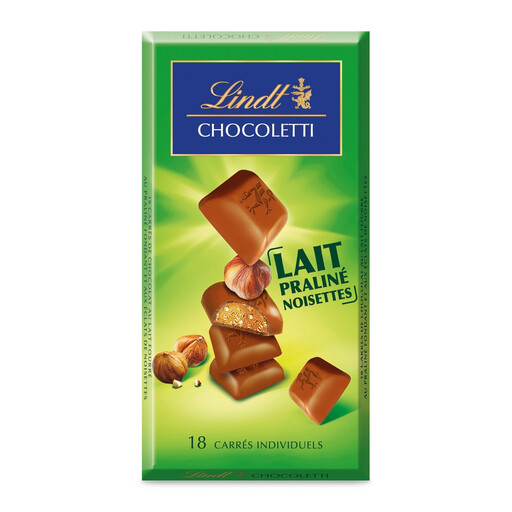 Image unavailable
Lindt Chocoletti milk chocolate praline bar, 100 g
This bar is for anyone who wants to consider a format that can be portioned, rather than choosing whole mini pralines. If you plan to use it to portion your recipe, check the size and weight of the squares. Try it in a small batch before deciding whether it’s right for baking.
The product page lists hazelnuts, almonds, milk, soya and barley, among other ingredients. Check the label on the exact packet before making biscuits to share.
View on Joybuy
Frequently asked questions
Are mini pralines always suitable for baking in biscuits?
No. Their small size doesn’t mean they’re designed to be baked into dough. If your recipe calls for pieces of chocolate, Lindt has a cookie recipe that uses chopped cooking chocolate. If you want to try pralines, take their size and filling into account and start with a small batch.
Which allergens should you check before making biscuits to share?
Read the label on the packet you’ll be using. The products reviewed here include ingredients such as hazelnuts, almonds, milk and soya; Côte d’Or Mini Roc also carries a ‘may contain wheat’ statement. In France, the Directorate-General for Competition Policy, Consumer Affairs and Fraud Control says that allergens in pre-packed foods must be highlighted in the ingredients list.
How should you compare two praline formats for a recipe?
First compare the net weight and size of the pieces with the quantity and texture your recipe calls for. Two boxes with a similar number of chocolates won’t necessarily contain the same amount. Then check the ingredients, allergens and nutrition information per 100 g; the Directorate-General for Competition Policy, Consumer Affairs and Fraud Control specifies this as the basis for nutrition declarations.


