Anyone looking for an easy-to-carry portion
You want to slip a sealed portion into a bag or pocket and know how much you’re taking, without carrying a jar and a spoon.


An individually wrapped portion can be easier to carry and count, but it isn’t a fuelling plan for a marathon by itself. To choose, distinguish between praline spread and a filled biscuit that’s ready to eat. Then check the carbohydrates per portion, allergens and how the snack fits into a strategy you’ve already tried during training.
You want to slip a sealed portion into a bag or pocket and know how much you’re taking, without carrying a jar and a spoon.
You want to know how many carbohydrates each portion provides and include the snack in a strategy you’ve already tried during training. The International Olympic Committee recommends practising carbohydrate intake during training to develop an individual strategy.
You check the ingredients, allergens and nutritional information for the exact product before choosing, whether or not it has a Nutri-Score on the packaging.
First, decide whether you want a portion that’s ready to eat or a spread that needs something to spread it on. Then check what you’ll get from the portion you plan to take, rather than relying on the word ‘mini’ alone.
| What to consider | What to check | Who it matters to |
|---|---|---|
| Carrying and portion size | Check whether each portion is individually wrapped, as well as its weight and the number of portions. | I want to take a small, sealed snack without handling a jar while I’m on the move; around 42% of consumers would put ease of carrying and portioning first. |
| Carbohydrates and trying it in training | Check the carbohydrates per portion and consider how much you plan to have as part of your own strategy. Try the snack during training before race day. | To include this snack in my fuelling plan, I need to know how much each portion provides and how well I tolerate it; around 33% of consumers would prioritise this planning. |
| Ingredients and labelling | Check the allergens and compare the nutritional values per 100 g and, if provided, per portion. | Before buying, I want to check the recipe of the exact format I’ll be taking; around 25% of consumers would make ingredients and labelling their top priority. |
In France, the Directorate General for Competition Policy, Consumer Affairs and Fraud Control states that displaying a Nutri-Score is optional. So, if it’s not shown, you should still check the nutritional information.
Compare the values per 100 g and, where provided, per portion. Use the Nutri-Score as an additional guide if it’s displayed.
An individually wrapped portion makes it easier to count what you take, but it doesn’t tell you how many carbohydrates suit your race-day strategy.
Check the carbohydrates in the exact portion and try the snack during training before adding it to what you plan to take with you.
A smaller portion doesn’t change the ingredients. Nutella lists hazelnuts, milk, soya, wheat and barley among the allergens in B-ready; this list doesn’t apply to every spread.
Check the ingredients and allergens on the packaging of the product you buy, even if you’re already familiar with another product from the same brand.
B-ready is a wafer filled with hazelnut and cocoa spread, available in individually wrapped portions. It isn’t a praline spread for spreading.
Kâliner sells its spread in single portions, including for breakfast on the go.
Funkie sells an organic praline spread and describes its recipe as oil-free.
These two Nutella B-ready products are filled biscuits you can take with you. They aren’t a substitute for praline spread. Compare the pack sizes and check the values per piece on the pack you choose.
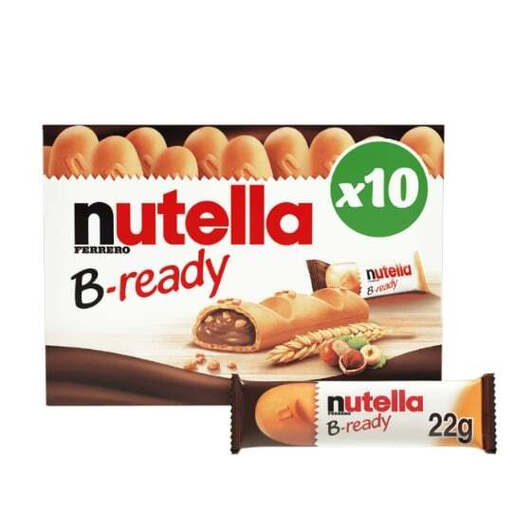 Image unavailable
This format of individually wrapped filled wafers is a good option if you want to count the portions you take without carrying a jar of spread.
Pack of 10 x 22 g portions, 220 g in total. Before adding this pack to your fuelling plan, check the carbohydrates per piece and the allergens on the packaging, then try the product during training.
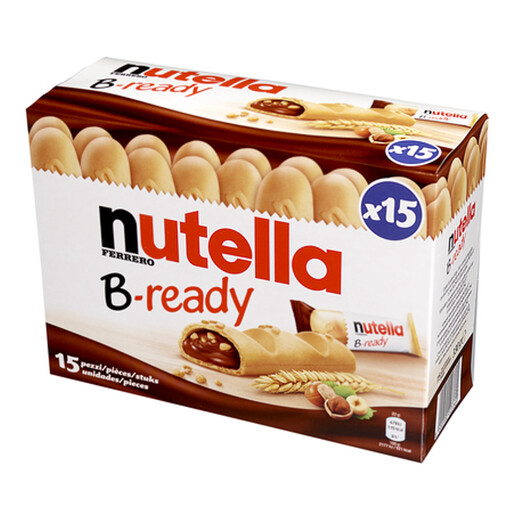 Image unavailable
These filled biscuits could be a good option if you’d prefer a snack that’s ready to eat rather than a spread that needs something to spread it on.
330 g pack. Check the number of pieces, the nutritional values per piece and the allergens on the packaging before deciding how many to take or trying the product during training.
No, displaying it is optional in France, as the Directorate General for Competition Policy, Consumer Affairs and Fraud Control explains. Nutritional declarations on prepacked foods are generally compulsory, so check them even if there’s no Nutri-Score on the packaging.
One piece on its own doesn’t provide a fuelling plan for the whole race. Nutella states that one 22 g B-ready contains 13,4 g of carbohydrates and 5,9 g of fat. Check the values on the pack you buy and try the snack during training as part of your strategy.
Check the allergens on the packaging of the exact product, as they depend on the recipe. Nutella lists hazelnuts, milk, soya, wheat and barley among the allergens in B-ready; this list shouldn’t be applied to other spreads or filled biscuits.