Who is this choice for?

People managing a diagnosed allergy

If you’re buying for someone with an allergy, start with the allergen in question and read the ingredients list and any ‘may contain’ warnings. According to the DGCCRF, allergens must be emphasised on the labels of prepacked foods.

People preparing individual portions

If you’re dividing up a snack or packing separate portions to take with you, check how many pieces are in the pack and whether they’re individually wrapped. This convenience doesn’t change the ingredients in each piece.

People comparing portions and sugars

If you want to compare two formats, look at the sugars and other nutritional values per 100 g, then check the weight of the portion you’ll eat. The DGCCRF presents values per 100 g as a basis for comparing prepacked foods.

What should you check?

First, make sure the recipe is suitable for the allergy in question. Packaging and nutritional values can then help you choose between formats.

Criteria What to check Who is it for?
Allergens Check the emphasised ingredients and any ‘may contain’ warnings on the pack you’re buying, including for each variety in an assortment. If a particular allergen must be avoided, a small portion doesn’t resolve the question of whether it’s present. Around 33% of consumers put checking allergens at the top of their list.
Individual pieces Compare the number of pieces, how they’re wrapped and the weight of each piece, if stated. For sharing or packing a snack, separate pieces make it easier to count the amount served. Around 27% of consumers put portioning first.
Recipe ingredients Distinguish between milk chocolate, filled chocolate and chocolate-coated confectionery, and check the ingredients for each product. When choosing between different recipes, some consumers want to check the ingredients added by a filling or coating first. Don’t assume that a shorter ingredients list will make a product suitable for an allergy. Around 20% make this their main priority.
Nutritional values Compare sugars and saturated fat in particular, per 100 g, then consider these values in relation to the portion served. Once the products you’re considering meet your household’s dietary requirements, comparing sugars on the same basis can help you choose between different portion sizes. Around 20% of consumers put this first.

Mistakes to avoid

  • Relying on the brand or the size of the bite

    Two products from the same brand may list different ingredients and potential traces. A mini format doesn’t tell you anything about allergens.

    Check the ingredients list, emphasised allergens and any ‘may contain’ warnings on the pack you’re buying.

  • Assuming Nutri-Score is compulsory

    According to Santé publique France, displaying it is voluntary. The DGCCRF explains that nutritional information is required for most prepacked foods.

    If a Nutri-Score appears on the product, use it as additional information. Compare the nutritional values per 100 g in the table on the packaging.

  • Confusing mini size with the amount eaten

    A small piece makes it easy to count individual units, but the number of pieces served and their weight determine the portion actually eaten.

    Check the weight of each piece, if stated, and decide how many pieces you’ll serve.

  • Using the tax on sugary drinks to compare chocolates

    Article 1613 bis of the French General Tax Code, published by Légifrance, applies to drinks. It’s not a criterion for choosing solid chocolate.

    Instead, compare these products by checking their ingredients, allergens and nutritional values.

Brands to check by product

Milka

Carrefour France lists a bag of eight milk chocolate Mini Bars, with a total weight of 200 g.

  • The bars are easy to count when sharing.
  • This product lists milk and soya lecithins, and may contain wheat and nuts.

Lindt

Lindt France lists a 35 g EXCELLENCE Milk mini bar and a bag of 26 individually wrapped LINDOR Milk squares.

  • These two products let you choose between a bar with a set weight and individually wrapped squares.
  • Their allergen declarations differ. Check the exact product, particularly for milk, soya and nuts; the LINDOR squares also list egg and wheat.

Côte d’Or

Auchan’s listing for Côte d’Or Mini Bouchées describes bite-sized pieces filled with milk chocolate.

  • The bite-sized format makes it easy to count the pieces you serve.
  • This recipe contains milk, hazelnuts, almonds and soya lecithins, among other ingredients, and may contain wheat. The pieces aren’t individually wrapped.

Carrefour

A Carrefour France listing lets you check the ingredients in a Carrefour milk chocolate bar. This product isn’t a mini format.

  • The product listing identifies dairy ingredients to look out for in the recipe.
  • Don’t assume the ingredients are the same in another Carrefour chocolate, whether mini-sized or not.

Marque Repère / P’TIT DELI (E.Leclerc)

E.Leclerc lists milk-filled mini chocolate bars in a pack of 16.

  • The listing shows nutritional information, so you can compare this product with others on the same basis.
  • The Nutri-Score E shown on this listing is based on the previous calculation method. Check the label on the specific product before comparing ratings.

Formats available on Joybuy

These products offer two ways to share milk chocolate confectionery: individually wrapped bars or tubes of small chocolate beans. If you have an allergy, your choice still depends on the label of each product.
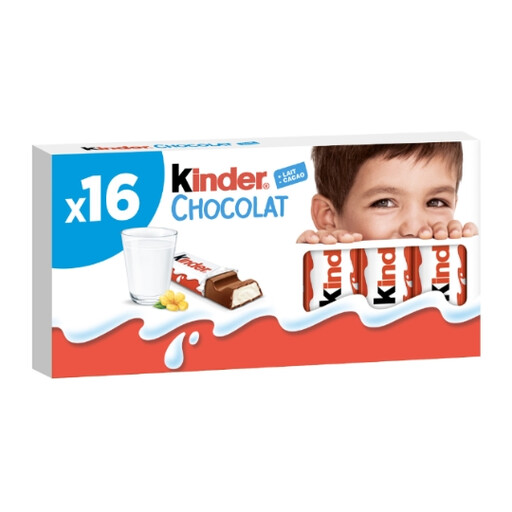
Kinder Chocolate x16, chocolate bars

Kinder Chocolate x16

Worth considering if you want to count bars when preparing separate portions. The product listing mentions milk and soya. Check these details against the allergy in question, and also look for any potential trace warnings on the pack you buy.

View on Joybuy

SMARTIES Hexatube 6 x 34g, milk chocolate beans

SMARTIES Hexatube 6 x 34g

The six tubes may suit sharing by container, rather than by mini bar. The product listing mentions milk and gluten from wheat and barley. Check the pack you buy for other allergen warnings and nutritional values per 100 g.

View on Joybuy

Frequently asked questions

Is Nutri-Score compulsory on mini milk chocolates?

No. According to Santé publique France, producers display it voluntarily. The DGCCRF explains that nutritional information is required for most prepacked foods in France. Use the values per 100 g to compare products.

Does the tax on sugary drinks apply to solid chocolate?

No. Article 1613 bis of the French General Tax Code, published by Légifrance, applies to drinks, not solid chocolate bars, squares or bites. To compare the sugar content of these products, check their nutritional values per 100 g.

Is a mini chocolate bite automatically suitable for someone with an allergy?

No. Its size doesn’t change its ingredients. For prepacked food, check the pack for emphasised allergens in the ingredients list and any ‘may contain’ warnings, then compare them with the allergy in question.

Can you use the label from another product by the same brand?

No. A chocolate bar and a filled bite may have different ingredients, even if they’re from the same brand. Check the recipe and warnings for the specific product you plan to buy.

How can you compare sugar in mini formats of different sizes?

First, compare the sugars per 100 g shown in each nutritional table. This is the common basis used by the DGCCRF. Then check the weight of each piece and how much you plan to serve.