Parents who prepare a set amount to serve
You want to separate some chocolate from the rest of the pack before snack time, without treating the word ‘mini’ as a guide to portion size.


For a child's snack, choose a format that lets you decide how much to serve in advance: it's easy to take a single bite from a pack, while a mini bar can be broken into pieces or shared. However, the word ‘mini’ doesn’t mean that a product is a suitable portion for a child. Check the allergens on the exact pack and compare the sugar content per 100 g. Santé publique France advises limiting sugary and fatty foods at snack time as part of your daily diet.
You want to separate some chocolate from the rest of the pack before snack time, without treating the word ‘mini’ as a guide to portion size.
You need to read the ingredients and precautionary warnings on the specific product you buy. A brand name or the category ‘milk chocolate’ isn’t enough to determine whether it’s suitable.
You want to compare the sugar content and other nutritional values of specific products, distinguishing between figures per 100 g and the amount actually served.
If allergies are a concern, check the exact packaging first, then decide how much to serve. When comparing recipes, the DGCCRF states that the nutrition declaration on relevant prepacked foods gives values per 100 g, and that displaying the Nutri-Score is voluntary.
| Criterion | What to check | Who is it for? |
|---|---|---|
| Allergens | Read the highlighted ingredients and any ‘may contain’ warnings on the exact pack. | If an ingredient isn’t suitable for your child, choosing a small format won’t make the product any more suitable. Around 42% of consumers prioritise avoiding an allergen. |
| Amount served | Check the weight of each piece or pack, and decide what you’ll serve before opening the pack. | If you prepare snacks in advance, choosing an easy-to-separate unit can help stop the pack from determining how much you serve. Around 33% of consumers prioritise this. |
| Nutritional information | Compare the ‘of which sugars’ line per 100 g in particular, and check the Nutri-Score if it’s shown on the pack. | If several recipes are suitable, their labels let you compare sugar content on a like-for-like basis. Around 25% of consumers make this their top criterion. |
A small bar isn’t necessarily a single bite: the EXCELLENCE Milk Mini Bar featured by Lindt France weighs 35 g and contains 51 g of sugars per 100 g. These figures describe this product, not an amount to serve.
Decide how much to serve before snack time, then check the net weight and nutritional values of the product you choose.
Carrefour’s product listing for Côte d’Or milk praline bites mentions milk, hazelnuts, almonds and soya, as well as the possible presence of wheat.
Check the ingredients and precautionary warnings on the pack you buy before preparing the snack.
According to the DGCCRF, displaying the Nutri-Score is voluntary in France. If it isn’t shown, you should still read the nutrition declaration.
Compare the values per 100 g and the ingredients list; use the Nutri-Score as an additional guide when it’s displayed.
Lindt France describes its EXCELLENCE Milk Mini Bar as a 35 g format, which is different from an individual bite.
Carrefour’s listing for Côte d’Or milk praline bites describes a box of 8 sachets, with a total weight of 200 g.
These two products suit different snack-time needs: a mini Kinder Bueno format and Smarties milk chocolate sweets in tubes. The weight of a pack or tube doesn’t determine how much to serve a child.
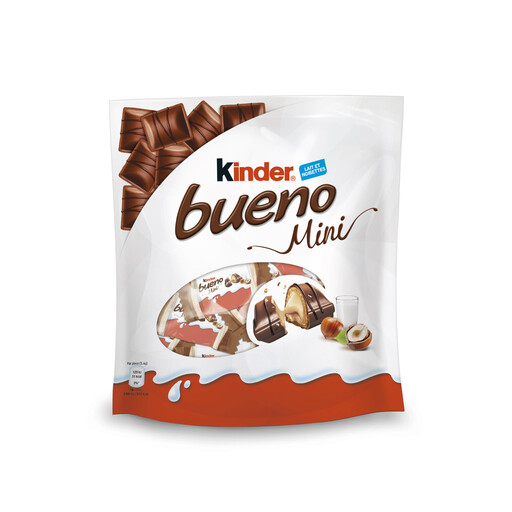 Image unavailable
Worth considering if you want to set aside an amount from the rest of the pack before snack time. The pack weighs 108 g; check the number and weight of the pieces on the packaging to decide how much to serve. If allergies are a concern, check the warnings relating to milk, wheat, hazelnuts, soya and almonds in particular.
 Image unavailable
The tubes are separate packaged units that you can use to prepare a snack; each weighs 34 g, but this isn’t a recommended portion for a child. Compare the sugar content per 100 g on the packaging, and check the ingredients and precautionary warnings if an allergy or intolerance is a concern.
No. The DGCCRF states that displaying it is voluntary in France. For most prepacked foods, a nutrition declaration includes sugars and other nutritional values per 100 g.
Read the ingredients list and precautionary warnings on the packaging of the product you buy. Anses advises that substances that can cause allergies or intolerances must be highlighted in the ingredients list. Depending on the recipe, check for milk, nuts, soya or wheat in particular.
No. The format name doesn’t determine how much to serve. Santé publique France advises limiting sugary and fatty foods at snack time as part of your daily diet, and suggests bread with a few squares of chocolate as one option.
No. Article 1613 ter of the French General Tax Code applies to drinks and liquid preparations for drinks intended for human consumption, not solid milk chocolate.