
Livraison le jour même ou le lendemain

Qualité garantie

Débloquez vos offres de bienvenue: Livraison GRATUITE | Jusqu'à -80 % | 30 jours d'essai gratuits à JoyPlus
Téléchargez l'application
Essential for a dorm room, handy in the office, or practical in an RV, the mini-fridge is the perfect ally for keeping drinks and snacks cool. But be warned: the market is flooded with models offering vastly different features, and a poor choice can quickly turn the dream into a noisy, energy-guzzling nightmare.
To help you navigate this, our editorial team has analysed the most common mistakes and broken down the essential criteria. Follow this guide to find the compact refrigerator that will truly meet your needs, with no unpleasant surprises.
To make the right choice, three technical criteria must be scrutinised. They determine the appliance's performance, user comfort, and suitability for your specific needs.
This is the most important criterion, as your entire choice will depend on it.
Capacity in litres can be misleading. A stated volume of 45 litres might seem adequate, but a poorly designed interior layout (fixed shelves, shallow door bins) will quickly make it impractical for daily use.
Always check the external dimensions to ensure the compact refrigerator fits into your intended space, leaving a few centimetres at the back and sides for ventilation. Think practically: are the shelves removable? Is there any semblance of a crisper drawer? Can the door storage accommodate a 1.5L bottle?
These two pieces of information are standardised and mandatory on the energy label. Never ignore them.
Enough theory, let's get practical. Here is our selection of models tailored to specific needs, chosen for their ability to avoid the pitfalls we've just covered.
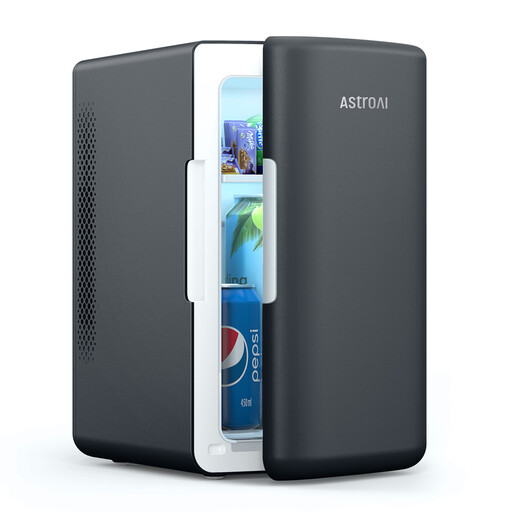
Why It's a Match: Ideal for a student, an office, or as a car fridge. Its dual power supply (220V mains and 12V car socket) makes it ultra-versatile. Its small footprint allows it to fit anywhere to keep drinks, snacks, or even beauty products cool.
It's upfront about what it is: a thermoelectric cooler/warmer, not a compressor fridge. It doesn't promise the impossible, which prevents any disappointment. Its mission is to chill, not to preserve sensitive items long-term.
Its versatility: it cools to 18-22°C below ambient temperature and can also heat up to 66°C. A true, ultra-portable Swiss Army knife.
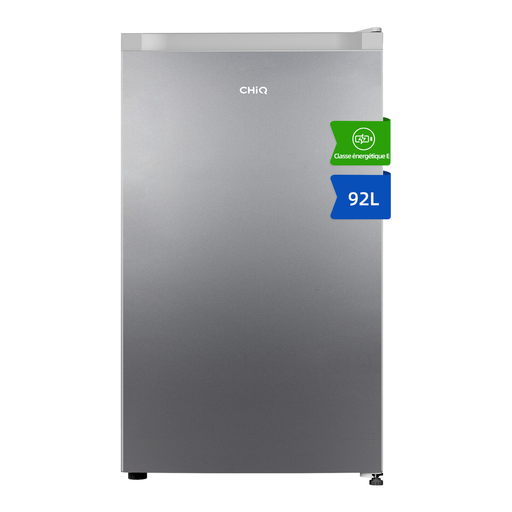
Why It's a Match: This is a true small refrigerator with a compressor, ideal for daily use in a studio or office. At just 47 cm wide, it fits anywhere yet offers a generous and well-organised 92-litre capacity.
It ticks the two critical boxes: noise and consumption. Marketed as quiet ("Low Noise Operation" technology), it won't be a disturbance. Its Energy Class E rating ensures controlled consumption for a compressor model, with no surprises on your bill.
Its dedicated "Chill" compartment, which maintains a lower temperature for meat and fish, and its adjustable glass shelves that allow you to customise the space.

Why It's a Match: The perfect solution for those needing extra storage in a garage, utility room, or second home. More than a mini-fridge, it's a clever chest freezer that converts into a refrigerator on demand.
Its purpose is crystal clear: this is a storage appliance, not a bedroom fridge. Its noise level of 38 dB is remarkably low for a freezer, and its Class E rating ensures reasonable consumption for its large capacity.
Simply put, its convertible function. Thanks to its 7-setting thermostat, it can switch from freezer mode (4-star) to refrigerator mode. Unbeatable flexibility to adapt to your needs: a stock of drinks in the summer, frozen reserves in the winter.
Explore our full selection of products that meet our criteria for performance, silence, and efficiency.
Consumption depends on the technology, size, and energy class. A small 6L thermoelectric cooler uses very little power, but a 90L compact refrigerator with a compressor rated Class E will consume around 80 to 100 kWh per year. To calculate the cost, multiply this figure by the price per kWh from your electricity provider. This information is required to be on the energy label of every appliance.
Absolutely, provided you choose a quiet fridge. Aim for a model with a noise level that does not exceed 40 dB. The ideal is around 38 dB, a barely perceptible sound that won't disturb your sleep. Also, be sure to leave 5 to 10 cm of space around the appliance (especially at the back) to allow for proper air circulation and prevent the compressor from overheating.
It all comes down to the cooling technology. An electric cooler (thermoelectric) chills relative to the ambient temperature and is ideal for transport or for keeping drinks cool. A mini-fridge (with a compressor) produces a constant, regulated cold that can safely preserve all types of food, including the most perishable items. The choice, therefore, depends entirely on your intended use.