Renters without a dedicated water supply
You want to avoid altering the plumbing in your studio flat. A tank can remove the need for a fixed water supply, but you’ll still need to decide where the waste water will go.


In a studio flat without a usable water supply, choose a model with a tank only if you can also arrange somewhere for the waste water to drain. If a connection is available, a countertop model saves you from filling it by hand. A slim 45 cm model, on the other hand, needs floor space and permanent connections. Then compare these formats based on the dishes you need to load, the space available and the stated noise level.
You want to avoid altering the plumbing in your studio flat. A tank can remove the need for a fixed water supply, but you’ll still need to decide where the waste water will go.
There’s more to fit in than plates and cutlery: if you regularly wash pans and saucepans, a 2–3 place-setting capacity may be too restrictive for your needs.
If you have floor space as well as a permanent water supply and waste outlet, a slimline appliance can offer more capacity than a mini countertop model. Electrolux, for example, offers freestanding models in this format with a capacity of 9 place settings.
Start by checking which connections you can actually use, then compare the capacity with the dishes you usually wash. In a studio flat, noise and the space needed to open the door are also important considerations.
Consider it: if you don’t have a usable fixed water supply and a small capacity suits your everyday loads.
Bear in mind: you’ll need to fill it by hand and arrange somewhere for the waste water to drain. Daan Tech describes both water-supply options for Bob; it doesn’t present the tank as a solution that needs no drainage.
Consider it: if an accessible connection means you can avoid filling the appliance by hand. Candy describes the CP 6E51LS as a 6-place-setting countertop model with a direct connection.
Bear in mind: you’ll need worktop space and a suitable waste-water outlet; the type of connection depends on the model.
Consider it: if your home has floor space and permanent connections, and you tend to build up more washing-up.
Bear in mind: this format isn’t designed to sit on a worktop and won’t suit you if you need a tank-fed appliance.
| Criterion | What to check | Who is this important for? |
|---|---|---|
| Water supply and drainage | How the appliance is supplied with water and whether the waste hose can reach a suitable outlet. | Without a fixed water supply, I want to install the appliance without any plumbing work, while still having a practical place to drain the water. Around 39% of consumers make this their top priority. |
| Capacity and dimensions | Whether larger items will fit, the external dimensions and the space needed with the door open. | If I cook regularly, I don’t want to have to choose between plates and pans every time I run a cycle. For around 38% of consumers, usable capacity comes before other criteria. |
| Noise and drying | The stated noise level in dB(A), the drying method and the end-of-cycle signal. | In a living space, I want cycles to disrupt my activities as little as possible and the drying performance to suit my needs. This is a priority for around 15% of consumers. |
| Energy use and maintenance | The energy-label figures for the Eco programme and how easy the filter is to access. | I prefer to compare energy use on a like-for-like basis and be able to clean the appliance easily. Around 8% of consumers prioritise these points. |
The tank replaces a fixed water supply, not the waste-water outlet. A poorly positioned hose can make everyday use difficult or cause an overflow.
Check where the hose can run and how it can be secured, then follow the drainage instructions in the manual for your chosen model.
This figure doesn’t tell you how much room there is for frying pans, saucepans or large plates. A customer review of the Klarstein Amazonia 6 on Fnac mentions this issue with larger items; the feedback relates to that particular model.
Measure the dishes you use most and compare them with the model’s loading limits and basket layout.
In a studio flat, the cycle runs close to where you relax or work. ADEME points out that a difference of just a few decibels can mean a noticeable change in noise.
Compare the stated noise levels on the exact product specifications and check whether you can adjust the end-of-cycle signal.
The length of a quick programme and the energy-label figures don’t necessarily refer to the same cycle.
Compare water and energy use using the label’s reference figures, then look separately at the duration of the programmes you plan to use.
Bob is an ultra-compact model designed for a worktop, with an integrated tank or a water-supply connection, depending on your chosen setup.
The CP 6E51LS is a countertop dishwasher with a capacity of 6 place settings and a direct connection to the water supply.
Klarstein describes the Oceana as a tabletop model that can connect to a tap without fixed installation.
Slimline 45 cm freestanding models are another option if you have floor space and permanent connections.
These countertop models show the choices available, from a small capacity and different water-supply options to a 6-place-setting model. For each one, check the space available and how the waste water drains before making your choice.
 Image unavailable
Worth considering if you have a usable water supply and want to fit more dishes on your worktop. The model title lists 7 programmes, automatic door opening for drying and a stated noise level of 47 dB. Check the appliance dimensions and the route for the waste hose in your chosen location.
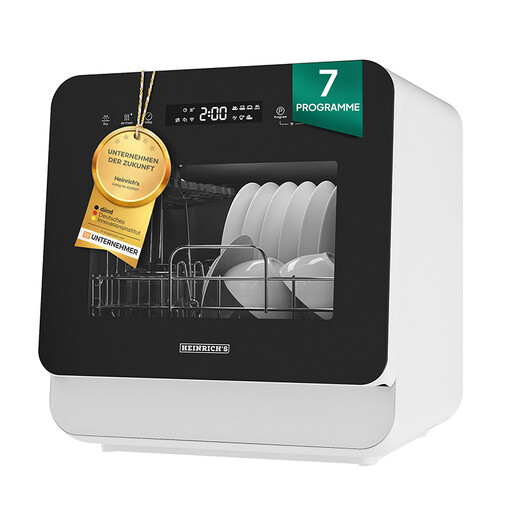 Image unavailable
Worth a look if you want a small-capacity model and would like to compare water-supply options with and without a connection. The title lists 7 programmes and 56,3 dB; that stated noise level is worth considering in a living space. Check the dimensions and how the waste hose connects.
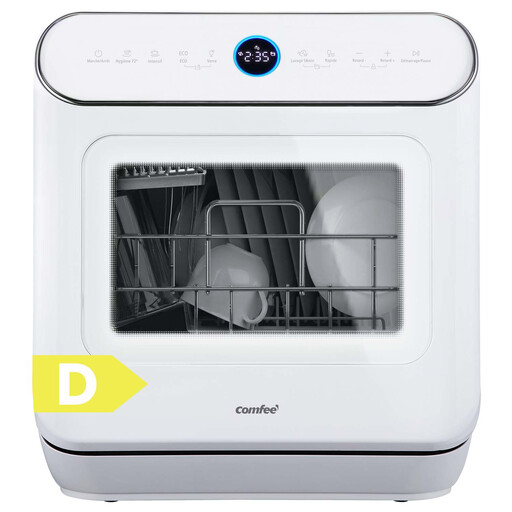 Image unavailable
Worth considering if you’re looking for a tabletop appliance for small loads and plan to fill it by hand. The title lists 7 programmes and automatic door opening. Before choosing a spot for it, check the manual to find out how to drain the waste water.
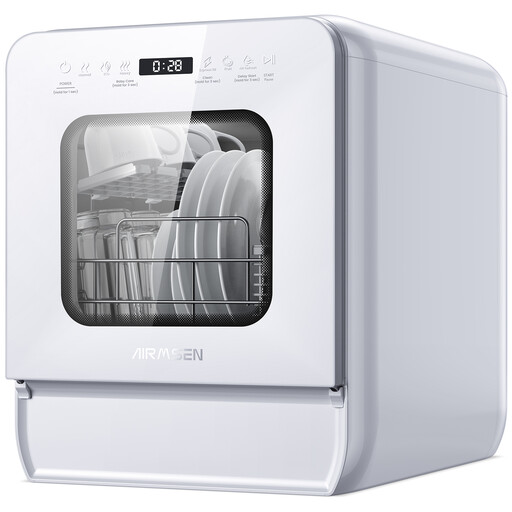 Image unavailable
Worth a look if you want a countertop appliance that can be supplied with water from a tank. The title lists a width of 37 cm and 9 programmes. Also measure the depth required, then check the route for the waste hose before deciding where to put it.
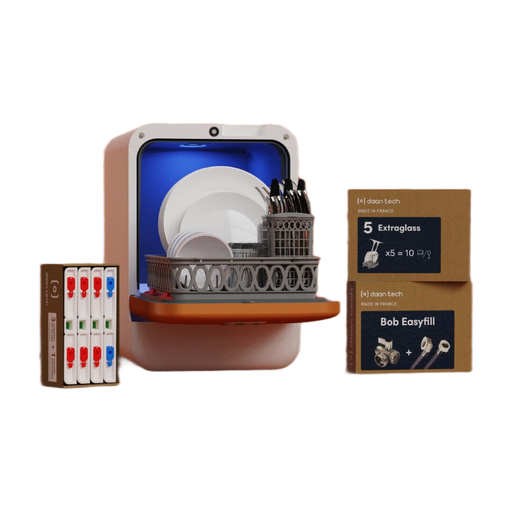 Image unavailable
Worth considering if worktop space is limited and your everyday load is small. Daan Tech lists Bob’s standard capacity as 2 place settings, so check that your dishes will fit. Also confirm the water-supply option and waste-water route for this pack.
It can work without a permanent water supply, but the waste water still needs to be drained. For Bob, Daan Tech specifies a 1,50 m drain hose. Check that it can reach a suitable outlet and be secured as instructed in the manual.
A 2–3-place-setting model may suit you if you often wash small loads. If you regularly use saucepans and frying pans, consider 6-place-setting models too. Measure your largest items and the space available: Boulanger, for example, lists the Candy CP 6E51LS as 55 × 44,3 × 50 cm.
Compare capacity, energy use in kWh per 100 cycles, water use per cycle, the Eco programme duration and the noise level. ADEME lists these as factors to consider; check quick programmes separately, as their duration alone isn’t enough to compare energy use.
No. For goods sold by a trader to a consumer in France, the statutory guarantee of conformity is mandatory, as the Ministry of the Economy explains. Any commercial guarantee is additional and does not replace it. If a product is faulty or doesn’t match its description, distinguish these statutory rights from the terms of any commercial guarantee.