One or two people without a kitchen water connection
You want to automate washing a small amount of crockery without plumbing work, while still being able to fill a tank and direct the waste water into a sink or suitable container.


Choose a mini dishwasher with a water tank if you can fill it by hand, place it on a stable surface and direct the waste water into a sink or suitable container. For one or two people, focus on comparing the appliance’s actual footprint, capacity, noise level, water and energy use on the same cycle, and drainage requirements. Hand-washing remains simpler when the available space, socket or drainage route cannot be made safe.
You want to automate washing a small amount of crockery without plumbing work, while still being able to fill a tank and direct the waste water into a sink or suitable container.
You need a worktop appliance whose width, depth, height, noise level and door clearance are all compatible with a limited space.
You mainly wash plates, glasses and cutlery for one or two people, and are happy with a capacity of around 3 place settings per cycle rather than a family-sized format.
Choose this if: you have a stable worktop, a socket suitable for the model and a safe route for the drain hose to the sink or a suitable container.
Bear in mind: not having a fixed water connection does not remove the need to fill the tank or manage waste water.
Choose this if: you cannot stabilise an electrical appliance, arrange drainage or accept filling it before every cycle.
Trade-off: this solution avoids the bulk of an appliance, but it does not reduce the time spent washing up in the same way.
| Priority | Points to check | Your needs |
|---|---|---|
| Waste-water drainage | Check that the hose is included and confirm its length, the available drainage point and, where specified, the maximum pumping height. Confirm the drainage instructions in the manual for the exact model. | I need to be able to direct waste water into the sink or a suitable container without a permanent installation. |
| Actual footprint | Measure the width, height and depth, then add the clearance needed for the door and hoses. Also compare the capacity with the amount of washing up you produce each day. | My worktop must remain usable, with enough room to open the door and use the sink. |
| Water use and duration | Compare litres per cycle and kWh per 100 cycles on the same reference programme. Also check the duration of the eco programme. | I want to know how much water to add and how long the crockery will remain in the appliance. ADEME explains that the energy label shows, among other details, water use per cycle and energy consumption per 100 cycles. |
| Installation and ventilation | Check the model’s voltage, power rating and electrical instructions. Use a stable surface and keep the ventilation openings clear. | I need to be able to install the appliance without obstructing ventilation or creating an unstable situation near water. |
An appliance can become difficult to use if its hose cannot reach the sink securely. Kitchen waste water is classed as grey water managed through domestic sanitation, according to Service-Public.fr.
Before ordering, identify the drainage point, measure the distance from the appliance and read the manual to find out the pumping height, hose length and drainage requirements.
A quick programme and a reference cycle do not necessarily represent the same type of use. Comparing them without using a common programme can therefore be misleading.
First compare the stated litres per cycle and kWh per 100 cycles on the energy label or for the same programme, then check the duration of the eco cycle.
Its depth, height, door clearance, hose routing, socket and ventilation can all prevent a practical installation, even when the width is suitable.
Measure the space in all three dimensions, allow room for the hoses and check that the ventilation openings will not be blocked.
A capacity of 3 place settings is suitable for a small load, but it may mean running several cycles or leaving some washing up outside the appliance in a larger household.
Estimate your daily volume, including bowls, frying pans and cooking containers. If this load regularly exceeds the format you have chosen, consider hand-washing alongside it or a larger-capacity appliance that fits your requirements.
French brand behind Bob, a compact freestanding mini dishwasher that can operate using an integrated tank or a connected water supply.
The Studio MINID3SL is a freestanding mini dishwasher for 3 place settings, sold with a standalone tank on the French market.
Comfee' features in the range of countertop mini dishwashers; the CDWMTO201D (W) is presented with an integrated 5 L tank and manual filling.
This selection brings together Joybuy mini dishwashers with manual filling, designed to reduce hand-washing in a small kitchen without a permanent connection to the water supply.
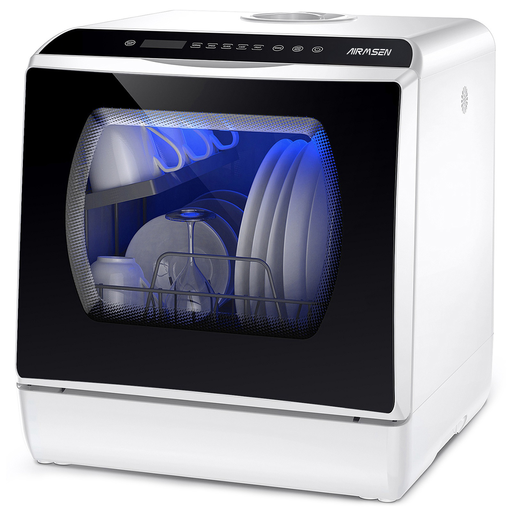 Image unavailable
An option for a small amount of daily washing up without a fixed water supply, provided the surface is stable and drainage can be arranged.
Integrated 5 L tank, stated capacity of 4 place settings, stated dimensions of 45.8 × 42.8 × 42.5 cm and 5+1 wash cycles.
Before installation, check that the hose can reach a suitable container and remain securely positioned, as well as confirming the rated voltage and electrical instructions.
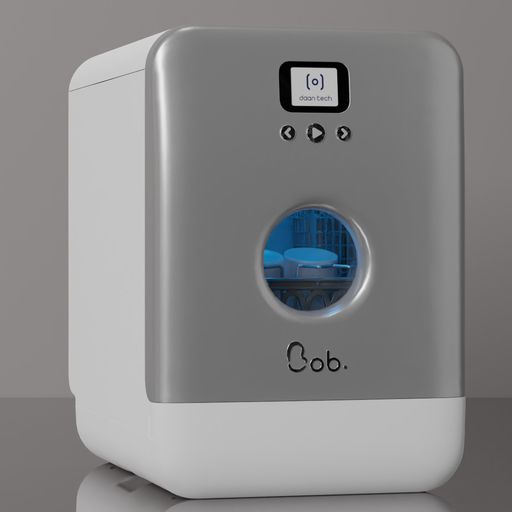 Image unavailable
This model is suitable for a one- or two-person household with a compact space and a properly planned drainage route.
Stated capacity of 3 place settings; stated dimensions of 49 × 34 × 49 cm. Daan Tech states that Bob has an integrated tank, front filling and a noise level of 43 dB.
Capacity is limited, so check that the drain hose is compatible with your sink or container. The manufacturer specifies a 1.5 m hose and a pump with a stated maximum height of 1.20 m.
 Image unavailable
An option to consider for a rented kitchen or one without a fixed water supply, provided you confirm the drainage arrangement before buying.
Integrated 5 L tank, manual filling, stated capacity of 3 place settings, stated dimensions of 420 × 435 × 435 mm and 6+3 programmes.
Consult the manual for the hose length, permitted pumping height and drainage point. Also allow enough room for the door, hose and ventilation.
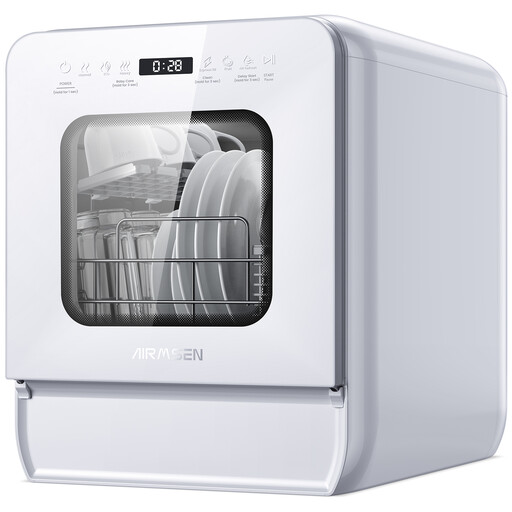 Image unavailable
Its slim format may suit a kitchen without a fixed water supply, after checking the available depth and drainage arrangement.
Integrated 5 L tank, stated capacity of 4 place settings, stated width of 37 cm, stated depth of 51 cm and 9 programmes.
The 51 cm depth may limit placement on a shallow worktop. Check the supplied hose, available drainage, voltage and the model’s safety instructions.
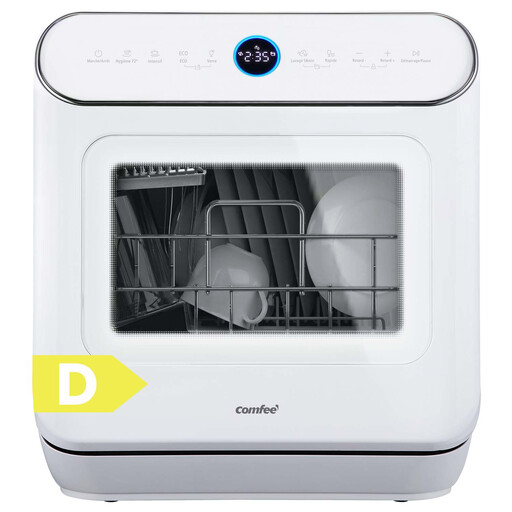 Image unavailable
This format is designed for a small load for one or two people in a home where the tank can be filled manually.
Stated capacity of 3 place settings, stated dimensions of 420 × 436 × 465 mm, 7 programmes, touch controls and a delay start of up to 24 hours.
Before installation, check that the drain hose is present, confirm its length and fixing point, and review the model’s specific requirements for power supply and ventilation.
No. The tank supplies clean water, but waste water must still be drained away. For Bob, Daan Tech specifies a 1.5 m drain hose and states that it can drain into a sink or a container larger than 5 L; for the Moulinex Studio MINID3SL, a French product listing states that it drains directly into the sink. In France, kitchen waste water is classed as grey water within domestic sanitation, according to Service-Public.fr.
An appliance rated for 3 place settings is mainly suitable for a small daily load for one or two people. It may be less suitable if you cook frequently, regularly entertain or need to wash large saucepans. In that case, check the internal dimensions, the maximum plate diameter and the manual for the exact model.
Check the voltage, power rating and instructions in the manual for the exact model before buying. For example, Bob is specified at 220-240 V, 50 Hz and 1,000 W; the Moulinex manual states that the ventilation openings must not be obstructed and that leaving the door open may create a tipping risk.
Use the energy label and check the reference programme. ADEME states that it shows, among other details, energy consumption per 100 cycles, water use per cycle, capacity, eco-cycle duration and noise class. The eco programme is often used as the reference, so do not compare this figure directly with one taken from an express programme.