Renters without a permanent water supply
A tank means you don't need to connect the water supply every time you use the dishwasher. You still need to plan for draining, find a suitable surface and make sure the installation works in your home.


A mini dishwasher with a water tank can suit a small kitchen without a permanent water supply, provided you can fill it, position it correctly and drain the wastewater in line with the instructions. If you can temporarily use a tap and a drain, check that a plumbed-in model is compatible with your setup. A compact dishwasher with a direct water connection is another option if the necessary connections are available, but it takes up more space.
A tank means you don't need to connect the water supply every time you use the dishwasher. You still need to plan for draining, find a suitable surface and make sure the installation works in your home.
The key question is whether the compartment can hold the dishes you use between cycles, especially everyday plates and utensils. A larger capacity could mean fewer cycles, as long as you have the space and water supply it requires.
For models with an energy label, details on water and energy use, Eco programme duration, capacity and noise make it easier to compare specific criteria, as the European Commission explains.
Start with the water supply and drainage, as well as the space available. An appealing capacity or programme won't make a dishwasher practical if you can't arrange somewhere for the water to drain.
| What to consider | What to check | Who should consider it? |
|---|---|---|
| Water supply and drainage | How the instructions say to fill the appliance; the route and secure positioning of the drain hose to a suitable outlet. | Without a fixed water supply, I need to be able to fill the appliance and drain the wastewater from where it stands. For around 42% of consumers, this is the top priority. |
| Capacity and size | Number of place settings, the space the appliance takes up and the dimensions of the dishes you actually use. | If I cook often, a small compartment could mean more cycles or having to wash my larger utensils separately. Around 33% of consumers prioritise capacity and how often they need to run a cycle. |
| Water, energy and noise | On the energy label for the model: water per Eco cycle, energy per 100 cycles, Eco programme duration, capacity and noise. | In a small kitchen, I want to check consumption, Eco cycle duration and noise before choosing between appliances that already meet my installation and capacity needs. This balance is a top priority for around 25% of consumers. |
The European Commission explains that the energy label for the household dishwashers covered includes details such as energy use per 100 cycles, water per Eco cycle, the duration of that programme, capacity and noise emissions. When comparing two models, use the same programme and units: these figures don't automatically describe their quick cycles.
A tank removes the need for a fixed water supply, but you still need to drain the wastewater. Daan Tech, for example, uses a drain hose for its Bob model.
Before buying, work out where the wastewater can go and check the hose route and how to secure it in the instructions. If you can't arrange drainage in a way that follows the instructions, don't choose this type of installation.
The stated capacity alone won't tell you whether your plates, glasses and pans will all fit in the rack together. A larger appliance also takes up more worktop space and may need a direct water connection.
Measure the dishes you wash regularly and compare them with the dimensions the model can accommodate. Then work out how many cycles you'd need based on your mealtime routine.
The consumption figures on the energy label relate to the Eco programme; they don't tell you how much a quick programme uses.
First compare the label figures on a like-for-like basis, then look separately at the duration and features of any other programmes you're interested in.
With Bob, Daan Tech offers a freestanding mini dishwasher that can use either its built-in tank or a water supply, depending on the setup you choose.
Candy's Rapidò range includes tabletop dishwashers, such as the CP 6E51LW, which connects directly to the water supply.
Bosch provides product-specific details and installation information for its compact dishwashers.
This tabletop model offers manual filling for kitchens without a permanent water supply. It's only suitable if you can arrange drainage and follow the manufacturer's installation instructions.
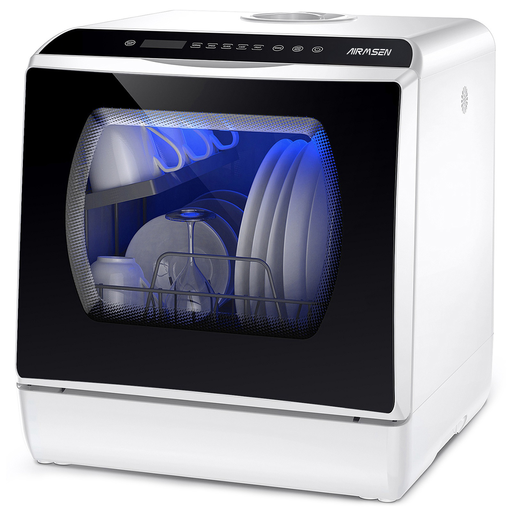 Image unavailable
Worth considering if you'd rather fill the appliance by hand than connect it to a permanent water supply. The model name indicates a built-in 5 L tank and 5+1 wash cycles. Before deciding where to put it, check the instructions for how to arrange wastewater drainage and any installation requirements.
Yes, if the model is specifically designed to be filled this way, but you'll still need to drain the wastewater. For Bob, Daan Tech describes drainage via a hose. Check that the drain and hose fixing are suitable for the instructions for your chosen model.
Check the overall dimensions, door clearance, hose route and whether the surface can support the appliance. Daan Tech lists Bob's dimensions as 34 × 49 × 49 cm and says that a wall shelf used as a support must be able to bear a minimum load of 25 kg. These details apply to this model only.
For the household dishwashers covered, the European Commission lists details including the energy class, energy use per 100 cycles, water per Eco cycle, Eco programme duration, capacity and noise. Compare these figures on a like-for-like basis, and don't assume they apply to a quick programme.