Anyone who wants to count the pieces
If you want to portion chocolates out over the week, look for a stated number of pieces and, if possible, their weight. This helps you plan how many to have without assuming that smaller means lower in sugars.


For your weekly shop, choose mini chocolate figures or bites with a stated piece count if you want to portion them out; opt for an assortment if you’re mainly buying to share. Either way, compare the sugars per 100 g and check the ingredients and allergens for the exact product, as a small piece isn’t necessarily low in sugars.
If you want to portion chocolates out over the week, look for a stated number of pieces and, if possible, their weight. This helps you plan how many to have without assuming that smaller means lower in sugars.
An assortment lets you offer a choice of recipes at home or to guests. Before choosing one, though, check the ingredients and allergens for each product.
Compare sugars and saturated fat per 100 g, then check the ingredients list and allergen information. These details matter more to your choice than the word “mini” on its own.
For your weekly shop, start with how you plan to use them: portioning out individual pieces, checking the ingredients or buying for several people.
| Criteria | What to check | Who is it for? |
|---|---|---|
| Easy-to-count portions | Number of pieces and net weight; weight per piece, if stated. | If I want to spread my chocolates over several days, I need to be able to count the pieces without guessing their size; around 42% of consumers prioritise this. |
| Ingredients and allergens | Sugars and saturated fat per 100 g; ingredients and allergen information for the exact product. | If the ingredients or allergens guide my purchase, I need to read the label on the product I’ve chosen; this is the top priority for around 33% of consumers. |
| Sharing and variety | Number of bites and recipes in the assortment. | When buying for a group, I want enough pieces or a range of recipes to offer; sharing is the top priority for around 25% of consumers. |
The size helps you count the pieces, but it doesn’t tell you how much sugar they contain.
Use the piece count to plan portions, then compare the “of which sugars” figure per 100 g.
In France, displaying the Nutri-Score is voluntary, as the Ministry of the Economy explains. Its absence doesn’t mean you can skip checking the nutrition information.
Compare the nutrition table and ingredients list, whether or not the logo appears on the packaging.
Ingredients vary between recipes, including within the same assortment.
Check the allergen information and any “may contain” statements on the packaging of the exact product.
The levy described by Légifrance applies to drinks and liquid preparations intended for human consumption, not solid chocolates.
When choosing a bag of chocolates, focus your comparison on its quantity and labelling.
Lindt offers seasonal mini chocolate figures and assorted Lindor bites.
Carrefour lists 200 g packs of Ferrero Rocher bites made with milk chocolate, hazelnuts and wafer.
Auchan offers Côte d'Or Mini Bouchées milk chocolate bites in a bag of 21 pieces, weighing 197 g.
E.Leclerc lists Équador praline clusters and wafer bites.
These Advent calendars are designed for opening a chocolate each day. For your weekly shop, consider whether this format suits you better than a bag of bites that you can portion out freely.
 Image unavailable
A way to enjoy chocolates over Advent, rather than serving an assortment to share. The calendar contains 65 g of chocolate; check the packaging for the weight of each piece, sugars and allergens if these factors matter to your purchase.
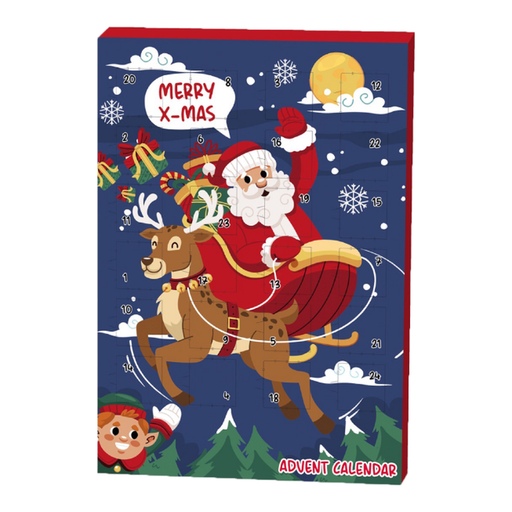 Image unavailable
A way to enjoy a chocolate each day throughout Advent. The calendar contains 50 g of chocolate; if the amount per piece matters to you, check this on the packaging, along with the sugars and allergens.
No. The levy defined by Légifrance covers drinks and liquid preparations intended for human consumption; it doesn’t apply to a bag of solid chocolates.
No, displaying it remains voluntary in France, according to the Ministry of the Economy. To compare prepacked chocolates, check the nutrition declaration, which is compulsory for most prepacked foods under DGCCRF rules, particularly the values per 100 g.
Compare the sugars and saturated fat per 100 g, then check the net weight and number of pieces. This second check helps you plan quantities, but doesn’t replace comparing the nutritional information.
Before buying, check the ingredients list, allergen information and any “may contain” statements for the exact product. The ingredients in one bite may differ from those in another recipe in the same assortment.