To serve with crêpes, bread or biscuits at a festival, choose chocolate spread in a mini pot or individual portion, and make sure you have something to serve it on and a utensil to spread it with. If you want to hand out a snack that can be eaten without spreading, an individually wrapped wafer is a different option. In either case, check the allergens and nutritional information for the product you buy. According to the DGCCRF, Nutri-Score is voluntary in France.
Who are these formats for?
Food stall organisers
If you’re serving a topping with bread, crêpes or biscuits, mini pots and food-service portions make it easy to serve the spread without passing around a large jar. Make sure you have something to serve it on and utensils, and check the allergens for each product.
Festival-goers without utensils
If you want a bite to take away without needing a knife or something to spread it on, an individually wrapped wafer could be a good option. However, Nutella B-ready is a filled wafer, so it won’t replace the chocolate spread needed at a crêpe or toast stall.
Shoppers comparing ingredients
If ingredients and nutritional values are important to you, compare the figures per 100 g first, then check the amount in each unit. The DGCCRF states that nutritional information is compulsory for most pre-packed foods in France, unlike Nutri-Score, which is voluntary.
What should you check for a festival?
First decide whether you need something to spread or simply a ready-to-eat snack to hand out. Then check each recipe and its packaging.
| Criteria |
What to check |
Who is it for? |
| Serving format |
Tell the difference between chocolate spread in a pot or tub and a wafer that’s already filled; check the weight per unit. |
If I’m serving crêpes or bread, I need a portion I can actually spread. Around 33% of consumers put this need for a spreadable product first. |
| Nutritional information |
Compare the figures per 100 g, particularly sugars, fat and salt. Also check the per-unit figures if they’re shown on the packaging. |
If I’m choosing between different recipes or portion sizes, I want to be able to compare their nutritional values on a like-for-like basis. This is the top priority for around 27% of consumers. |
| Allergens |
Read the ingredients, highlighted allergens and any ‘may contain’ warnings on the product you buy. |
When I’m handing out portions to a group, I need to know what each recipe contains before serving it. Checking allergens comes before other criteria for around 27% of consumers. |
| Quantity and packaging |
Check the number of units, their weight and how much packaging you’ll need to deal with after serving. |
To organise distribution, I’m looking for enough portions for the number of people I expect, without creating unnecessary packaging. Around 13% of consumers prioritise managing quantities and packaging. |
Which common mix-ups should you avoid?
-
Mistaking a filled wafer for a spreadable portion
Nutella B-ready is a snack to eat as it is. Its filling isn’t suitable for topping crêpes, bread or biscuits.
Decide how you’ll serve it at your stall before choosing between spread and a ready-to-eat bite.
-
Using Nutri-Score as your only criterion
According to the DGCCRF, displaying Nutri-Score is voluntary in France. You can still compare a product without the logo using its nutritional information, which is compulsory for most pre-packed foods.
If the products you’re comparing display Nutri-Score, consider it alongside the ingredients and figures per 100 g, then check the amount in each portion.
-
Assuming individual packaging means there’s no risk from allergens
An individually wrapped portion still contains the allergens in its recipe. Nutella France lists hazelnuts, milk, soya, wheat and barley among the ingredients in B-ready.
Read the label on the batch you’re handing out, and avoid sharing utensils and surfaces between recipes when allergies are a concern.
-
Assuming organic means a particular nutritional profile
E.Leclerc’s product listing for the 350 g Bio Village chocolate spread displays a Nutri-Score E, while noting that the logo is based on the previous calculation, before April 2025. Organic certification and the score describe different characteristics.
Check the ingredients and nutritional values separately. If a Nutri-Score is displayed, also check which version applies to the product you’re buying.
Brands and formats to know
These examples come in different formats, so check that the one you choose suits the way you plan to serve it.
Nutella
Nutella France describes B-ready as an individually wrapped filled wafer. Ferrero Food Service France separately offers 25 g pots of chocolate spread and 15 g tubs for food service.
- The two ranges serve different purposes: a ready-to-eat snack or spread to serve with something.
- Food Service formats are aimed at professional customers, so don’t confuse their purchasing channel with that of a mini pot sold in shops.
100 % Natu
Carrefour lists a weekly set of chocolate spread comprising 7 mini pots of 30 g, 210 g in total.
- The pots let you hand out separate portions while still offering a spreadable product.
- Before handing them out to a group, check the ingredients, allergens and nutritional information on the packaging of the product you choose.
Nustikao
E.Leclerc lists a 1 kg pot of Nustikao chocolate and hazelnut spread, which is better suited to a properly equipped serving area than to handing out snacks on the go.
- E.Leclerc’s product listing provides nutritional values per 100 g and displays a Nutri-Score E.
- The pot doesn’t separate the portions. The listing highlights hazelnuts, milk and lactose, and also mentions possible traces of other nuts and soya.
Bio Village
E.Leclerc lists a 350 g pot of organic Bio Village hazelnut spread.
- This format could work if you’re organising the service yourself from a pot.
- The listing displays a Nutri-Score E based on the previous calculation, before April 2025, and mentions possible traces of peanuts, cereals containing gluten and other nuts.
ALDI BIO
ALDI France lists a 350 g pot of organic chocolate spread labelled ‘no palm oil’.
- The pot is suitable for an organised serving area if you plan ahead for utensils and portioning.
- The ‘no palm oil’ claim doesn’t tell you about allergens or nutritional values, so read the label on the product you choose.
A Joybuy option for individual snacking
This selection is a filled wafer to hand out as a snack, with no topping to add and no utensil needed. It isn’t a portion of chocolate spread for serving with crêpes or toast.
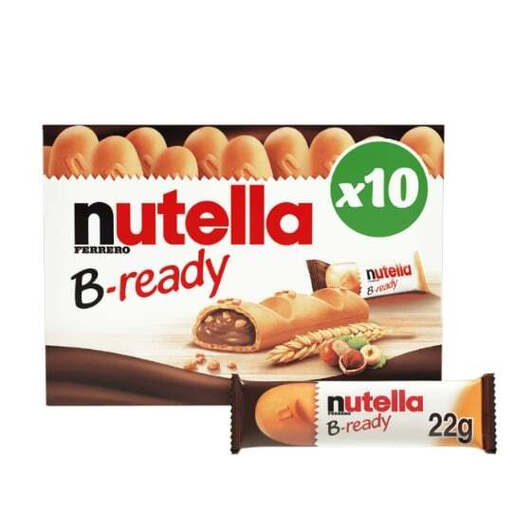 Image unavailable
Nutella B-ready, 10 × 22 g
Worth considering if you want to hand out individual snacks without having to spread anything: the pack contains 10 wafers of 22 g each, 220 g in total.
These are filled wafers, not spread. The recipe contains hazelnuts, milk, soya, wheat and barley. Check the label on the pack before serving them to festival-goers.
View on Joybuy
Frequently asked questions
Is Nutri-Score compulsory on chocolate spread in France?
No. The DGCCRF states that Nutri-Score is voluntary, while nutritional information is compulsory for most pre-packed foods. Compare the figures per 100 g even if there’s no logo.
What should I check before handing out portions to a group?
Read the ingredients, highlighted allergens and any ‘may contain’ warnings on the pack you’ve bought. Nutella B-ready contains hazelnuts, milk, soya, wheat and barley, among other ingredients. Don’t assume another wafer or chocolate spread has the same ingredients.
Mini pot, tub or wafer: which one can I use to top a crêpe?
Choose chocolate spread in a mini pot or tub, and have a utensil ready to spread it on the crêpe. A filled wafer is a ready-to-eat snack, not a portion of spread.
Which date should I check on the packaging?
Follow the date shown on the product you’ve bought and its storage instructions. According to the DGCCRF, pre-packed food labelling must show a use-by date for highly perishable foods that can pose a microbiological risk, or a best-before date for other products.


