Anyone planning their race-day fuel
You want to know how many carbohydrates you’ll get from what you take with you on a long run or for a marathon. The amount you actually eat matters more than the word “mini” on the packaging.


For a snack around marathon time, an easy-to-measure portion of spread is more practical than a large jar, but a small jar is not necessarily a single serving. Don’t treat this spread as a complete source of fuel during a race: Nutella France states that its 15 g reference serving contains 8.6 g of carbohydrates, while a review cited on PubMed refers to 30 to 60 g of carbohydrates per hour for exercise lasting 1 to 2.5 hours. These figures do not describe the 25 g portion featured below, so check its label before including it in your race plan.
You want to know how many carbohydrates you’ll get from what you take with you on a long run or for a marathon. The amount you actually eat matters more than the word “mini” on the packaging.
You’re after a little spread to enjoy around your training, without taking a large jar with you. A small jar means buying less, but you’ll still need to measure each serving.
Before choosing, you check the sugars, fat, ingredients and allergens for the exact product, rather than relying on the pack size or brand alone.
First decide whether you want a snack to take with you or something to count towards your fuel during exercise. Then compare the amount you’ll actually eat and the label for each product.
| Criteria | What to check | Who it matters to |
|---|---|---|
| Carbohydrates during exercise | The carbohydrates in the portion you’ll actually take with you, and how it might fit into your planned race fuel. Don’t apply the values for a different pack size to the product you’ve chosen. | If I’m relying on this spread during a race, I want to be able to calculate what each serving provides, without assuming it will meet all my needs on its own. Around 42% of consumers may put this measurable contribution at the top of their list. |
| Pack size and serving | The product’s weight, whether it comes in individual portions and how much you plan to eat. A 200 g jar still needs to be portioned out. | For a snack around training, I’d rather take a set amount than open a jar and guess how much I’ve put on. Portion control would be the top priority for around 33% of consumers. |
| Recipe and allergens | The nutritional information per 100 g and for the portion you’ll eat, as well as the ingredients and allergens for the exact product. | When I compare two spreads, the sugars, fat and ingredients can influence my choice, especially if I need to avoid an allergen. Around 25% of consumers may consider the recipe and allergens their main criteria. |
The product listing for Auchan’s 200 g jar says it does not come in individual sachets. So the jar’s weight doesn’t tell you how much you’ll take each time.
If you want a set portion, look for individual packaging or measure out the amount you plan to take in advance.
According to Nutella France, 15 g of Nutella provides 8.6 g of carbohydrates. For context, a review cited on PubMed refers to 30 to 60 g of carbohydrates per hour for exercise lasting 1 to 2.5 hours. These figures relate to different amounts and neither represents a complete marathon fuelling strategy.
If you’re thinking of eating spread during exercise, check the carbohydrates in the exact portion and try out your fuelling plan in training rather than on race day.
According to the French Ministry of the Economy, Nutri-Score remains voluntary. The DGCCRF distinguishes this logo from the nutrition declaration required for the relevant prepacked foods.
Whether or not a product displays the logo, compare the nutritional values per 100 g, particularly sugars and fat, and consider the portion you’ll eat.
Nutella France’s information lists hazelnuts, milk and soya; the Auchan listings mentioned here relate to different recipes. The words “chocolate and hazelnut” aren’t enough to establish the full ingredients of a particular product.
If you have an allergy, check the ingredients list and allergen information on the exact pack before eating it.
Nutella France offers jars of spread and, separately, Nutella & Go, a snack to take away with cereal sticks.
Carrefour’s range includes a 400 g jar of Carrefour Classic' hazelnut, cocoa and vanilla spread.
Auchan’s range includes cocoa and hazelnut spreads in 200 g and 400 g jars, as well as a 400 g organic option.
This selection features a 25 g portion of chocolate and hazelnut spread for a small snack to take with you. The pack size alone doesn’t tell you how many carbohydrates it would provide during a race.
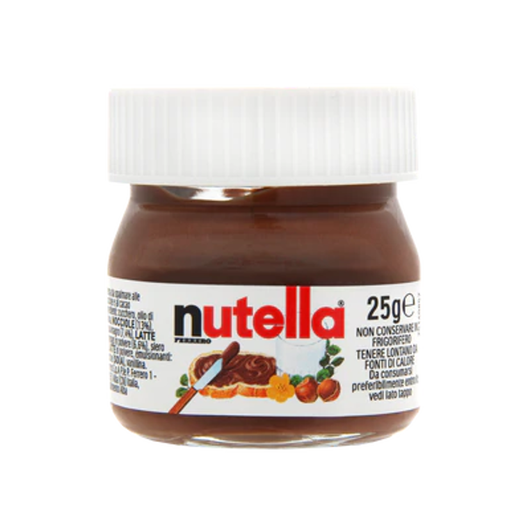 Image unavailable
This 25 g pack is ideal if you want to take a set amount of spread with you for a snack around your workout.
To work out how it might fit into your race fuel, check the carbohydrates and sugars on the label for this 25 g product. Check the ingredients and allergens too.
It shouldn’t be treated as a complete source of fuel on its own. Nutella France states that 15 g of its product provides 8.6 g of carbohydrates, while a review cited on PubMed refers to 30 to 60 g of carbohydrates per hour for exercise lasting 1 to 2.5 hours. If you want to take some with you, check the carbohydrates in your exact portion and try it during training.
No: the weight of the jar doesn’t determine how much you eat. The listing for Auchan’s 200 g jar states “Individual sachets: No”. If you want a set amount, check the packaging or measure out your portion.
No. According to information from the French Ministry of the Economy dated July 2025, displaying Nutri-Score is voluntary. The DGCCRF notes that nutrition declarations have been mandatory for the relevant prepacked foods since 13 December 2016. Use them to compare the values per 100 g and for the portion you’ll eat.
No. The provisions set out by Légifrance in September 2026 apply to drinks and liquid preparations for drinks intended for human consumption, not to spread. It’s still worth checking the amount of sugars on the label when comparing products.
Check the information for the exact product rather than guessing its ingredients from the name. Nutella France’s information lists hazelnuts, milk and soya, among other things; ingredients and allergen information may differ in other recipes.