Who are these formats for?

Parents who want a clearly identifiable portion

A small pastry or an individually wrapped one makes it easier to see what you’re serving, but doesn’t tell you what it contains. To compare two products, also check the weight of each pastry and the nutritional values per 100 g.

Parents who pay close attention to ingredients

If you’re choosing between several recipes, compare the sugars, fat, saturated fat and salt rather than relying on terms such as “mini” or “all-butter”. The DGCCRF explains that nutrition information for prepacked foods is generally given per 100 g.

Families concerned about allergens

Check the ingredients for the exact product you’re considering: the Carrefour and Auchan product pages reviewed here list wheat, milk, eggs and soya, among other ingredients. For unpackaged pastries, ask for allergen information before buying.

What should you check before choosing?

To compare the options, consider the product’s ingredients, how much you’ll serve and what you need to check about allergens.

What matters What to check Who it matters to
Nutritional composition Compare sugars, saturated fat and salt per 100 g, then relate those figures to the portion you’ll serve. For an occasional breakfast, I want to check the ingredients rather than assume anything from the word “mini”; around 42% of consumers would put this first.
Portion and preparation Check the weight of each pastry and whether it’s ready to eat or needs baking. When mornings are rushed, I look for an easy-to-serve amount and a preparation method that fits the time I have; portion size and convenience would come first for around 33% of consumers.
Allergens Read the ingredients and any “may contain” statements. For unpackaged products, ask the seller for the information. If a recipe needs to be avoided because of an allergen, I need to know what’s in it before serving it; this would be the main concern for around 25% of consumers.

Common misconceptions to avoid

  • Assuming “mini” means a different nutritional composition

    A small pastry makes it easier to control the amount you serve, but its name doesn’t tell you how much sugar, saturated fat or salt it contains.

    Compare the values per 100 g and, where shown on the label, per pastry. Then take account of the amount you’ll actually serve.

  • Choosing based on the Nutri-Score alone

    According to the DGCCRF, displaying the Nutri-Score is voluntary. Whether it appears or not, you should still read the nutrition information and ingredients.

    If it’s displayed, use it as one guide among several and compare the nutrition information for the products you’re considering.

  • Assuming all chocolate pastries have the same recipe

    The Carrefour, Auchan and Bridor product pages list several allergens, but their recipes and “may contain” information aren’t necessarily the same.

    Check the label on the product you buy or ask for allergen information for an unpackaged pastry, especially if you know your child has an allergy.

  • Confusing “ready to bake” with “ready to serve”

    Bridor’s 40 g mini chocolate pastry needs to be defrosted, baked and cooled before serving.

    If you need a pastry that’s ready to eat straight away, check the preparation instructions before you buy.

    Preparation takes time and requires an oven.

Brands to know, depending on the format

Carrefour

Carrefour offers a Mini All-Butter Chocolate Pastry, sold individually in its bakery section.

  • The product page lists the ingredients, including wheat, milk, soya and eggs.
  • If nutrition information is important to your decision, check the product details in store or on the packaging.

Auchan

Auchan offers a pack of 16 individually wrapped chocolate pastries, each weighing 45 g.

  • The product page lists the ingredients, allergens and nutritional values per 100 g and per 45 g pastry.
  • The portion is easy to identify, but this product isn’t described as a mini bite-sized pastry.

Bridor

Bridor’s professional catalogue lists a 40 g mini chocolate pastry that’s ready to bake, ref. 40261.

  • The product page gives the format, ingredients and preparation steps.
  • This product needs to be defrosted, baked and cooled. Its professional product page doesn’t describe a family-sized supermarket purchase.

A product to consider on Joybuy

This pack of chocolate pastries, which need baking, makes it easy to count how many you serve. Check their size if you’re specifically looking for mini pastries for a toddler’s breakfast.
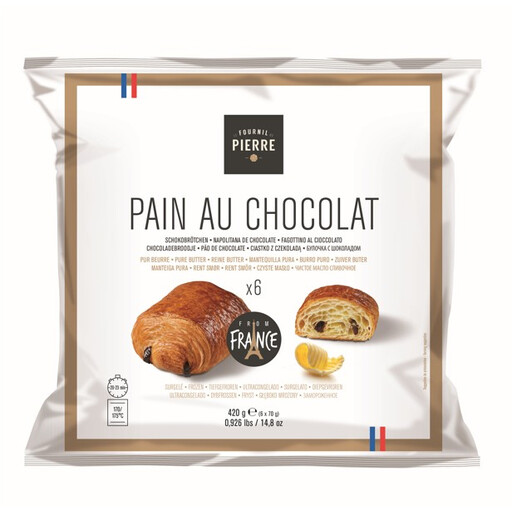
Pack of six Fournil de Pierre chocolate pastries to bake, 420 g

Fournil de Pierre, chocolate pastries to bake x6, 420 g

The six pastries in the pack make it easy to count how many you plan to serve. The total pack weight is 420 g. If you’re looking for a small portion, check the size and weight of each pastry, as well as the ingredients and allergens, before offering one to your child.

View on Joybuy

Frequently asked questions

Is one mini chocolate pastry enough for a toddler’s breakfast?

Don’t treat it on its own as a replacement for your child’s usual breakfast. Assurance Maladie recommends offering a varied diet and limiting sugar and fatty foods for children aged 8 months to 3 years. A pastry could be an occasional option, depending on your child and the rest of the meal.

Is the Nutri-Score compulsory on chocolate pastries?

No. In France, the DGCCRF says displaying the Nutri-Score is voluntary. Nutrition information is generally required for prepacked foods and allows you to compare sugars, fat, saturated fat and salt per 100 g.

Does the tax on sugary drinks apply to chocolate pastries?

No. The Official Bulletin of Public Finances describes a levy on certain non-alcoholic drinks, not pastries. When choosing a chocolate pastry, check the sugar content in its nutrition information instead.

How can you check the allergens in a pastry bought from a bakery?

Ask for allergen information before you buy. French regulations require consumers to be informed when specified allergenic substances have been used and remain in the final food. If you know your child has an allergy, also check any relevant information about handling and traces.

Does the term “all-butter” help you choose a pastry for a toddler?

It describes one feature of the recipe, but isn’t enough to assess the portion or the overall composition. Compare the nutrition information, ingredients and allergens for the specific product you plan to buy.