Managers of busy coffee services
A bite-sized treat that’s easy to hand out, with a clearly stated number of pieces, makes it easier to organise service and replenishment.


For frequent coffee service, start by choosing a format with a per-piece weight and unit count that make it easy to plan portions and replenishment. An assortment gives you a choice of recipes, but you’ll need to check the allergens for each one. A mini bar in a single flavour makes the choice on offer simpler, but you’ll still need to check its allergens.
A bite-sized treat that’s easy to hand out, with a clearly stated number of pieces, makes it easier to organise service and replenishment.
An assortment means you don’t have to serve the same mini bar every time, provided you can identify the ingredients and allergens in each recipe.
If customers can’t see the outer packaging, staff need to be able to find the information for the exact products being served, particularly their ingredients and allergens.
For hotel coffee service, start with the portion you want to serve, then check the food information and packaging. The word ‘mini’ alone doesn’t tell you how much each piece weighs.
| What matters | What to check | Who it matters to |
|---|---|---|
| Portion and service frequency | Weight per piece and number of units in the pack. | When coffees are being served one after another, I want to offer a consistent amount and plan how many pieces I’ll need. Around 42% of consumers would make consistency their top priority. |
| Allergens and product information | Ingredients and allergens for each recipe, and a way to find this information at the point of service. | If I offer several recipes, I need to be able to tell a customer which one they’re getting. Checking allergens would be the main concern for around 33% of consumers. |
| Variety and replenishment | Recipes included, net weight and number of pieces per bag or box. | To offer variety with coffee without making ordering more complicated, I look for packaging suited to the pace of service. Around 25% of consumers would prioritise this flexibility. |
Supplier EpiSaveurs describes 8 g and 8.5 g miniatures in a specific Mars assortment for professional use. These weights don’t apply to other bags labelled ‘mini’. A more conventional individually wrapped bar could also work if its portion suits the service you have in mind: compare the weight per piece rather than relying on the format name alone.
The number of pieces or total net weight won’t always tell you how much you’ll be serving with each coffee. The 8 g and 8.5 g miniatures described by EpiSaveurs are from its 3 kg Mars assortment.
Check the weight per piece and the number of units in the pack you choose before setting a serving policy.
Allergens can vary from one miniature to another. The Mars assortment described by EpiSaveurs and the Twix product listed by Joybuy don’t have interchangeable ingredient lists.
Keep the packaging or a product information sheet so staff can identify the recipe being served and its allergens.
According to Santé publique France, Nutri-Score is voluntary information that supplements the nutrition declaration. Its absence doesn’t, by itself, mean that mandatory nutrition information is missing.
To compare products, check the nutrition values, ingredients and portion for the exact product. Use Nutri-Score when it’s displayed, but don’t make it your only consideration.
Worth considering for a caramel and nougat mini bar or an assortment of several recipes.
A chocolate, caramel and peanut recipe found in the Mars assortments reviewed.
A single-recipe option combining biscuit and caramel; Joybuy lists, among other products, a bag of 15 minis.
An option if the hotel would like to offer a chocolate-covered wafer bar instead of a caramel and nougat recipe.
Retailer brands worth considering when comparing smaller packs and assortments.
These products are mini bars or chocolate bites in a single recipe. If you’re serving them with coffee, compare the number of pieces, the individual weight where stated, and the information for each specific variety.
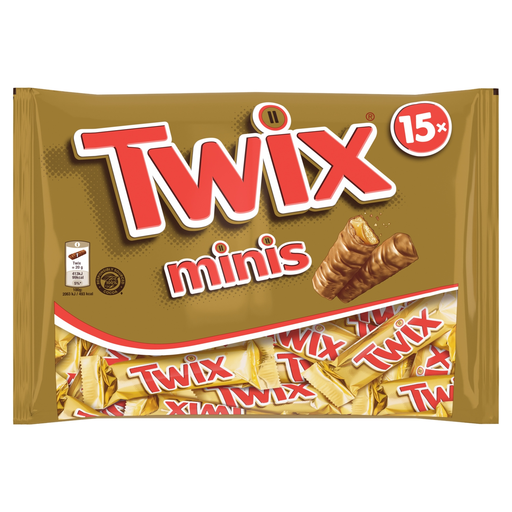 Image unavailable
This single-recipe product is suitable for service planned by the bag and contains 15 mini bars. The information for this variety lists wheat, milk and soya, and possible traces of nuts and other cereals containing gluten. Check the weight of each bar if you need to set a precise portion.
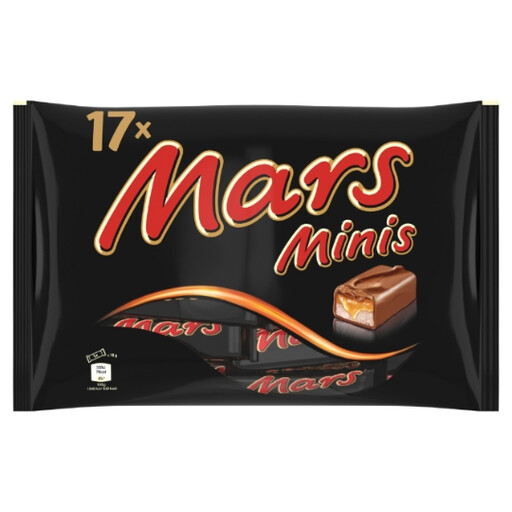 Image unavailable
This single-recipe bag is suitable for replenishment planned by pack. The product information states that it contains around 17 mini bars; check the number of pieces and their weight on the bag you receive. The information for this product includes milk, soya, barley and egg, with possible traces of peanuts and nuts.
 Image unavailable
The 9 individually wrapped pieces, each stated to weigh 11.6 g, make it easy to count the units for coffee service. This variety lists wheat, milk and soya. Check the labelling on the product you receive before comparing its sugar or saturated fat content with another product.
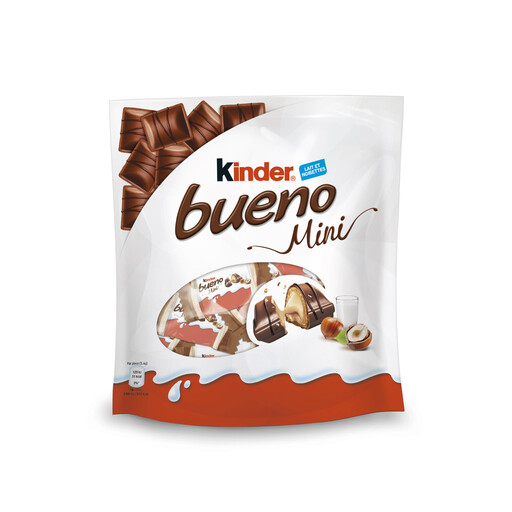 Image unavailable
These chocolate bites offer another recipe to serve with coffee. The bag weighs 108 g; check the number of pieces and their weight before planning service. The information for this product lists milk, hazelnut and soya, and possible traces of other nuts and wheat.
No. In France, a nutrition declaration is compulsory for prepacked foods, while Nutri-Score is voluntary additional information, according to Santé publique France and the DGCCRF. When comparing two products, also check their nutrition values and serving sizes.
The levy described by the French Ministry of the Economy applies to sugary drinks; that classification doesn’t mean it applies to mini chocolate bars. So don’t use the ‘soda tax’ as a factor when choosing these products.
Make sure you have a reliable way to match each product you serve with its food information, especially its allergens. Légifrance states that consumers and catering businesses must be informed about the presence of substances or products that can cause allergies or intolerances. Check the exact recipe before advising a customer.
A large assortment may suit a busy service that wants to offer several recipes, while a small bag makes it easier to try one recipe and replenish by pack. Compare the number of pieces, their weight and the recipes included, then make sure the allergen information for each one remains accessible.