Anyone following a specific recipe
If your recipe specifies a particular weight and type of chocolate, check the bar’s weight and cocoa content before measuring out the amount you need.


For a cake, start with the type of chocolate specified in the recipe and weigh out the amount you need. Mini bars are easy to portion, but their size doesn’t guarantee the same ingredients or cocoa percentage as baking chocolate. Check the ingredients and allergen information before substituting, too.
If your recipe specifies a particular weight and type of chocolate, check the bar’s weight and cocoa content before measuring out the amount you need.
Individually portioned bars can be convenient to split up. For a cake, you’ll still need to weigh them and compare their ingredients with those of the chocolate specified in the recipe.
If your cake needs to meet any ingredient or allergen requirements, check the information for the exact product, including any precautionary ‘may contain’ statements on the packaging.
First, choose the type of chocolate specified in the recipe, then check the quantity and product label for the chocolate you plan to use.
| What matters | What to check | Consumers concerned |
|---|---|---|
| Following the recipe | Check the type of chocolate and cocoa percentage specified, then weigh out the amount you need. | If I want to use the dark chocolate specified for my cake, its ingredients matter more than the size of the pieces. Around 42% of consumers put following the recipe first. |
| Portioning | Check the total weight and weigh the portions you use; compare their ingredients with those specified in the recipe. | If I only want to use part of the pack, I look for portions that are easy to separate without changing the amount I add. Portioning is the top priority for around 25% of consumers. |
| Ingredients and allergens | Check the ingredients, allergen information and nutritional values per 100 g for the exact product. | If my cake needs to take an ingredient or allergen into account, I need to check exactly what the bar contains. This comes before other criteria for around 33% of consumers. |
Carrefour’s product listing describes Milka Mini Tablettes as chocolate bars for snacking, not as chocolate intended for baking. Individually portioned bars won’t necessarily give you the same result in a cake.
Before swapping them for the chocolate specified in the recipe, weigh the portions and compare the type of chocolate, ingredients and allergen information.
According to the European Commission, displaying nutritional information on the front of packaging isn’t compulsory under current EU rules. Nutri-Score, recommended in France by the Ministry of Health, doesn’t replace the nutrition declaration.
Whether or not it’s displayed, check the nutritional values per 100 g, ingredients and allergen information.
The scope of the levy described by Légifrance covers drinks and liquid preparations for drinks, not solid chocolate bars.
If sugar content matters to your choice, check the bar’s nutrition declaration rather than relying on this levy.
Lindt describes its Dessert range as suitable for baking, including dark chocolate bars with 51% and 70% cocoa.
Auchan’s baking chocolate range includes several types of Nestlé Dessert bars, including a 205 g dark chocolate bar and 170 g variants.
Carrefour’s product listing describes a 200 g dark Dessert bar containing at least 52% cocoa.
According to the Carrefour listing consulted, Milka Mini Tablettes comes in a pack of 8 bars weighing 200 g in total.
Carrefour lists Côte d’Or L’Original milk chocolate in a pack containing two 200 g bars.
These two Nestlé Dessert bars are for recipes using dark or white chocolate respectively. Choose the type specified for your cake: don’t assume either one is a mini format without checking the packaging.
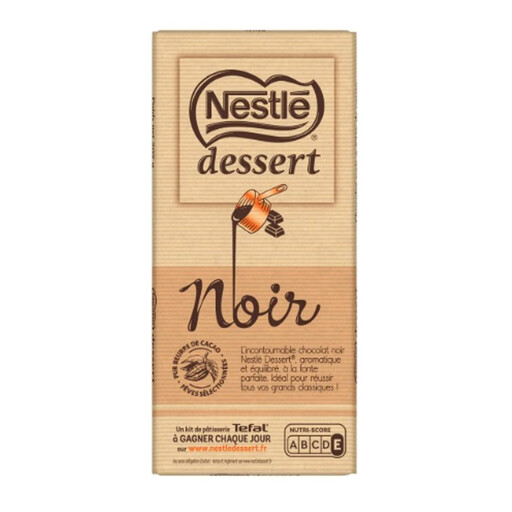 Image unavailable
Worth considering for a cake recipe that calls for dark chocolate intended for baking.
205 g bar. If your recipe specifies a cocoa percentage, check the packaging for this product before using it, and weigh out the amount you need.
 Image unavailable
Worth considering if your recipe calls for white chocolate, but not as a direct substitute for dark chocolate.
170 g bar containing milk; may contain traces of egg, gluten and nuts. Check the exact packaging if this information matters to your choice.
Yes, if their type of chocolate and ingredients are suitable for the recipe, and you weigh out the amount required. Carrefour’s listing describes Milka Mini Tablettes as chocolate bars, but doesn’t say they’re equivalent to a baking chocolate bar.
Read the ingredients list and allergen information on the packaging for the exact product, including any precautionary ‘may contain’ statements. This information varies between the Lindt, Carrefour and Milka products described here.
No. The European Commission says that displaying nutritional information on the front of packaging isn’t compulsory under current EU rules; France’s Ministry of Health describes Nutri-Score as a recommended scheme. Check the nutrition declaration, ingredients and allergen information as well.
Not to a solid bar: the scope of the levy described by Légifrance covers drinks and liquid preparations for drinks. To find out how much sugar a bar contains, check its nutritional information.