Who are these formats for?

People who want to keep track of their portion

It’s easier to count individual pieces than to measure out a portion from a large bag. As a guide, Carrefour and Auchan list Harrys Mini Tressée at 35 g per piece. However, the number of pieces you eat determines the total amount.

People putting together a savoury lunch

Auchan’s La Fournée Dorée mini sandwich rolls come pre-sliced and ready to fill. This format lets you choose what goes into your lunch, unlike a sweet brioche that’s ready to eat.

People comparing recipes

If sugar, fat or ingredients influence your choice, compare the per-100 g values of similar products, then check the amount per piece. Also check the allergens on the packaging of the product you buy.

What should you look for in store?

First, distinguish between brioche that’s ready to eat and small rolls designed to be filled. Then, for each type, use the label information to work out what it means for the number of pieces you plan to eat.

What to consider What to check Who is this useful for?
Amount per piece The weight of one piece and how many pieces you plan to have for lunch. When I take brioche with me, I want to be able to count what I’m having without treating the whole bag as one portion. Around 40% of consumers would prioritise this way of measuring their portion.
Ingredients and nutritional values Sugars, fat and salt per 100 g in similar products, followed by the ingredients list and allergens. If I’m tempted by several recipes, I want to understand how they differ before choosing which one to eat. Around 30% of consumers would put the ingredients and nutritional values first.
Suitable for filling The size and shape of the roll, and what you actually plan to add to it. For a savoury lunch, I’m looking for a small roll to fill rather than a sweet brioche that’s ready to eat. This would be the main priority for around 30% of consumers.

Common mix-ups to avoid

  • Assuming ‘mini’ tells you about the nutritional value

    Weight and recipe vary from one product to another. For example, Carrefour lists Mini-Gâches Carrefour Original at 375 kcal and 15 g of fat per 100 g. Their small size alone doesn’t tell you what they contain.

    Compare the per-100 g values, then take the weight per piece and the number of pieces you’ll eat into account.

  • Making sweet brioche your entire lunch

    A portion that’s easy to count doesn’t determine what else is in your meal. Manger Bouger recommends, among other things, eating more fruit and vegetables and pulses, and cutting down on foods that are high in fat, sugar and salt.

    Decide what other foods you’ll have with your brioche, or choose a small roll to fill if you’re putting together a savoury lunch.

  • Guessing allergens from the format or brand

    Two products that look alike may have different recipes.

    If you have an allergy, check the ingredients and allergen information on the packaging of the product you buy.

  • Comparing ready-to-eat brioche with rolls to fill as if they had the same purpose

    A small roll needs filling and preparation; sweet brioche is ready to eat. So the number of pieces in a pack isn’t enough to compare these formats.

    First decide how you want to use it, then compare the weight and nutritional information of similar products.

Brands to know

Harrys

The range includes individually portioned Mini Tressées topped with pearl sugar. The sliced ‘Less Sugar’ brioche featured by Harrys is a different format.

  • Carrefour and Auchan list each Mini Tressée at 35 g, making the weight per piece a useful way to keep track of how much you eat.
  • Auchan lists 127 kcal and 6.1 g of sugars per 35 g piece. If you have more than one, remember to count each piece separately.

Carrefour Original

Mini-Gâches made with pure butter and crème fraîche come in a pack of eight, weighing 360 g in total, or 45 g per piece.

  • The individual pieces make it easy to count how many you choose.
  • Carrefour lists 375 kcal and 15 g of fat per 100 g. The mini size is no substitute for checking the nutritional values.

Epi d'Or

The brioche mini burgers featured by E.Leclerc are rolls to fill: eight pieces weighing 160 g in total, or 20 g each.

  • This format is suited to making small filled bites rather than buying sweet brioche that’s ready to eat.
  • The filling changes the nutritional profile of your lunch; the values for the roll alone don’t describe the finished bite.

A savoury option on Joybuy

These brioche bites are already filled and intended for a savoury meal. They’re not a replacement for sweet mini brioche that’s ready to eat, or an unfilled roll that you fill yourself.
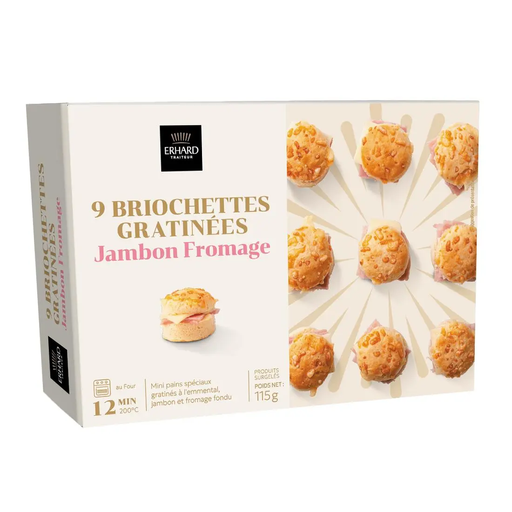
ERHARD brioche bites with ham and Emmental, pack of nine

ERHARD ham and Emmental brioche bites, x9, 115 g

A savoury lunch option made up of small, ready-filled pieces. The pack contains nine bites weighing 115 g in total; this total weight doesn’t determine how much you choose to eat.

Frozen product that must be cooked in the oven before eating. Follow the instructions on the packaging and check the allergen information there.

View on Joybuy

Frequently asked questions

Is a sweet mini brioche enough for lunch?

Its size makes it easy to count the pieces, but it doesn’t determine what else is in your lunch. Plan the other foods you’ll have with it. For a savoury lunch, a mini roll to fill lets you choose what goes inside. Manger Bouger recommends, among other things, making more room for fruit and vegetables and pulses.

Should I compare values per 100 g or per piece?

Use the per-100 g values to compare similar products, then check the weight and values per piece to work out how they fit the amount you plan to eat. For example, Carrefour and Auchan list Harrys Mini Tressée at 35 g and 127 kcal per piece.

Is the Nutri-Score enough to help me choose?

No. Santé publique France explains that displaying the Nutri-Score is voluntary. When choosing between similar products, also check the portion size, nutrition declaration, ingredients and allergens. The logo alone doesn’t tell you what your lunch will consist of.

What should I check if I have a food allergy?

Read the ingredients and allergen information on the packaging of the product you’re buying. Don’t assume you know what it contains from its small size or from another product by the same brand.