If you want to keep that milky taste while looking for a stronger cocoa flavour, compare organic milk chocolate bars that clearly state their cocoa content, particularly the 50% or higher recipes from Ethiquable. Choose organic dark chocolate if you prefer a less milky recipe, but don’t assume it contains less sugar: in either case, check the nutritional information per 100 g and the ingredients.
Who is this choice for?
Milk chocolate fans looking for more cocoa
You want to stick with a milk chocolate recipe, but compare options with a higher cocoa content. Ethiquable offers organic milk chocolate bars with 50%, 53% and 56% cocoa. The percentage helps you identify which recipes to compare, but doesn’t tell you how much sugar they contain.
Shoppers who care about organic certification and sourcing
You want to identify whether a bar is organic and, if it matters to you, distinguish a Fairtrade claim from organic certification. These labels address different questions from nutritional composition.
Shoppers who include chocolate in their organic shop
You’re looking for an option at your usual retailer. Carrefour Bio and Bio Village product pages list cocoa percentages you can compare; then check which product is available in your shop and read its label.
What should you look for?
When choosing between organic milk and dark chocolate, start with whether you prefer a milky recipe. Then compare the labels of products that match your preference: cocoa content alone doesn’t tell you how much sugar they contain.
| Criteria |
What to check |
Who it’s for |
| Cocoa content |
Check the cocoa percentage, then compare the sugar content per 100 g. Ethiquable offers organic milk chocolate with 50%, 53% and 56% cocoa. |
If I want more cocoa without giving up milk chocolate, the stated percentage helps me choose which recipes to compare. Around 42% of shoppers put this first. |
| Organic certification and sourcing |
Look for organic labelling; check separately for any Fairtrade claim. |
I first want to make sure the bar fits my organic shop, then decide whether the sourcing commitment matters to me too. This is the top priority for around 33% of shoppers. |
| Usual shop |
Check the pack size and whether the product is available in your shop. The Carrefour Bio and Bio Village product pages state at least 40% and 36% cocoa respectively for the milk chocolate bars in question. |
When I add a bar to my usual shop, I want to be able to find the product that meets my criteria. Around 25% of shoppers prioritise this convenience. |
Common misconceptions to avoid
-
Assuming “dark” tells you everything you need to know
The word doesn’t tell you the exact cocoa or sugar content of a bar. Organic milk chocolate bars from Ethiquable, Carrefour Bio and Bio Village list different cocoa percentages.
Compare the percentage stated on each product, then check its sugar, fat and energy content per 100 g in the nutritional information.
-
Thinking Nutri-Score has to appear on the packaging
In France, the DGCCRF states that displaying Nutri-Score is voluntary. Pre-packed foods are subject to separate rules on nutritional declarations.
If Nutri-Score is shown, treat it as additional information. To compare two bars, check their nutritional values per 100 g and their ingredient lists.
-
Confusing organic certification with nutritional composition
Organic certification relates to how a product is produced. On its own, it doesn’t tell you how much sugar or cocoa it contains; a Fairtrade claim relates to another criterion.
Check the organic label, any sourcing information and the bar’s composition separately.
Brands to consider
These products show different cocoa percentages among organic milk chocolates; their inclusion here doesn’t imply that they’re available on Joybuy.
Ethiquable
Ethiquable offers organic milk chocolate with 50%, 53% and 56% cocoa, as well as a Fairtrade commitment claimed by the brand.
- Several cocoa percentages are listed, making it easier to compare the milk chocolate recipes in the range shown.
- Check the ingredients, allergens and nutritional information for the specific bar you’re considering.
Carrefour Bio
The Carrefour Bio product page for a 100 g organic milk chocolate bar states a minimum cocoa content of 40%.
- The stated minimum percentage gives you a useful reference point for comparing this bar with other milk chocolate recipes.
- The product page warns that it may contain traces of nuts and cereals containing gluten; check the label on the bar you choose.
Bio Village
The Bio Village range featured by E.Leclerc includes organic milk chocolates with 30% and 36% cocoa.
- The stated percentages make it easy to tell these two milk chocolate recipes apart.
- If you’re looking for around 50% cocoa, check the percentage on the specific product you choose rather than relying on the range name alone.
An option on Joybuy
If you want to stick with milk chocolate while doing an organic shop, this selection features a 40 g hazelnut bar. If a high cocoa content is your priority, check the percentage for this specific product before choosing it.
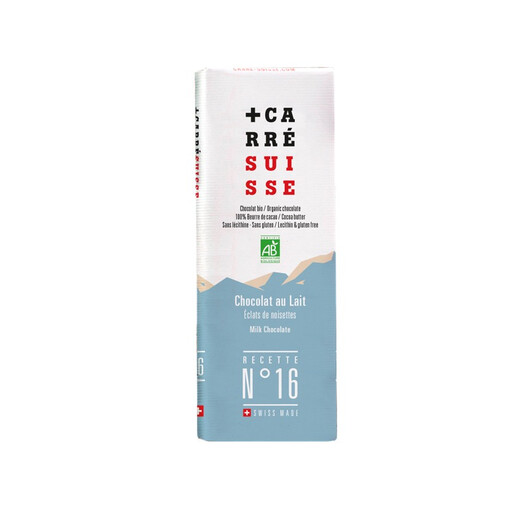 Image unavailable
CARRE Organic Milk Chocolate with Hazelnuts, 40 g
This 40 g bar is a good fit if you’re looking for hazelnut milk chocolate as part of an organic shop. To decide whether it also matches your preference for a high cocoa content, check the percentage on the packaging, along with the organic label, ingredients and nutritional values.
View on Joybuy
Frequently asked questions
Does organic milk chocolate have to display a Nutri-Score?
No. In France, the DGCCRF says Nutri-Score is voluntary, while nutritional declarations are compulsory for most pre-packed foods. To compare bars, look in particular at the sugar and fat content per 100 g.
How can you tell if a bar is suitable for an organic shop?
Look for a clearly identifiable organic label on the bar and check the ingredients list. The French Ministry of Agriculture notes that organic production is governed by European regulations; a Fairtrade claim doesn’t replace proof of organic status.
What should you check on the label about allergens?
Read the ingredients and any precautionary allergen statements on the specific product. The Carrefour Bio bar’s product page mentions milk and possible traces of nuts and cereals containing gluten. The DGCCRF states that allergenic ingredients must be highlighted on the labels of pre-packed foods.
Does the tax on sugary drinks apply to a bar of chocolate?
No, not under the levy described in Article 1613 ter of the French General Tax Code: according to Légifrance, it applies to drinks and liquid preparations for drinks, not solid bars. The sugar content of the bar is still worth checking on its label.


