Fans of extra chocolatey biscuits
You want a pronounced dark chocolate flavour rather than the taste of a milk chocolate biscuit. Lindt DESSERT Noir Intense 70% and NESTLÉ DESSERT 70% are baking ranges worth comparing for this purpose.


If you want a pronounced cocoa flavour in your biscuits, start by comparing dark chocolate bars for baking with 70% cocoa, rather than choosing milk chocolate. However, the cocoa percentage alone won’t tell you how the chocolate will turn out in your recipe. Check the sugars per 100 g, ingredients and allergens for the specific bar you choose too.
You want a pronounced dark chocolate flavour rather than the taste of a milk chocolate biscuit. Lindt DESSERT Noir Intense 70% and NESTLÉ DESSERT 70% are baking ranges worth comparing for this purpose.
You want to compare sugar levels and check the ingredients or allergens before baking biscuits. The nutrition declaration shows the values per 100 g, while the ingredients list and any ‘may contain’ warnings relate to the specific product.
You’d rather look for chocolate labelled for desserts and compare classic and ‘intense’ dark varieties. E.Leclerc offers both descriptions in its TABLETTE D’OR range; check the cocoa content separately for each one.
For biscuits, first decide whether you want the flavour of milk or dark chocolate, then compare specific bars according to what matters most to you.
| What to consider | What to check | Who is it for? |
|---|---|---|
| Cocoa intensity | The ‘dark chocolate’ description and cocoa percentage; some baking bars state 70%. | If you want biscuits with a pronounced cocoa flavour, choose a bar with an intensity that suits your recipe. Around 36% of consumers put this flavour first. |
| Sugars and nutrition information | The ‘of which sugars’ figure per 100 g, using the same basis for comparison. | If you’re comparing several bars for the same biscuit dough, you’ll want to compare their sugar content on a like-for-like basis. Nutrition information is a priority for around 29% of consumers. |
| Ingredients and allergens | The ingredients list, stated allergens and ‘may contain’ warnings for the exact product. | Before serving biscuits to someone with an allergy, check the chocolate you’ve used. Around 21% of consumers make allergen suitability their top consideration. |
| Identifying baking chocolate | Look for ‘dessert’ or ‘baking’ on the label, then check the cocoa percentage of the variety you choose. | When buying chocolate for a biscuit recipe, you may want to quickly identify a bar intended for baking. This is the top consideration for around 14% of consumers. |
Here, ‘dark’ refers to dark chocolate. This distinction matters if your recipe calls for a more pronounced cocoa flavour than you’d get from milk chocolate.
Check the product description and cocoa percentage before changing the chocolate specified in your recipe.
According to the French Ministry of the Economy, displaying the Nutri-Score is optional in France. The DGCCRF states that prepacked foods subject to the requirement must carry a nutrition declaration.
If a Nutri-Score is shown, check the nutrition information too, particularly the sugars per 100 g. Don’t judge the product’s composition from the logo or cocoa percentage alone.
The Lindt DESSERT Noir Intense 70% product lists soya and may contain milk and nuts. Carrefour’s product page for Côte d’Or Bio 70% also states that it may contain milk and nuts.
Before baking, check the ingredients and allergen warnings on the exact product packaging.
The French Ministry of the Economy describes this levy as applying to sugary drinks, not chocolate bars.
When choosing your chocolate, compare the type of chocolate, the stated sugar content, the ingredients and the allergens instead.
Lindt DESSERT Noir Intense is a baking bar with 70% cocoa. Lindt recommends it for desserts with an intense cocoa flavour.
Carrefour’s product page for NESTLÉ DESSERT 70% Absolu describes a dark dessert chocolate bar containing at least 70% cocoa.
E.Leclerc offers ‘dark dessert chocolate for baking’ and ‘intense dark dessert chocolate for baking’ bars in this range.
Carrefour’s product page describes Côte d’Or Bio as a dark chocolate bar with at least 70% cocoa, but doesn’t present it as a baking bar.
Carrefour Bio’s product page describes a 70% dark chocolate bar made with organic cocoa mass, cane sugar, cocoa butter and vanilla extract.
These dark chocolate bars offer two options to explore for your biscuits: products stating 70% cocoa and one labelled as dessert chocolate. Check what your recipe calls for before choosing.
 Image unavailable
Worth considering if you’re looking for a dark chocolate bar labelled as 70% cocoa for your biscuits. Before adding it to the dough, check that this product suits your recipe and check the allergens on its packaging.
 Image unavailable
The mini size may be useful if you’re measuring out the amount of chocolate needed for your biscuits. Before using it as baking chocolate, check the ingredients and make sure it’s suitable for your recipe.
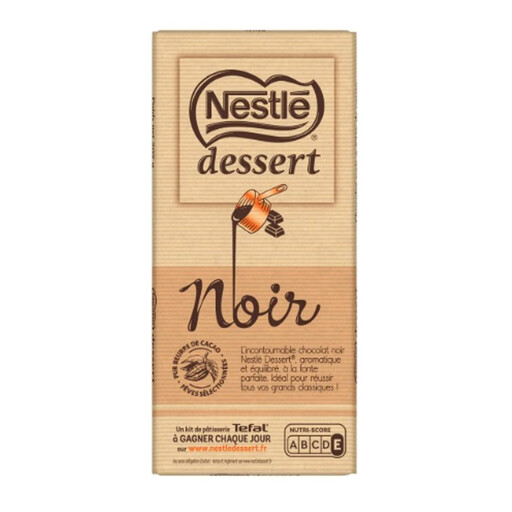 Image unavailable
The ‘Dark Dessert’ description makes this one worth considering for dark chocolate biscuits. If your recipe calls for a specific cocoa percentage, check the one stated for this bar. Also read the sugar and allergen information on the packaging.
No. The levy described by the French Ministry of the Economy applies to sugary drinks, not chocolate bars. To compare chocolate for biscuits, check the sugars per 100 g on the nutrition declarations instead.
No. According to the French Ministry of the Economy, displaying it is optional in France. The nutrition declaration, which the DGCCRF requires for applicable prepacked foods, lets you compare sugars and fat per 100 g, among other values.
Because ‘dark chocolate’ doesn’t mean it’s free from allergens or traces. Anses reminds consumers that substances that can cause allergies or intolerances must be highlighted in the ingredients list. Check the ‘may contain’ warnings on the specific bar too.