Hosts who aren’t sure what everyone likes
Offering one milk chocolate and one dark chocolate lets everyone choose what they prefer. Having a choice doesn’t remove the need to check the allergens in each product.


If you’re not sure what all your guests like, offering both milk chocolate and dark chocolate with around 70% cocoa gives them a choice of two different flavours. Before serving, check the allergens on each pack. To compare the sugar content of bars in different sizes, use the values given per 100 g.
Offering one milk chocolate and one dark chocolate lets everyone choose what they prefer. Having a choice doesn’t remove the need to check the allergens in each product.
A dark chocolate labelled as containing 70% cocoa gives you a clear guide when choosing this option. The percentage alone doesn’t tell you about the sugar content or possible traces of allergens.
If your guests’ dietary needs are a factor in your choice, compare the ingredients lists, allergen information and nutritional values per 100 g before putting the chocolates out.
For a get-together with friends, first choose the flavours you’d like to offer, then check the ingredients of each chocolate separately.
| What matters | What to check | Who is it for? |
|---|---|---|
| A choice of flavours | Pair a plain milk chocolate with a dark chocolate that shows its cocoa content. | When I don’t know what my guests like, I want to offer them a choice between a milder flavour and one with more cocoa. Around 31% of consumers prioritise this variety. |
| A more intense cocoa flavour | Check the cocoa percentage on the specific product, for example 70%. | If I’m mainly looking for a more pronounced cocoa flavour, I want to be able to identify the dark chocolate on offer at a glance. Around 25% of consumers prioritise this intensity. |
| Taking allergens into account | Read the highlighted ingredients and any “may contain” warnings on each pack. | Before serving chocolate to a friend with an allergy, I need to check each recipe, including the dark chocolate. Around 25% of consumers prioritise allergen suitability. |
| Comparing nutritional content | Compare sugar and saturated fat in particular, per 100 g, as well as the ingredients. | To compare two different-sized products, I need to use the same basis rather than relying on the type of chocolate alone. Around 19% of consumers make this nutritional comparison first. |
The Lindt Excellence 70% Dark mini bar may contain traces of milk, soya and nuts. Its colour alone can’t tell you whether it’s suitable for someone with an allergy.
If a guest has an allergy, check the information on the pack of the specific product you’ve bought before serving it.
The 70% label describes the stated cocoa content of a product; it doesn’t replace its nutritional information.
Use the percentage to choose a flavour, then compare the sugar per 100 g on the relevant packs.
In France, the DGCCRF describes Nutri-Score as a voluntary label. Its absence doesn’t mean that the nutritional information required for a prepacked food product is no longer available.
Read the nutritional values per 100 g and the ingredients list, whether or not the logo is shown.
A Côte d'Or milk chocolate bar with raisins and hazelnuts contains hazelnuts, milk and soya, among other ingredients. The added ingredients make it particularly important to check the recipe for your group.
Serve this type of chocolate separately and check that there’s another suitable option for any guests who need one.
Two products could make a milk and dark chocolate pairing: according to Lindt France, L'Authentique Lait contains at least 30% cocoa, while the Excellence Noir mini bar is labelled as 70%.
A Milka Alpine Milk bar is labelled as containing at least 33% cocoa, according to information from Mondelēz International.
Products listed by Carrefour France and Joybuy include an organic dark chocolate labelled as 70% cocoa and a milk chocolate bar with raisins and hazelnuts.
The Nestlé Dessert 70% Dark bar listed by Carrefour France is intended for baking.
This Joybuy selection includes dark and milk chocolates, in bars or multipacks, so you can offer a choice of flavours with drinks. Check the ingredients of each product before serving.
 Image unavailable
Consider this if you’d like to offer a flavoured dark chocolate rather than a plain one.
The bar combines lemon zest and green pepper. Check its cocoa content and allergen information on the pack you buy.
 Image unavailable
At 35 g, this mini bar is a handy individual option for guests who enjoy dark chocolate.
It is labelled as containing 70% cocoa. This product may contain traces of milk, soya and nuts, so check the pack before serving.
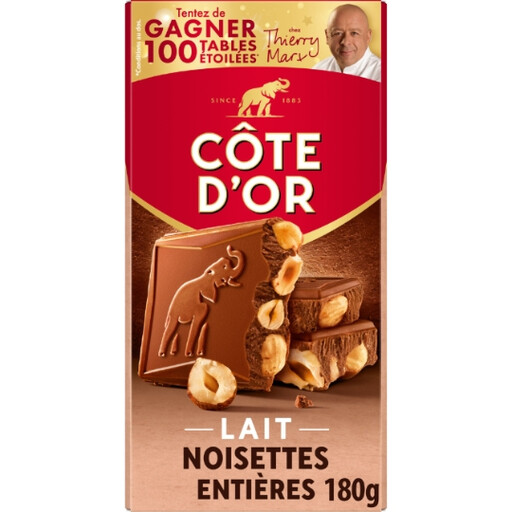 Image unavailable
This bar is a good fit for a table where guests would also like a milk chocolate with whole hazelnuts.
Hazelnuts are listed in the product name, so don’t present it as suitable for everyone without checking your guests’ needs and the label.
 Image unavailable
The pack of three gives you individually wrapped portions of milk chocolate.
Before handing them out, check the ingredients, allergens and any possible trace warnings on the multipack.
 Image unavailable
This multipack lets you offer a milk chocolate option alongside a dark chocolate.
Each of the three bars is listed as weighing 100 g. For this specific product, read the label before comparing nutritional values or checking for allergens.
No. The DGCCRF says that Nutri-Score is voluntary. Nutritional declarations are still compulsory for most of the prepacked foods concerned; use the values per 100 g in particular to compare two bars.
No, not to a solid bar. In France, Article 1613 ter of the General Tax Code, in the version published by Légifrance as at 1 July 2026, applies to drinks and liquid preparations for drinks that meet the conditions set out in the text, not to chocolate bars.
Read the pack for each product rather than relying on labels such as “milk” or “dark”. Look for highlighted allergens in the ingredients and any “may contain” warnings, then keep the packaging available for guests who need to check it.
The cocoa percentage alone isn’t enough to tell you. Check the sugar per 100 g on the specific products, particularly if one of the recipes contains added ingredients.