To share chocolate during a crêpe night and keep some bars for later, choose a multipack of individually wrapped bars based on how many occasions you have in mind. If you’re mainly planning to melt the chocolate for a filling, consider a product intended for baking instead. For each recipe, check the weight, sugars per 100 g and allergens.
Who are these formats for?
People hosting several guests
If you want to break off pieces for crêpes without opening your whole stash, count the individually wrapped bars rather than looking only at the total weight of the multipack. Carrefour’s three-to-six-bar packs, with each bar weighing 100 g, are examples of formats worth comparing.
Families who keep bars for lunchboxes
A multipack can come in handy for the evening and other occasions, provided each bar is wrapped separately. Before planning to use them this way, check the ingredients and allergen information for the recipe you buy.
People making a melted chocolate filling
If the chocolate is for making crêpe filling rather than handing out individual bars, it’s also worth considering a baking format. Carrefour, for example, lists 170 g Nestlé Dessert bars, available individually or in packs of two.
How do you compare multipacks?
First decide whether you’ll break the chocolate into pieces to share, keep the bars for later or use it in a recipe. Then compare the formats by the number of bars, their weight and the exact recipe.
| What to consider |
What to check |
Who is it for? |
| Sharing and keeping some back |
Count the individually wrapped bars, check their weight and the total weight of the multipack. |
If I want to serve chocolate tonight without opening the bars I’m saving for later, how they’re separated matters just as much as the total quantity. Around 45% of consumers would prioritise this need to share some and keep some back. |
| Sugars and allergens |
Compare the ‘sugars’ figure per 100 g and read the ingredients and any ‘may contain’ warnings for the exact recipe. |
Before serving several guests or packing a lunchbox, I need to be able to check what each product contains. For around 33% of consumers, checking the ingredients would be the main priority. |
| Chocolate to melt |
Check the product description, its weight and whether it’s intended for baking. |
If I’m planning a melted filling rather than pieces to share, the recipe will guide my choice of bar. This would be the priority for around 22% of consumers. |
Common mix-ups to avoid
-
Relying on the Nutri-Score alone
The DGCCRF says that displaying the Nutri-Score is voluntary in France. Whether or not it appears on the packaging, it doesn’t replace checking the nutritional information on a prepacked chocolate bar.
To compare two recipes, check their ‘sugars’ figure per 100 g in particular. You can then use the Nutri-Score as additional information if it appears on the packaging.
-
Confusing the number of bars with the total pack weight
Three 100 g bars and two 170 g bars offer different ways to portion the chocolate, even though both products are sold in multipacks.
Check the total weight and the number of individually wrapped bars, based on what you’ll serve during the evening and what you want to keep.
-
Assuming the allergens in one recipe apply to an entire brand
A plain, praline or almond variety may have different ingredients and different ‘may contain’ warnings.
Before offering a bar to someone with an allergy, read the label on the exact product, including any ‘may contain’ warnings.
-
Planning the evening around a format without checking it’s available
A product you’ve spotted in a range may not be available at your chosen shop or for your selected collection option.
Check the pack size and availability when you order, and have another suitable format in mind.
Brands to compare
These examples of formats from Carrefour’s listed range are useful for comparing different needs. Check the pack size for the product you choose.
Milka
Carrefour lists Tendre au Lait in a multipack of six 100 g bars.
- The six individually wrapped bars make it easy to save some for another occasion.
- Check that this quantity suits your needs, and check the allergens for the recipe you buy.
Côte d’Or
Carrefour lists L’Original in a multipack of three 100 g bars.
- The pack gives you three separate bars for the evening and for later.
- The product information mentions that it may contain nuts; check the label on the product you choose.
Lindt
Carrefour’s listed products include three-bar packs of L’Authentique and Maître Chocolatier, with 100 g bars, as well as a pack of three 110 g bars.
- The examples contain the same number of bars, but the weight of each one varies.
- Check the weight and recipe of the exact variety before comparing multipacks.
Nestlé
Carrefour’s listed Dessert products include a 170 g milk chocolate bar and a pack of two 170 g bars.
- These formats are worth considering if you’re using the chocolate in a recipe.
- Don’t assume a praline or almond recipe has the same ingredients or allergens as the recipe you choose.
Carrefour
The formats listed by the retailer include Carrefour Classic’ in a pack of three 100 g bars and Carrefour in a pack of five 100 g bars.
- These two pack sizes let you compare a three-bar or five-bar stash.
- Check which pack size your shop offers before deciding how much you’ll need.
Multipacks of chocolate bars on Joybuy
These two Milka milk chocolate multipacks suit the ‘individually wrapped bars’ option: one contains three 100 g bars and the other contains two. Choose based on how much you want to open for the evening and save for later. Check the recipe and labelling for each product.
 Image unavailable
Milka Alpine Milk, 3 × 100 g
With three separate bars, you can open one for crêpes and keep the others wrapped for another occasion. The pack contains 300 g in total. Check the ingredients, allergens and nutritional information for this variety before serving it.
View on Joybuy
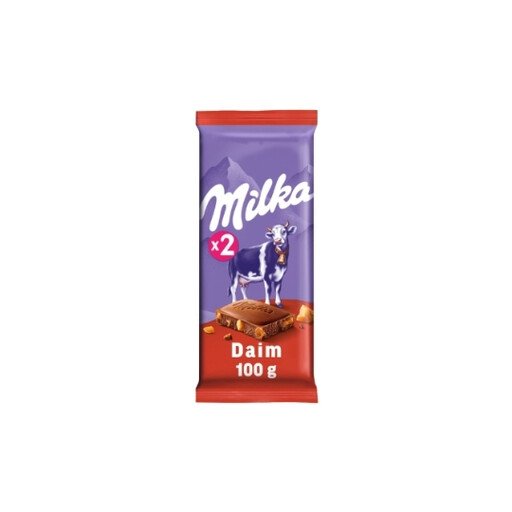 Image unavailable
Milka Milk Chocolate Bar I737, 2 × 100 g
Two separate bars are ideal if you’re planning to serve one during the evening and keep the other for later. The pack contains 200 g in total. Check the ingredients, allergens and nutritional information for this variety.
View on Joybuy
Frequently asked questions
Is the Nutri-Score compulsory on a milk chocolate bar?
No. The DGCCRF and the Ministry of the Economy say that displaying the Nutri-Score is optional in France. To compare prepacked chocolate bars, read their nutritional information, particularly the ‘sugars’ figure per 100 g, even if no Nutri-Score is shown.
What should I check before putting a bar in a lunchbox or serving it to a guest with an allergy?
Read the ingredients, highlighted allergens and any ‘may contain’ warnings on the packaging for the exact recipe. Another bar, even from the same brand, may have different ingredients.
How should I store any bars left over after the evening?
Follow the storage instructions on the packaging and check the best-before date on any unopened bars. The DGCCRF says that this date may be worded ‘best before…’.
Does the ‘soda tax’ apply to milk chocolate bars?
No, the levy in question doesn’t apply to milk chocolate bars. The Official Bulletin of Public Finances describes it as a levy on non-alcoholic drinks containing added sugars. When choosing a chocolate bar, check its sugar content in the nutritional information instead.


