If you’re after a stronger cocoa flavour while sticking with milk chocolate, choose a bar that states its cocoa percentage. For guests with different tastes, a milk, dark and white chocolate selection offers more choice; a large milk chocolate bar is a good option if sharing it easily is the priority. In every case, compare the sugars per 100 g and check the ingredients and allergens for the product you’re buying: the cocoa percentage alone doesn’t tell you everything about its composition.
Who are these options for?
Fans of richer milk chocolate
If you want a more pronounced cocoa flavour without choosing a bar of entirely dark chocolate, look for a product that states its cocoa content. Then compare the sugars in the nutrition information separately from that percentage.
Hosts catering for guests with different tastes
A very rich chocolate won’t necessarily suit everyone. A selection of milk, dark and white chocolates, such as the one described by Lindt France, offers a choice of recipes; check the ingredients for each one.
People who check ingredients and allergens
If a guest needs to avoid an ingredient, check the exact packaging rather than relying on the colour of the chocolate. As Anses points out, allergens present in the recipe must be highlighted in the ingredients list; check for ‘may contain’ warnings too.
What should you look for on match night?
First decide what matters most to your group: cocoa flavour, a variety of recipes, ingredients or the amount you can share. Each priority calls for different checks on the packaging.
| What matters | What to check | Who it’s for |
|---|
| Cocoa intensity |
Chocolate description and cocoa percentage, if stated. |
I want milk chocolate with a more pronounced cocoa flavour, without serving dark chocolate. Around 40% of consumers are said to make this their top priority. |
| Variety of flavours |
The recipes included in the selection and whether any are filled. |
If my guests don’t all like the same chocolate, I’d rather give them a choice of recipes. Variety is said to be the top priority for around 30% of consumers. |
| Ingredients and allergens |
The ingredients list and ‘may contain’ warnings for each product. |
If an ingredient is a problem for a guest, I need to know exactly what’s in the chocolate before serving it. Around 20% of consumers are said to put this check first. |
| Amount to share |
The net weight of the pack or bar and the number of pieces, if stated. |
For a group, I want to choose an amount that’s right for sharing rather than an individual format. This is said to be the top priority for around 10% of consumers. |
What should you avoid getting mixed up?
-
Assuming ‘dark’ is a precise description of milk chocolate
On its own, this word doesn’t tell you whether the product is a bar of dark chocolate, a selection or a milk chocolate with a richer flavour.
Read the product description and check its cocoa percentage if it appears on the packaging. If you’re catering for fans of both milk and dark chocolate, look at the contents of a selection instead.
-
Judging sugar content by the cocoa percentage alone
Cocoa content doesn’t replace the nutrition information for the full recipe. A Nutri-Score, if shown, doesn’t tell you the sugar content on its own either.
Compare the ‘of which sugars’ figure per 100 g for the products you’re considering, then check any other nutritional values relevant to your choice. According to the DGCCRF, displaying the Nutri-Score is voluntary in France.
-
Overlooking allergens in chocolate selections
Ingredients and ‘may contain’ warnings can differ from one bar or bite to another. So the information for one recipe won’t necessarily apply to the whole selection.
Check the ingredients list and ‘may contain’ warnings on the exact packaging you’ll be serving, especially if a guest needs to avoid soya or nuts.
-
Confusing the format with the amount of chocolate
A bar, multipack and selection can all have different net weights and numbers of pieces.
Check the net weight and, for bite-sized chocolates, the stated number of pieces so you can work out how much you’ll have to share.
Brands and ranges to consider
Lindt
The Lindor range includes a selection of milk, dark and white chocolate bites, as featured by Lindt France.
- Several recipes in one box, to suit different tastes.
- The bites are filled, so check the ingredients and any nut warnings on the box you choose.
Côte d’Or
The L’Original Lait bar is an example of milk chocolate you can compare with products that state their cocoa percentage.
- Its Carrefour France product page gives details including the presence of milk and soya lecithins.
- The page also warns that it may contain nuts; a description of the flavour doesn’t replace a stated cocoa percentage.
Carrefour
Carrefour France product pages feature milk chocolate bars in different recipes and formats, including Terra Etica and Carrefour ranges.
- The Terra Etica product page states that this particular bar contains at least 50% cocoa.
- Don’t assume the same composition or nutrition information applies to Carrefour Classic’ or Sélection bars: compare each product separately.
E.Leclerc / Marque Repère
The Marque Repère category featured by E.Leclerc includes milk chocolate bars, multipacks and recipes with hazelnuts or fillings.
- The different formats make it easier to compare the quantity and type of recipe that would suit your group.
- Check the composition and collection options for the specific product and store.
Milk chocolate to share on Joybuy
These two formats are handy for sharing on match night: a pack of three bars and a 200 g bar. If you’re looking for richer milk chocolate, check the cocoa percentage on the product you’re considering before you choose.
 Image unavailable
Milka Alpine Milk, 3 × 100 g
This pack is a good choice if you’d like to share several milk chocolate bars among your guests.
It contains three 100 g bars. To compare its cocoa flavour and composition with another product, check the cocoa percentage, nutrition information and allergens on the packaging.
View on Joybuy
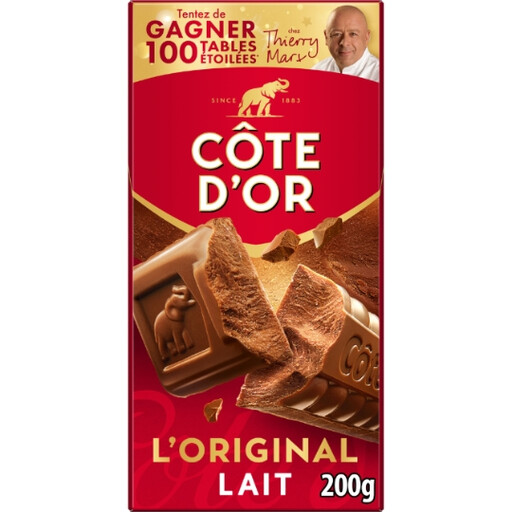 Image unavailable
Côte d’Or Classic Milk, 200 g
This bar is a good choice if you’d prefer to serve one milk chocolate to share during the match.
It weighs 200 g. If cocoa intensity or a particular ingredient matters to your group, check the details for this bar on its packaging.
View on Joybuy
Frequently asked questions
Does ‘dark’ always mean a richer milk chocolate?
No. The word alone doesn’t distinguish between a bar of dark chocolate, a selection and a richer milk chocolate. Check the product description, then its cocoa content if it’s stated.
Is the Nutri-Score compulsory on chocolate bars in France?
No. The DGCCRF describes the Nutri-Score as a voluntary label in France. To compare the nutrition information for two bars, refer to their nutrition declarations, which are given per 100 g.
How do you compare the sugar content of two milk chocolates?
Check the ‘of which sugars’ figure per 100 g on each pack. Don’t infer this figure from the cocoa percentage: the two details tell you different things about the recipe.
What should you check if a guest needs to avoid soya or nuts?
Check the ingredients list and ‘may contain’ warnings for every product you’re serving. Anses points out that allergens present in the recipe must be highlighted in the ingredients list; a selection may contain several different recipes, so check each one.
Does the so-called ‘soda tax’ help you choose a chocolate bar?
No. The French Ministry for the Economy says that the contribution in question applies to non-alcoholic drinks. To compare milk chocolate bars, check their ingredients and the ‘of which sugars’ figure per 100 g instead.


