Students looking for a specific Fairtrade label
For your first food shop, a general claim about sustainable cocoa isn’t enough if you want a clearly identifiable standard. Compare the name of the scheme and the proportion of the recipe it covers.


When choosing a Fairtrade milk chocolate bar as you move into student accommodation, first check which standard is named on the product and which ingredients it covers. Fairtrade/Max Havelaar, Fair for Life and the Small Producers’ Symbol are different schemes. Then check the recipe, allergens, sugar per 100 g and whether the bar you’re interested in is available.
For your first food shop, a general claim about sustainable cocoa isn’t enough if you want a clearly identifiable standard. Compare the name of the scheme and the proportion of the recipe it covers.
A 100 g bar could be a good choice for a one-off purchase. If you have a particular product in mind, check it’s available at the shop or through the collection option you plan to use.
In shared accommodation, check the allergens on the bar you actually buy, including any ‘may contain’ warnings. The nutrition information also lets you check the sugar content per 100 g.
Start with the factor that really matters to your purchase: the Fairtrade standard, how you’re organising your shop or the ingredients. For example, a bar with puffed rice won’t necessarily be a substitute for plain milk chocolate.
| Factor | What to check | Who is it for? |
|---|---|---|
| Proof of Fairtrade sourcing | The name of the standard, which ingredients it covers and what proportion of the recipe is included. | If Fairtrade is why I’m buying it, I want to know exactly what the label covers rather than relying on the word ‘sustainable’. Around 45% of consumers put this evidence at the top of their list of criteria. |
| Size and availability | The size of the bar and whether it’s available at your shop or through your chosen collection option. | For my first food shop, I prefer to choose a suitable size and make sure I can get the bar I’ve planned to buy. This comes first for around 33% of consumers. |
| Ingredients and allergens | The ingredients, any ‘may contain’ warnings and the sugar per 100 g in the nutrition information. | When shopping for a shared household, I need to take allergens into account and want to compare recipes on a like-for-like basis. Ingredients are the top priority for around 22% of consumers. |
Lindt and Nestlé describe their cocoa-sourcing initiatives, but their general information doesn’t prove that a particular milk chocolate bar carries the Fairtrade/Max Havelaar label.
If a specific label is important to you, look for its name on the bar or product information and check which ingredients it covers.
In France, the DGCCRF states that Nutri-Score is voluntary. Its absence alone doesn’t tell you what’s in the bar.
To compare sugar content, check the nutrition information per 100 g on the products you’re considering.
The Carrefour product listing for the Chevaliers d’Argouges bar says it has been removed from shelves and is unavailable through Carrefour Drive.
Check availability with the shop or through your chosen collection option before adding it to your shopping list.
Without checking, you might have to look for another bar when you do your shop.
The milk chocolate recipes reviewed contain milk, but other allergen warnings vary from bar to bar.
If someone needs to avoid an ingredient, check the ingredients list and any ‘may contain’ warnings on the packaging of the bar you buy.
The 100 g organic milk chocolate bar listed by Carrefour carries the Fair for Life label, a standard separate from Fairtrade/Max Havelaar.
The organic milk chocolate bar with puffed rice listed by Carrefour is a good fit if you want this particular recipe and a clearly defined Fairtrade scheme.
The 100 g organic Fairtrade milk chocolate bar listed by Carrefour explicitly displays the Fairtrade/Max Havelaar label.
Lindt describes a responsible cocoa-sourcing programme, but this alone doesn’t identify a milk chocolate bar certified by Fairtrade/Max Havelaar.
Nestlé’s information covers its Cocoa Plan and Rainforest Alliance, among other things, but doesn’t establish that a particular milk chocolate bar carries the Fairtrade/Max Havelaar label.
If your first food shop includes a bar with puffed rice, this Ethiquable option has a clearly stated proportion of Fairtrade ingredients and a named standard in the product information.
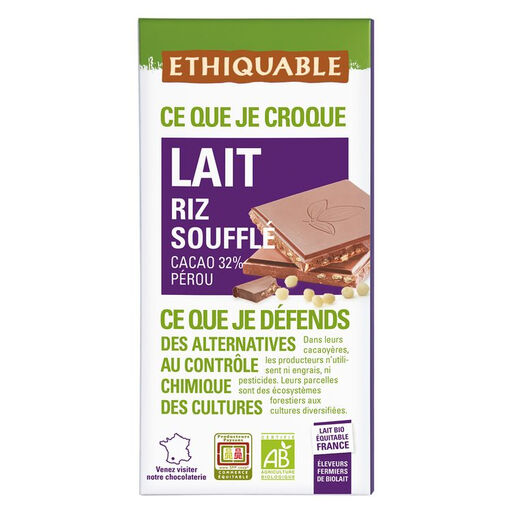 Image unavailable
A good option for a one-off purchase if you’re looking for milk chocolate with puffed rice rather than a plain bar.
According to Carrefour’s product listing for this recipe, 99.5% of the ingredients come from Fairtrade sources, including 74.1% certified by the Small Producers’ Symbol. The recipe contains milk; the listing also warns that it may contain traces of nuts, sesame and gluten. Check the information on the packaging you receive, especially if an allergen is a concern.
No. The rates published by the Official Bulletin of Public Finances – Tax applies to non-alcoholic drinks containing added sugars or sweeteners, not to chocolate bars. However, if you’re choosing between two recipes, check their sugar content in the nutrition information.
No. The DGCCRF describes Nutri-Score as voluntary labelling, separate from the nutrition declaration generally required for pre-packed food. So its absence doesn’t mean you can skip checking the nutritional values per 100 g.
No, not if you’re looking for a clearly identifiable Fairtrade scheme. Check the product for the name of the standard and the ingredients it covers: Fairtrade/Max Havelaar, Fair for Life and the Small Producers’ Symbol each have their own name.
Read the ingredients and allergen information on the packaging of the bar you’ve bought. The three recipes listed by Carrefour contain milk, but their warnings about possible traces aren’t the same. Don’t assume they are based solely on the ‘milk chocolate’ category.