Parents with a cool bag
You can keep chilled products cold during the journey and meal. You can then compare the recipes of plain or stirred yoghurts, their sugar content and the portion sizes that suit your picnic.


For a summer picnic, first choose based on whether you can keep the product chilled. Fresh yoghurt must be stored according to the instructions on the pack, while a long-life dairy product is only suitable without a cool bag if its packaging says it can be kept at room temperature before opening. To find a mild-tasting option for your child, then compare the recipe, sugars, allergens and format. Don’t assume that a pouch or milk drink is the same as fresh yoghurt.
You can keep chilled products cold during the journey and meal. You can then compare the recipes of plain or stirred yoghurts, their sugar content and the portion sizes that suit your picnic.
A pouch or drinking yoghurt means you don’t need to serve it from a pot. However, check the storage instructions for the product you choose: the format doesn’t mean a fresh product can be kept out of the fridge.
You can look at products whose packaging specifically says they can be stored at room temperature before opening. Check the product name and ingredients: a fermented milk drink is not interchangeable with fresh yoghurt.
Choose this if: you have a cool bag that can maintain the stated temperature and want to compare plain or stirred recipes.
Plan for: spoons and keeping it chilled until mealtime.
Choose this if: your child can have an individual portion without a spoon.
Check: the instructions for that specific product, including how long it can be kept out of the fridge.
Consider this if: you don’t have a cool bag and the packaging says it can be stored at room temperature before opening.
Bear in mind: its recipe and product name may differ from those of fresh yoghurt.
Once you’ve chosen an option that can be stored safely during the journey, compare the recipe and packaging to find one your child can enjoy at the picnic.
| Factor | What to check | What matters to shoppers |
|---|---|---|
| Storage | For a fresh product, check the temperature and date on the packaging; use a cool bag to maintain the required storage conditions. | If I can’t keep food cold, I need to find a product whose packaging says it can be stored at room temperature before opening. Storage is the top priority for around 42% of consumers. |
| Taste and sugars | Compare the “of which sugars” line on the same basis, per 100 g or per 100 ml depending on the product, and check the ingredients list. | If I’m looking for a mild flavour for my child, I don’t want to guess the sugar content from the flavour or child-focused packaging. Around 33% of consumers prioritise the recipe and sugars. |
| Child-friendly format | Check the portion size, how it opens and whether a spoon is needed; also check the age stated for that product. | If we’re eating outdoors without crockery, I prefer a portion my child can enjoy in its intended packaging. Format is the top priority for around 25% of consumers. |
A pouch is still a chilled product if its label says it must be refrigerated. The DGCCRF recommends using a cool bag for picnics; the product’s stated storage temperature is what matters.
Use a cool bag for products that need to be refrigerated. If you can’t keep them cold, only choose a product whose packaging says it can be stored at room temperature before opening.
The flavour and child-focused packaging don’t tell you how much sugar a product contains. Auchan’s product information lists 4.4 g of sugars per 100 g for a plain stirred yoghurt and 10 g per 100 g for a drinking yoghurt pouch.
Read the nutrition information and compare quantities expressed in the same unit. Also check the ingredients list for each recipe.
Carrefour’s listing for Yoplait Grands Filous vanilla yoghurt shows a 750 g carton. Serving a portion outdoors takes more planning than opening an individual pack.
If you choose a pack to share, bring what you need to serve it and follow the storage instructions after opening.
A flavour name is no substitute for the ingredients list. The DGCCRF states that allergens must be highlighted in the ingredients list on prepacked products.
Check the packaging of the product you buy to identify milk and any other listed allergens.
The Petits Filous range includes formats aimed at children, including drinking products.
The retailer offers products for children, with listings that let you check ingredients and packaging.
The retailer’s listings include both plain stirred yoghurt in pots and drinking yoghurt in pouches.
The retailer’s catalogue includes DELISSE plain and stirred yoghurts, worth considering if you’re looking for pots to carry in a cool bag.
This selection features a plain fromage blanc dessert in individual portions for children, rather than a classic fresh yoghurt. Before taking it along, check the packaging for storage instructions before and after opening.
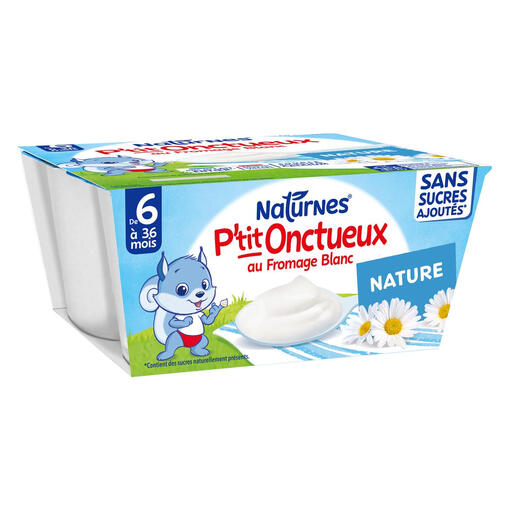 Image unavailable
The four 90 g pots make it easy to plan individual portions for a child from 6 months. This is a plain fromage blanc dessert, not a classic fresh yoghurt.
Before taking it along, check the packaging for storage instructions before and after opening, the ingredients list, allergens and nutrition information.
If the packaging says it must be kept chilled, make sure you can maintain that temperature during the journey and picnic. The DGCCRF recommends using a cool bag for picnics; check the instructions and date on each fresh product.
No: taste doesn’t tell you how much sugar a product contains. Compare the “of which sugars” line per 100 g or per 100 ml, depending on the unit shown, then read the ingredients list for the product you choose.
No: check the age guidance for the specific product. Yoplait describes its Petits Filous range, for example, as specially formulated for children over 3 years old; this guidance doesn’t apply to other ranges.