What should you look for?
First, consider how the fresh cheese fits into the planned pre-race snack, then choose a flavour and format your child is familiar with. The table compares shoppers according to the factor they prioritise when making this choice.
| Factor |
What to check |
Who is it for? |
| Mild flavour |
Look for the word “plain” and read the ingredients rather than judging the taste by the words “fresh cheese” alone. Galbani describes its ricotta as mild, with a slightly grainy texture. |
If my child refuses strongly seasoned flavours, I want to choose something they’ll enjoy. This would be the top priority for around 29% of consumers. |
| Place in the snack |
Check the carbohydrate content of the product you choose and consider the rest of the snack and hydration in light of the activity. Auchan lists 3.4 g of carbohydrates per 100 g for its plain Bio fresh cheese. |
For a long-distance race, I don’t want to rely on a single dairy product to make up the snack. Around 36% of consumers would make this their priority. |
| Portion and serving suggestion |
Compare the weight per pot and how the product is served: by the spoonful, mixed into a recipe or spread on bread. The options reviewed include 100 g pots of Auchan Bio plain and a 150 g pot of Les Croisés plain whipped cheese. |
I’m looking for a format that’s easy to serve to my child, without confusing the size of a pot with how much they should eat. Around 21% of consumers would put format first. |
| Allergens and storage |
Check the exact packaging for allergens, possible traces and refrigeration instructions, particularly after opening. |
If I’m concerned about an allergy or how to transport the product, I need to be able to check this information before serving it. Around 14% of consumers would make it their top priority. |
Brands to compare, depending on the recipe you’re looking for
These products show how different types can be used: a small pot of plain fresh cheese, ricotta or spreadable cheese. Compare each recipe and its label, and don’t assume that the features of one product apply to the whole brand.
Carrefour
Plain fresh cheeses to consider if you’re looking for a lightly seasoned flavour and individual pots.
- The Carrefour Classic’ product information describes a plain recipe made with pasteurised milk and cream, with lactic cultures.
- According to Carrefour, its Carrefour Bio plain product contains 3.6 g of fat and 85 kcal per 100 g. These figures don’t apply to other Carrefour products.
Auchan
Plain fresh cheese pots and fruit recipes to compare separately.
- Auchan lists 100 g pots for its plain Bio fresh cheese, with 7.1 g of protein, 3.4 g of carbohydrates and 0.11 g of salt per 100 g.
- According to its product information, Auchan Bio fruit contains 8% cane sugar. Don’t assume it has the same nutritional values as the plain version.
Galbani
Ricotta is an alternative to small pots of plain fresh cheese, and can be used in sweet or savoury recipes.
- Galbani describes its 250 g Ricotta as having a very mild flavour.
- The brand also notes that it has a slightly grainy texture, which may matter if your child prefers smooth textures.
Marque Repère / Les Croisés
A plain whipped cheese to consider for toast or a sandwich, rather than as a small pot to eat with a spoon.
- E.Leclerc lists a 150 g pot of Les Croisés plain whipped cheese.
- To compare it with fresh cheese in a pot, check the ingredients, allergens and nutritional information for the product you choose.
Boursin
The Garlic & Fine Herbs recipe is an example of a seasoned spreadable cheese, rather than a plain option.
- The ingredients published by Bel Foodservice France let you check for garlic, fine herbs, salt and pepper before choosing a flavour your child will enjoy.
- The same product information lists 39 g of fat and 1.3 g of salt per 100 g. These values apply to this recipe only.
Product available on Joybuy
This is a plain fromage frais dessert in small pots, rather than a standard plain fresh cheese to automatically swap into a race-day snack. Check how it fits into your child’s usual snack by looking at the product label.
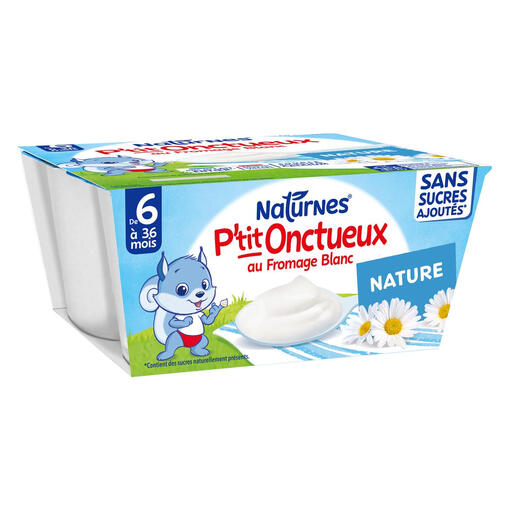 Image unavailable
Nestlé P'Tit Smooth with plain fromage frais, from 6 months, 4 × 90 g
This plain fromage frais dessert in small pots may suit a family looking for this format rather than standard fresh cheese. The name says “from 6 months”, but that doesn’t determine whether it’s suitable for a child’s snack around a race.
Pack size: 4 pots of 90 g. Check the label for carbohydrates, allergens and storage instructions after opening.
View on Joybuy
Frequently asked questions
Is plain fresh cheese enough to fuel a long-distance race?
No. You shouldn’t rely on plain fresh cheese as the only part of a snack for exercise. Auchan lists 3.4 g of carbohydrates per 100 g for its plain Bio product; the IRBMS advises considering the type and intensity of the sport, as well as its timing, when planning a sporty child’s diet.
Plain, ricotta or garlic and fine herbs: what should you choose for a mild flavour?
A plain recipe is the most straightforward starting point if your child prefers lightly seasoned flavours. Galbani describes its ricotta as very mild, but slightly grainy; Boursin Garlic & Fine Herbs contains herbs and pepper, so it suits a different taste preference.
Is a small pot or a spreadable cheese better?
Choose according to how you’ll serve it: a pot to eat with a spoon, or a spreadable cheese for toast or a sandwich. The 100 g pots of Auchan Bio plain and the 150 g pot of Les Croisés plain whipped cheese show different formats, not recommended portions for every child.
What should you check if your child has a food allergy?
Before serving, check the packaging of the product you’ve bought for allergens and possible traces. The fresh cheeses mentioned here contain milk; if your child is allergic to cow’s milk protein, simply switching brands won’t make a fresh cheese suitable.
How should you store fresh cheese after opening?
Follow the temperature and use-by instructions after opening shown on the packaging of the product you choose. If you’re preparing a snack to take with you, also check how to follow these instructions until it’s time to serve.


