When choosing mild fresh cheese for a child, first check their age, stage of weaning and the type of milk used: the word ‘plain’ is not enough. According to Manger Bouger, 0%, skimmed and semi-skimmed products are not suitable for children under 3, and cheeses made with raw milk should be avoided before the age of 5. For family meals, fresh cheese in a pot, cream cheese, ricotta and mascarpone each have different uses, so check the ingredients of the product you choose.
Who is this guide for?
Parents of a child starting weaning
You want to check that a product is suitable for your child’s age before comparing flavours or brands. Manger Bouger’s guidance distinguishes, among other things, the start of weaning from the dietary choices for children under 3.
Parents looking for a plain flavour
You’re looking for a product without herbs or strong seasoning, with ingredients and allergens you can check on the label. However, a plain flavour doesn’t tell you anything by itself about the salt content or type of milk.
Families who cook with fresh cheese
You’re choosing between a product to eat with a spoon, spread on bread or add to a sauce, quiche or dessert. Ricotta, mascarpone and cream cheese don’t all serve the same purpose.
What should you look at first?
For a child, start with their age and the product’s ingredients, then choose a texture that suits the meal you have in mind. The words ‘plain’ or ‘mild’ don’t replace any of these checks.
Plain fresh cheese in a pot
Suitable for: a spoonable texture and a flavour without strong seasoning.
Bear in mind: ‘plain’ doesn’t mean suitable for every age. The plain Carrefour Bio and Auchan Bio fresh cheeses described in the retailers’ product listings are made with semi-skimmed milk.
Plain cream cheese
Suitable for: toast or a sandwich, if the ingredients in the product you choose are right for the meal.
Bear in mind: a spreadable cheese product may contain salt and other ingredients not found in plain fresh cheese in a pot. Compare the labels, not just the product names.
Ricotta
Suitable for: sweet or savoury dishes, hot or cold, in line with the uses suggested by Galbani.
Bear in mind: for a dish intended for a child, check the product you buy and the ingredients in the whole recipe.
Mascarpone
Suitable for: dishes where you want its smooth, creamy texture.
Bear in mind: it’s not a direct substitute for plain fresh cheese in a pot. According to its product listing, Galbani Mascarpone 500 g contains 39 g of fat per 100 g.
| What to consider |
What to check |
Who it’s for |
| Age and type of milk |
Check the stage of weaning, the type of milk and whether the product is labelled as pasteurised. According to Manger Bouger, 0%, skimmed and semi-skimmed products are not suitable before the age of 3, and cheeses made with raw milk should be avoided before the age of 5. |
When their child starts weaning, parents first want to know whether a product is right for their child’s age; around 42% of consumers would make this their top priority. |
| Flavour and ingredients |
Read the product name, ingredients, allergens and salt content per 100 g on the product you choose. |
To introduce a mild flavour, some parents look for a plain recipe without added herbs; around 33% of consumers would put this simplicity first. |
| Texture and use |
Choose between a pot to eat with a spoon, a spreadable product and a cooking ingredient. Also check the pack size and storage instructions after opening. |
When making toast or cooking for the family, parents first want a product that suits the recipe; around 25% of consumers would prioritise this use. |
Common mix-ups to avoid
-
Assuming ‘mild’ or ‘plain’ means suitable for a particular age
A mild flavour tells you nothing about when to start weaning, the type of milk or whether the product is pasteurised. Manger Bouger recommends an exclusively milk-based diet from birth to 4 months, and sets out separate restrictions for children under 3 and under 5.
Before comparing brands, check your child’s age and the information on the packaging of the specific product.
-
Using all fresh cheeses in the same way
Fresh cheese in a pot, a spreadable cheese product, ricotta and mascarpone shouldn’t be chosen just because they seem mild in flavour. Their ingredients and uses in recipes can vary.
First decide whether you’ll eat the product with a spoon, spread it or cook with it. Then compare the ingredients, salt and fat content of the products you’re considering.
-
Forgetting the storage instructions
Fresh cheeses need to be kept chilled. The DGCCRF notes that rising temperatures speed up microbial growth; once opened, you should also follow the instructions for that specific product.
Follow the storage temperature and use-by date on the packaging, along with the storage period after opening if one is given.
Brands to compare
These products show how categories and recipes can differ. Check the listing for the product you’re thinking of buying rather than assuming what it contains from the brand name.
Carrefour
Carrefour’s range includes plain fresh cheese in individual portions.
- The product listing for Carrefour Bio plain fresh cheese specifies organic pasteurised semi-skimmed milk and lactic cultures.
- According to Manger Bouger, semi-skimmed products are not suitable for children under 3, regardless of whether they’re labelled ‘organic’ or ‘plain’.
Auchan
Auchan’s range includes plain fresh cheese in a pot and plain spreadable fresh cheese.
- The listing for Auchan Bio plain fresh cheese specifies organic pasteurised semi-skimmed milk and lactic cultures.
- Auchan’s spreadable recipe also lists salt. Compare it as a spreadable product, rather than confusing it with plain fresh cheese in a pot.
Philadelphia
According to the product listing published by Courses U, Philadelphia Nature is one of the pasteurised spreadable cheese products.
- Its product description sets it apart from plain fresh cheese in a pot, which is intended to be eaten with a spoon.
- For a child, check the ingredients, allergens and nutritional information on the pack you buy before using it as a substitute for another dairy product.
Boursin
Bel Foodservice France lists Boursin Nature, made with pasteurised milk, in 16 g portions.
- The Nature version can be compared with other products without confusing it with seasoned flavours.
- Check the salt, fat, allergens and storage instructions on the pack being sold.
Galbani
Galbani’s range illustrates the difference between two cooking ingredients: ricotta and mascarpone.
- Galbani suggests using its ricotta in hot or cold dishes.
- Galbani Mascarpone 500 g contains 39 g of fat, including 25 g of saturated fatty acids, per 100 g. Check that it’s right for the recipe you have in mind.
E.Leclerc
E.Leclerc has a Marque Repère category dedicated to yoghurts and fresh cheeses.
- This category can be a useful starting point for comparing the product descriptions in its fresh food range.
- When choosing fresh cheese for a child, check the specific product: type of milk, ingredients, allergens and storage instructions.
A Joybuy product related to this topic
This plain fromage blanc dairy dessert in pots may interest parents comparing spoonable products. Its age guidance doesn’t replace checking its ingredients against dietary guidance for young children.
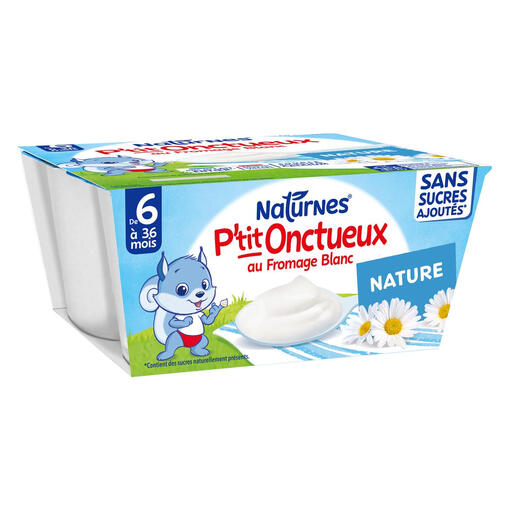 Image unavailable
Nestlé P'Tit Smooth plain fromage blanc, 6+ months, 4 x 90 g
For comparing plain dairy desserts to eat with a spoon: this product is labelled 6+ months and contains four 90 g pots.
The description lists pasteurised skimmed milk in the fromage blanc. For a child under 3, check the full recipe and fat content before relying on the age guidance: according to Manger Bouger, skimmed products are not suitable for this age group. Also check the salt content and pasteurisation information on the packaging.
View on Joybuy
Frequently asked questions
Can you give fresh cheese to a baby under 4 months?
No. From birth to 4 months, Manger Bouger recommends an exclusively milk-based diet. At this age, fresh cheese is not a substitute for breast milk or infant formula.
When can children start trying dairy products?
They can be introduced as part of weaning, which starts between 4 and 6 months according to Manger Bouger. Take your child’s stage of weaning into account, then check the ingredients of the product you choose.
Is plain fresh cheese always suitable for a child under 3?
No. ‘Plain’ describes the flavour, not whether it’s suitable for a particular age. Manger Bouger says that 0%, skimmed and semi-skimmed products are not suitable for children under 3. Check the type of milk and the recipe of the specific product.
Should you check whether a product contains milk as an allergen?
Yes. Check the ingredients list for milk and look at the product’s allergen information. Manger Bouger doesn’t recommend routinely delaying the introduction of major allergens during weaning. If your child has been prescribed a dairy-free diet, follow that advice.
How should you store fresh cheese after opening?
Follow the storage temperature and the recommended storage period after opening shown on the packaging. Also observe the use-by date before opening and keep the product chilled, in line with DGCCRF advice.


