If your child prefers mild flavours, start by comparing plain fresh cheeses made with pasteurised milk, taking their age, any allergens and how you plan to serve the cheese into account. If a spread for toast would work better than a pot to eat with a spoon, plain spreadable cheese could be a good option. However, Auchan product listings show that these two types of product can differ significantly in fat and salt per 100 g. So check the nutrition information for the specific product you choose rather than relying on the word ‘plain’ alone.
Who is this guide for?
Parents of children who prefer plain flavours
If your child isn’t keen on garlic or herbs, start by looking at plain varieties and their texture. The plain products in individual pots listed by Auchan are a good option if you’re looking for something to eat with a spoon.
Parents choosing between a pot and a spread
Fresh cheese to eat with a spoon and spreadable cheese are made for different uses. To choose between them, compare the ingredients, fat and salt in each product, even if both are labelled ‘plain’.
Parents of young children
Your child’s age affects what you need to check before serving fresh cheese. Manger Bouger advises that skimmed and semi-skimmed products aren’t suitable for children under 3. For children under 5, its guidance rules out raw milk and cheeses made with raw milk, except Emmental and Comté.
What should you look for first?
For an evening snack, first check anything that depends on your child’s age and the product’s ingredients. Then compare the nutrition information and choose a format that suits the way your child will eat it.
| What to consider |
What to check |
Who is it for? |
| Age and allergens |
Check the dairy ingredients, whether the milk has been pasteurised and the allergens listed on the pot. For children under 3, also bear in mind Manger Bouger’s advice on skimmed and semi-skimmed products. |
If my child is young or has an allergy, I want to check the ingredients before choosing a flavour or format; around 42% of consumers would prioritise these precautions. |
| Nutrition information |
Compare energy, fat, saturated fat and salt per 100 g, then consider the amount you’ll actually serve. |
To choose between a small pot of plain fresh cheese and spreadable cheese, I need to compare their labels rather than rely on their names alone. Around 33% of consumers would prioritise nutritional value. |
| Flavour and format |
Choose between a pot to eat with a spoon and a product to spread. If you’re looking for a mild flavour, check that the variety is plain. |
If my child prefers eating with a spoon or having something on toast, I look for a texture and format they’ll enjoy; around 25% of consumers would put this need first. |
Mistakes to avoid
-
Assuming all ‘plain’ products are the same
Auchan’s product listings show that its plain Bio fresh cheese contains 85 kcal, 3.6 g of fat and 0.1 g of salt per 100 g, compared with 230 kcal, 22 g and 0.9 g respectively for its plain spreadable fresh cheese. These figures apply to these specific products, not to the categories as a whole.
Compare the nutrition information for the exact product, then take into account how much you’ll serve.
-
Confusing a creamy texture with a mild flavour
A garlic and fine herbs variety can be creamy without having the neutral flavour you’re looking for. Carrefour lists a Boursin Garlic and Fine Herbs variety, for example.
Check the specific flavour and save seasoned varieties for flavours your child already enjoys.
-
Choosing without taking your child’s age into account
Manger Bouger distinguishes between the advice for children under 3 on skimmed and semi-skimmed products, and the advice for children under 5 on raw milk and cheeses made with raw milk, with the exception of Emmental and Comté.
Before choosing fresh cheese, check your child’s age and the information about dairy ingredients on the packaging.
-
Forgetting storage instructions
Use-by dates and instructions for after opening matter for fresh products. Auchan’s listing for its plain spreadable fresh cheese says to keep it between +2 °C and +6 °C and consume it within 7 days of opening.
Follow the use-by date, temperature and instructions on the pot you buy. If you know the cold chain has been broken, don’t serve it.
Brands to compare
Auchan
The products reviewed include plain fresh cheeses in individual pots and plain spreadable fresh cheese.
- Auchan Bio plain and Pouce plain listings specify 60 g pots made with pasteurised semi-skimmed milk.
- Plain spreadable fresh cheese has a different recipe and nutritional values. Also check for possible traces of allergens and any age-related precautions.
Philadelphia
The plain variety listed by Carrefour is a spreadable cheese, worth considering if you’d prefer something for toast rather than a pot to eat with a spoon.
- Its ingredients list includes whole milk, cream, salt and guar gum.
- It shouldn’t be treated as equivalent to an individual portion of plain fresh cheese. Check the label of the format you choose.
Carrefour
The plain varieties reviewed include spreadable cheese in nine 20 g portions and a 150 g tub.
- These formats let you choose between individual portions and a tub to serve from.
- Check the ingredients and nutrition information for the exact product rather than assuming the two formats are the same.
Les Croisés / Marque Repère E.Leclerc
The E.Leclerc selection mentioned includes a 150 g plain whipped cheese and a garlic and fine herbs version in the same format.
- The distinction between plain and flavoured varieties helps you choose according to your child’s tastes.
- Before choosing the plain variety for a child, check its ingredients, allergens and nutrition information on the packaging.
Boursin
Flavoured varieties, including Garlic and Fine Herbs, are better suited to children who already enjoy these flavours.
- The flavour name makes it easy to distinguish a herby variety from a plain product.
- A creamy texture doesn’t mean the flavour will be neutral, so check the recipe before choosing it for a mild snack.
Galbani
Ricotta offers another texture to consider, either served with a spoon or used in a simple recipe.
- According to Galbani, its ricotta contains 174 kcal per 100 g; this figure applies to the product featured by the brand.
- Before offering it to a child, check the pot you buy for dairy ingredients, allergens, salt and storage instructions.
A product to discover on Joybuy
This individual-pot option is for families looking to serve plain fromage frais with a spoon. The format doesn’t remove the need to check the ingredients and age guidance before offering it to a child.
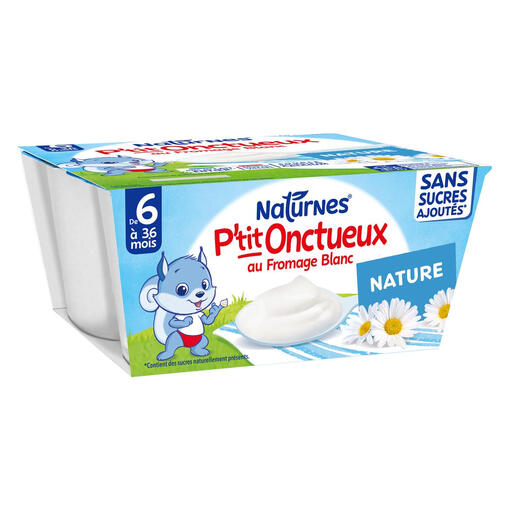 Image unavailable
Nestlé P'Tit Smooth with plain fromage frais, from 6 months, 4 × 90 g
For a snack served with a spoon, this plain fromage frais comes in four 90 g pots and is labelled as suitable from 6 months.
This age guidance doesn’t replace checking the label. Check the dairy ingredients and whether the milk has been pasteurised, as well as the allergens and nutrition information for the product you buy. For children under 3, bear in mind Manger Bouger’s advice on skimmed and semi-skimmed products.
View on Joybuy
Frequently asked questions
Can plain spreadable cheese replace plain fresh cheese in a small pot?
Not necessarily: they may differ in recipe, intended use and nutritional values. If you’re choosing a product to spread, compare its fat and salt per 100 g with those of the small pot you’re considering, then check how much you’ll serve.
What should I check for a child under 5?
Check whether the fresh cheese you’re considering is made with pasteurised milk. Manger Bouger says that children under 5 shouldn’t have raw milk or cheeses made with raw milk, except Emmental and Comté. Also check the allergens listed on the product.
Is semi-skimmed cheese suitable for a child under 3?
Don’t choose a semi-skimmed product without taking your child’s age into account: Manger Bouger says that 0%, skimmed and semi-skimmed products aren’t suitable for children under 3. Check the dairy ingredients in the pot, even if it’s marketed for children.
How should you store fresh cheese after opening?
Follow the temperature and after-opening guidance on the packaging. Instructions vary between products. For the Auchan plain spreadable fresh cheese mentioned here, the listing says to keep it between +2 °C and +6 °C and consume it within 7 days of opening.


