For reheating meals in a studio flat
If you mainly need to reheat and defrost meals, with the occasional simple cooking task, start by comparing solo models. Then check how much worktop space they’ll actually take up.


If you’ll mainly be reheating and defrosting food in a studio flat, start by comparing solo microwaves. A grill model is worth considering if you occasionally want to brown or crisp dishes; a combination microwave with convection is a better fit if you also plan to cook oven-style meals. Whichever you choose, check the dimensions, ventilation clearances and electrical requirements before buying.
If you mainly need to reheat and defrost meals, with the occasional simple cooking task, start by comparing solo models. Then check how much worktop space they’ll actually take up.
If you’d also like to cook dishes that need oven-style heat, look at combination microwaves with convection. Whether one is right for you depends on the recipes you plan to make, as well as the space, ventilation and power supply available.
If reheating is still your main use but you’d sometimes like to brown or crisp a dish, it’s worth comparing a grill microwave with a solo model. Just don’t assume it will replace an oven.
Consider it: if reheating and defrosting make up most of your cooking.
The trade-off: it won’t meet your needs if you want to brown or crisp food, or cook using convection.
Consider it: if you mainly reheat food but would sometimes like to brown or crisp a dish.
The trade-off: the grill alone won’t provide the convection heat needed for other oven-style cooking.
Consider it: if you don’t have a separate oven and will genuinely use the convection function for cooking.
The trade-off: measure the space before you commit: some combination models are deep and heavy.
| Priority | What to check | Depending on your needs |
|---|---|---|
| Space and installation | Compare the appliance’s external dimensions with the space available, then check the manual for ventilation clearances. Factor in its weight if you may need to move it. | My worktop is narrow, or I need to be able to take the appliance to another home. |
| Cooking functions | Choose between microwave, grill and convection functions based on the dishes you plan to make. Check the features of the exact model rather than assuming what it can do from its capacity. | I don’t need the same functions for leftovers and food to defrost as I do for browning dishes or baking cakes. |
| Electrical connection | Check the stated power consumption or total power, voltage and, where specified in the documentation, current. Make sure these are compatible with the socket and electrical circuit available. | Before installing the appliance in my kitchenette, I want to know whether its electrical requirements are suitable for my home. |
| Containers | Follow the guidance on compatibility, power and heating time for the meal and its packaging. Use a suitable container if it’s not clear whether the tray is microwave-safe. | I sometimes reheat a meal in its packaging and want to know whether it’s microwave-safe. |
Convection gives you more cooking options, but you’ll need enough room to fit and use the appliance. For example, Panasonic France lists the NN-C69KSM as 520 mm deep and weighing 22,2 kg.
Make a list of the dishes you genuinely plan to cook, then measure the space and check the ventilation instructions for the model you’re considering.
Capacity doesn’t tell you the appliance’s external dimensions, and microwave power alone doesn’t tell you what electrical connection it needs. For example, Electrolux France lists the EMZ421MMK as having a total power of 1 270 W, 230 V and 10 A.
As well as the cooking functions, compare the exact model’s dimensions, weight and electrical requirements.
Whirlpool France says the ventilation openings must not be blocked.
Follow the clearances given in the manual and keep the openings unobstructed once the appliance is installed.
According to Anses, reheating at too high a power setting increases the risk of substances from the packaging migrating into food.
Follow the instructions for the meal and its packaging. If it’s not clear whether the packaging is suitable, transfer the food to a microwave-safe container.
These examples show features and sizes to check on each model; they are not the appliances featured in the Joybuy selection below.
The EMZ421MMK gives you a useful benchmark for checking how much space a freestanding microwave needs.
With a freestanding Whirlpool model, installation matters just as much as the functions you’re looking for.
The MC28H5015AW is an example of a combination model with several cooking modes.
The NN-C69KSM is a practical example of the dimensions to check before choosing a combination model.
The solo model featured here is suited to mainly reheating and defrosting food. If you want to brown or crisp dishes, or cook using convection, compare models with those functions instead.
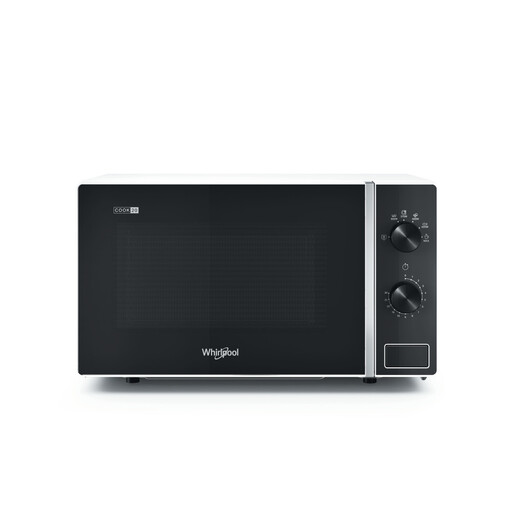 Image unavailable
This solo model is worth considering if you mainly want to reheat and defrost food. Its name lists a capacity of 20 L and microwave power of 700 W. Check its dimensions, ventilation clearances and electrical requirements for your chosen space.
Start by comparing solo models: their functions are suited to these tasks and a few simple cooking jobs. A grill model is worth considering if you’d also like to brown or crisp dishes; convection is for other types of cooking.
A combination microwave with convection can handle some oven-style cooking if you genuinely plan to use that function. Check which dishes the model can cook, then consider its dimensions, weight, ventilation and electrical requirements before planning where to install it in your studio flat.
Measure the available width, depth and height, then compare these with the appliance’s external dimensions. Allow for the clearances listed in the manual: Whirlpool France reminds users that the ventilation openings must not be blocked.
Only if the tray is microwave-safe and you follow the preparation instructions. Anses warns that using too high a power setting increases the risk of substances migrating from the packaging. If you’re not sure whether it’s suitable, use a microwave-safe container.