
Same-day & Next-day Delivery

Quality Guaranteed

Unlock Your Welcome Offers: FREE Delivery | Up to 80% OFF | Free 30-day JoyPlus trial
Download the APP
Is your kitchen countertop disappearing under appliances, spice jars, and other utensils? Rest assured, you're not alone. Optimising your kitchen, especially when space is tight, is a constant challenge. A microwave shelf can seem like the perfect solution to free up space. But be warned: a poor choice can quickly turn this great idea into a real headache.
As a product expert at Joybuy, my role is to guide you through the jungle of options to find solutions that are as practical as they are durable. Let's break down the three most common pitfalls when buying a microwave stand, and more importantly, how to avoid them.
To avoid falling into these traps, simply focus on a few key technical criteria. They will help you choose a kitchen organiser that will deliver on its promises for years to come.
The choice of material is the cornerstone of longevity. Carbon steel is a reliable choice for its robustness and ability to support heavy loads. But that's not the whole story: to withstand steam and ambient humidity, it must have an effective protective coating (such as baked-on paint or an anti-rust treatment).
Before you check out, carefully verify the maximum load capacity stated by the manufacturer. It should be significantly higher than the weight of your microwave, plus anything else you plan to place on it. Also, remember to distribute the load evenly, always placing the heaviest items on the bottom shelf.
A good microwave shelf should adapt to your kitchen, not the other way around. Before you even start browsing models, take out your tape measure and get a few crucial measurements:
Opting for a shelf that is expandable in width or adjustable in height is a real bonus. This modularity ensures a perfect, precise fit and guarantees you can reuse your kitchen storage solution even if you change your microwave or move house.
Stability depends on the overall design, but also on details that make a world of difference. A wide base and thick uprights are a good start. But the game-changing detail is the non-slip pads under the feet. They prevent the shelf from sliding, protect your countertop from scratches, and absorb vibrations from the microwave when it's running.
Because every kitchen is different, here is a selection of models that meet various needs and budgets, all approved based on our criteria for modularity, robustness, and practicality.
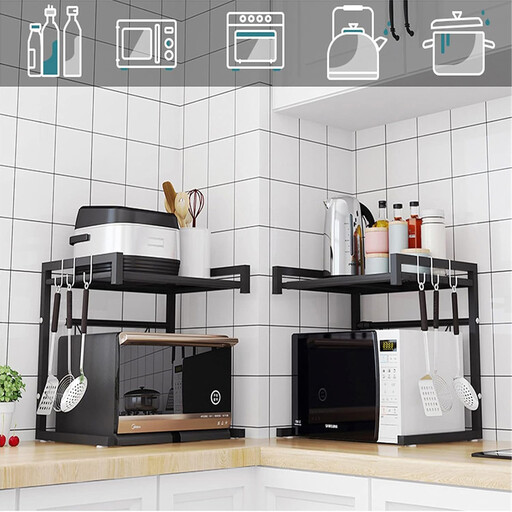
Our take: Perfect for small kitchens, this C-shaped shelf optimises the vertical space above the microwave without creating visual clutter. Its clean design and adjustable width make it a smart, versatile solution for a first-time setup or for freeing up an already crowded countertop.
Its expandable structure outsmarts the fixed-dimension trap. It adjusts to the exact width of most microwaves on the market.
Its expandable C-shaped design for a custom fit; frees up valuable countertop space.
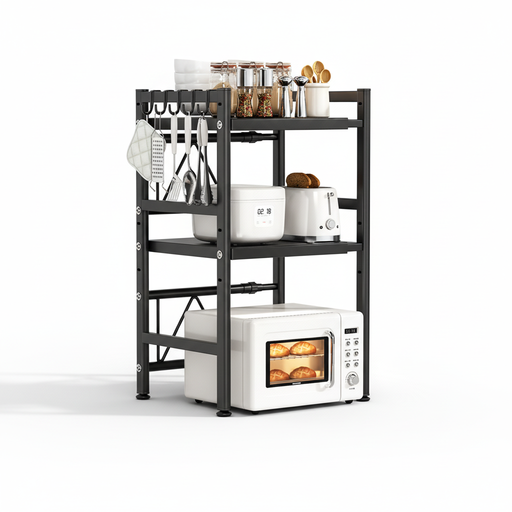
Our take: For those who want to optimise every square inch, this 3-tier model is a true command centre for the kitchen. It holds the microwave, as well as a toaster, spices, or dishes, and transforms a simple corner into an ultra-functional storage hub.
Its robust carbon steel design with a protective coating checks all the boxes: stability and anti-corrosion. Its expandable width (39-62 cm) and adjustable tiers eliminate the risk of an incompatible purchase.
High capacity with 3 tiers, a robust carbon steel structure, and adjustable width for unbeatable versatility.
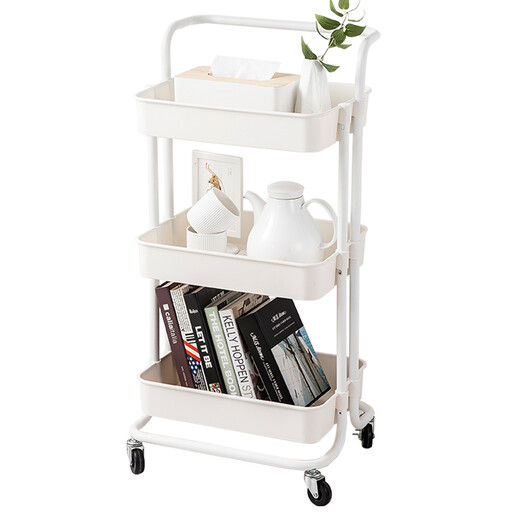
Our take: This shelf gets straight to the point: 3 tiers to efficiently organise kitchen essentials. It's the ultimate pragmatic choice for decluttering your space without the complexity of features like expandability.
This model plays the transparency card to avoid the trap of unpleasant surprises. The description is clear: the painted iron tubes can oxidise from the inside in a humid environment. The buyer is informed and can make a knowledgeable decision.
Simple 3-tier structure for essential storage; easy assembly and transparency about materials.
We have selected a full range of products that meet our strict standards for quality and safety.
Capacity varies enormously from one model to another, from 15 kg to over 50 kg. It is therefore essential to consult the product specifications to find the recommended maximum load from the manufacturer. For reference, an average microwave weighs between 10 and 18 kg. Always aim for a load capacity that is significantly higher than the weight of your appliance and anything else you will add to it.
Opt for materials like carbon steel or stainless steel, which are naturally more resistant. Also, ensure they have a quality protective coating (epoxy paint, powder coating). For maintenance, a simple wipe with a soft, damp cloth followed by thorough drying is sufficient. Most importantly, never use an abrasive sponge that could damage the protective layer.
Yes, if it is well-designed. Quality models have reliable locking systems (tightening screws, clips) that secure the structure once the width is set. Be sure to tighten all mechanisms securely after assembly. The presence of non-slip pads further enhances the overall stability.