
Livraison le jour même ou le lendemain

Qualité garantie

Débloquez vos offres de bienvenue: Livraison GRATUITE | Jusqu'à -80 % | 30 jours d'essai gratuits à JoyPlus
Téléchargez l'application
A spanner that slips, a missing size, or a seized ratchet mechanism can turn a routine task into a real waste of time. Whether you're working on car maintenance, plumbing, electrical work, or DIY jobs around the house, choosing the right metric spanners depends on accessibility, nut sizes, and how often you'll use them.
Product listings often focus on durability or versatility. However, there are certain details worth checking carefully before you head to the checkout.
A 12-piece set doesn't necessarily cover every useful size. Check the exact list of sizes: some sets focus on common sizes from 8 to 19 mm, while others offer larger sizes or start at 6 mm.
For a car, motorbike, or household equipment, the sizes 10, 11, 12, 13, 14, 15, 17 and 19 mm come up regularly. However, your needs may vary depending on the vehicle and the type of work.
A chrome or polished finish makes cleaning easier and can improve corrosion resistance, but it's not enough to judge a spanner's quality. You also need to consider the material, heat treatment, head geometry, and fit precision.
Chrome vanadium spanners, often marked Cr-V, are made from an alloy well suited to hand tools. That doesn't mean they can withstand every stress: using a tube or extension on a spanner not designed for it increases the risk of deformation and injury.
A standard open-ended spanner can be difficult to position in an engine bay or behind a fitting. Conversely, an offset ring spanner or a flexible ratchet spanner can make access much easier, provided you use its mechanism correctly.
The offset angle, handle length, swing arc, and head orientation matter just as much as the spanner size.
Choose products that clearly state the steel used and, where available, mention forging or heat treatment. These details tell you about the manufacturing process, but they don't guarantee unlimited use.
After each use, wipe off grease and moisture, then store the spanners in a pouch or on a rack. A light lubrication of moving parts is recommended for ratchet models. Avoid leaving them in a damp place, especially inside a vehicle subject to wide temperature fluctuations.
For plumbing, general maintenance, and fittings of various sizes, a 150 mm adjustable spanner can complement a set of fixed spanners. However, it doesn't always replace a perfectly fitted fixed spanner.
Metric ratchet spanners are particularly suited to repetitive tasks. A small ratcheting angle is very useful in tight spaces. Models with a 72- or 144-tooth mechanism claim a reduced working arc; nevertheless, check the torque limits stated by the manufacturer.
For loosening a very stubborn nut, it's better to use a suitable, stable tool. A ratchet is not designed to take an improvised extension, unless the manufacturer explicitly says so.
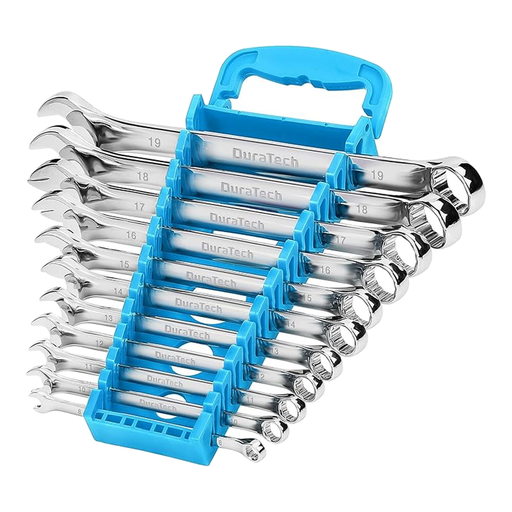
Why this choice suits this profile: The 11 sizes from 8 to 19 mm cover the essentials for DIY at home and for first-time car jobs.
Sizes are marked on both sides, and the plastic tray helps prevent misplacing or losing spanners.
Treated chrome vanadium steel, 12-point ring end, and 15-degree offset.
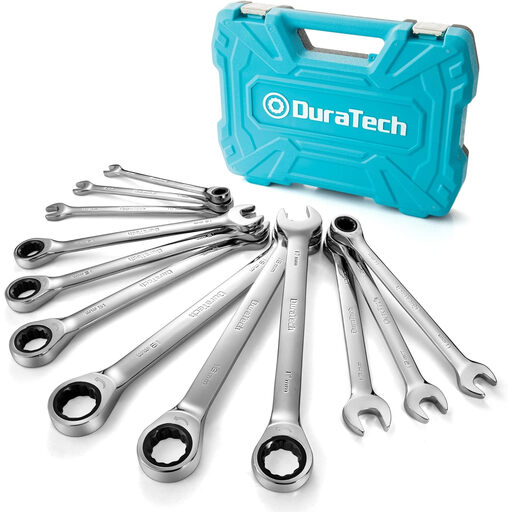
Why this choice suits this profile: The 72-tooth reversible mechanism is ideal for those who want smooth progress during repetitive tasks.
The 8 to 19 mm range is clearly detailed, and the storage case lets you quickly check all pieces are present.
Forged and treated Cr-V steel, claimed 5-degree working arc, and directional markings.
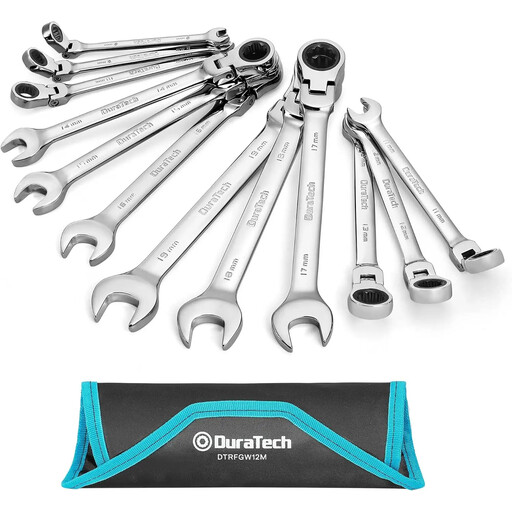
Why this choice suits this profile: The 180-degree pivoting head is designed for mechanics and tradespeople working in hard-to-reach areas.
The flexible head reduces repositioning when the straight handle won't fit around the nut.
180-degree flex head, 72 teeth, claimed 5-degree arc, and a roll-up pouch.
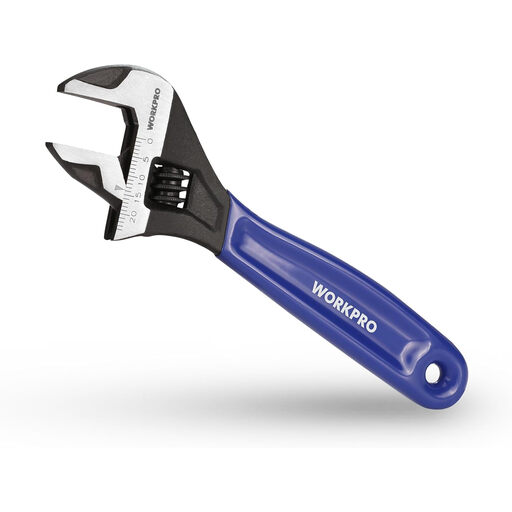
Why this choice suits this profile: Its compact size is ideal for fittings, nuts, and maintenance tasks where you need to cover several sizes with a single tool.
The engraved metric scale lets you check the opening before tightening, rather than adjusting the spanner by eye.
150 mm length, Cr-V steel, machined jaws, and a claimed maximum opening of 24 mm.
We've put together a comprehensive, real-time updated selection of products that meet these demanding criteria and European safety standards.
Before each tightening, choose a size that exactly matches the nut. Position the spanner flat, then apply force in line with the handle. A poorly engaged open-end spanner can damage the nut's faces, while a tool that's too large increases the risk of slipping.
For car spanners, store the different sizes in order and regularly check the teeth of the mechanism on ratchet models. Replace any spanner that shows a crack, a deformed jaw, or abnormal play. Tools intended for electrical circuits should only be used under the specified conditions, and never on a live installation with a non-insulated tool.
A combination spanner usually has an open end and a ring end. An offset ring spanner often has two closed ends, with an angle that makes it easier to access around obstacles. It's very practical for mechanics, but less versatile for nuts that are accessible from the side.
They can be used for tightening and loosening as long as the mechanism and load stay within the limits stated by the manufacturer. For a heavily seized nut, however, it's better to use a fixed spanner or a suitable loosening tool to avoid putting excessive strain on the ratchet.
Clean off grease and moisture after each use, dry the tools, then store them on their rack. Don't use improvised extensions and never strike the handle. Always choose a spanner whose size precisely matches the fastener.