
Livraison le jour même ou le lendemain

Qualité garantie

Débloquez vos offres de bienvenue: Livraison GRATUITE | Jusqu'à -80 % | 30 jours d'essai gratuits à JoyPlus
Téléchargez l'application
A 1/4 inch metric socket set can simplify a wide range of tasks: assembling furniture, maintaining a bike, carrying out small car repairs or doing jobs around the house. But not all sets are created equal. A smart-looking case can hide a limited selection of sizes, sockets you’ll rarely use, or a mechanism that’s awkward to handle in tight spaces.
Before you place an order, take the time to check the features that really matter. Here are the most common pitfalls, the technical points to look out for, and a selection of sets suited to different needs.
A 14-piece socket set isn’t necessarily more practical than a larger kit. The number quoted can include the ratchet, extension bar, socket holder and several accessories. So look at the detail of the sizes supplied rather than relying on the number on the box.
For everyday repairs, metric sockets from 4 to 13 mm already cover many small nuts and bolts. However, they won’t replace a set that also offers 16, 17 or 19 mm sockets, which are essential for certain car jobs.
A bulky ratchet can quickly become awkward to position under a bonnet, behind a piece of furniture or in a tight engine bay. The number of teeth has a very real impact here. A 72-tooth ratchet offers a reduced swing arc, typically around 5°, allowing you to work with limited movement to tighten or loosen.
That doesn’t mean a ratchet with a high tooth count is right for every job. For heavily tightened assemblies, stick to the limits stated by the manufacturer and use a tool suited to the required torque.
Chrome-vanadium steel, often shortened to Cr-V, is very common for making sockets and ratchets. Heat treatment and a chrome finish improve resistance to wear and oxidation, but they don’t make the tool indestructible.
After use, wipe the sockets clean, avoid leaving them in a damp environment and return them to their holder. A 1/4 inch set isn’t designed to be used as a breaker bar or a striking tool.
The 1/4 inch format refers to a compact drive square, suitable for small sockets and jobs that require precision. It’s ideal for assembly, light mechanical work, maintaining household equipment and working in hard-to-reach spaces.
Before ordering, check that the sockets and accessories all use the same drive size. An adaptor can broaden your options, but it adds height and can affect how the tool handles.
The sizes engraved or moulded on each socket need to be easy to spot. Markings that are too faint increase the risk of picking the wrong size and damaging the flats of a nut.
For versatile home use, a range from 4 to 13 mm, including half-sizes like 4.5 and 5.5 mm, makes a compact and consistent foundation. For more varied car maintenance, it’s better to go for a more comprehensive set with multiple drive sizes.
A 76 mm extension bar lets you reach a recessed nut or one set deep inside a housing. It’s particularly useful for assembly and certain jobs around an engine. A quick-release ratchet makes changing sockets easier thanks to a release button, without having to pull hard on the accessory.
Always make sure the socket is properly engaged before applying force. The direction selector should also be clearly set to tightening or loosening.
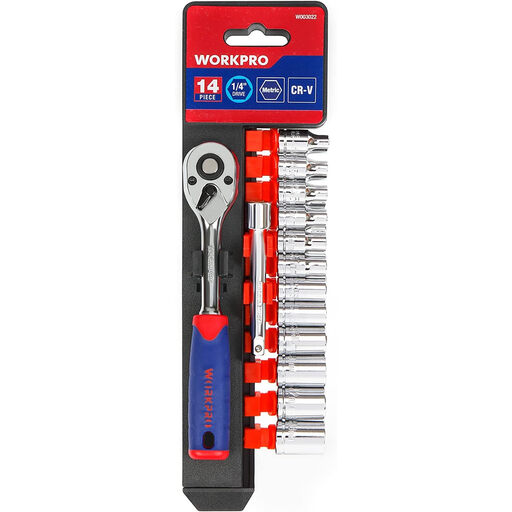
Why this choice suits this profile: Its compact size is ideal for household repairs, assembly and light mechanical work, without having to carry a bulky case around.
The composition clearly lists metric sizes from 4 to 13 mm, the 1/4 inch drive and a 76 mm extension bar. This makes it easy to check the contents before buying.
Chrome-vanadium steel, 72-tooth reversible ratchet, quick-release button and soft-grip handle.
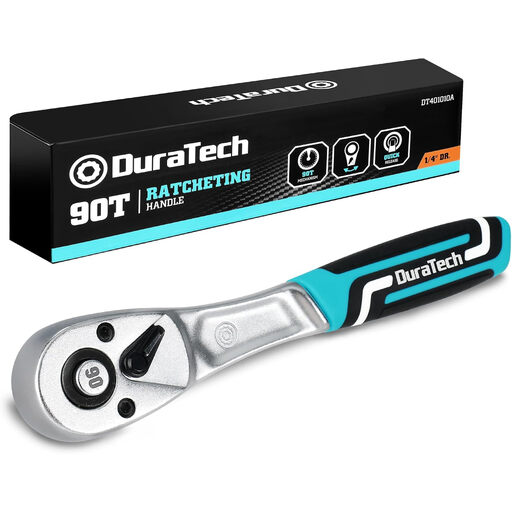
Why this choice suits this profile: This ratchet on its own can complement an existing set when manoeuvrability and a small swing arc are the priority.
The product page states a 90-tooth mechanism, a claimed 4° swing arc and a quick-release button, rather than just a vague promise of comfort.
Chrome-vanadium steel, reversible direction and ergonomic handle with chrome finish.
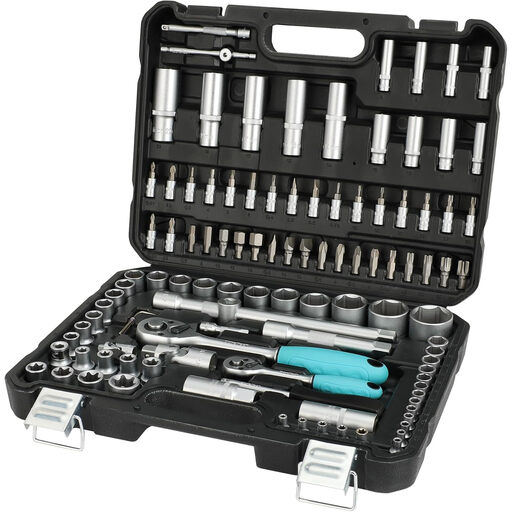
Why this choice suits this profile: Its extensive composition is ideal for those who regularly maintain a car, motorbike, workshop or several pieces of equipment.
The inclusion of 1/4 and 1/2 inch drives, extension bars, universal joints and metric and SAE sockets reduces the need for additional purchases, provided you check the sizes you need.
108 pieces, chrome-vanadium steel sockets, S2 bits, 72-tooth ratchets and storage case.
We’ve put together a comprehensive, real-time updated list of products that fully meet these strict selection criteria and European safety regulations.
It’s suitable for small maintenance jobs, removing certain components and working on small accessories. For larger or heavily tightened nuts, a 3/8 or 1/2 inch drive may be needed. Check the dimensions given by the manufacturer or in the repair manual.
The number of teeth affects the swing arc. A 72-tooth model generally requires a slightly wider movement than a 90-tooth model, but both can be practical in tight spaces. Robustness, the quality of the mechanism and staying within the permitted torque matter just as much.
Avoid prolonged exposure to moisture, wipe off grease marks and regularly check the condition of the mechanism. Don’t use an improvised extension bar to increase the force applied. If a socket shows signs of deformation or cracking, replace it before carrying on with the job.