
Livraison le jour même ou le lendemain

Qualité garantie

Débloquez vos offres de bienvenue: Livraison GRATUITE | Jusqu'à -80 % | 30 jours d'essai gratuits à JoyPlus
Téléchargez l'application
When repairing a car, motorbike, machine or household appliance, a metric ratchet combination spanner set can save you a great deal of time. Each spanner typically combines an open end with a ratcheting box end, so you don't have to remove the tool after every movement.
But not all sets are created equal. A smart-looking presentation or a high piece count doesn't guarantee a useful range of sizes or comfortable use. Here are the main pitfalls to avoid before you place your order.
A 12-piece set might cover sizes from 8 to 19 mm, while another 12-spanner set could start at 6 mm and include non-consecutive sizes. So don't just look at the number of spanners: check the detailed list of dimensions.
For common car repairs, sizes 8, 10, 12, 13, 14, 15, 17 and 19 mm are often the most useful. For household maintenance or mechanical work, an assortment ranging from 6 to 22 mm offers greater versatility.
A standard ratchet spanner needs a certain angle to advance. In an engine bay or behind a metal structure, too wide an arc can make the tool unusable.
72-tooth models typically offer a working arc of 5°. 144-tooth versions can go down to 2.5°, depending on the product specification. These figures indicate the movement needed to re-engage the mechanism, but they don't replace checking the head thickness and the space available around the nut.
The material matters, but the treatment and finish deserve your attention too. Chrome-vanadium spanners can be forged and heat-treated. Their chrome-plated or matte surface makes cleaning easier and limits oxidation, provided you store them correctly.
However, these details alone don't tell you the torque capacity. To loosen a seized fastener, use a tool designed for that job, respect its limits and avoid extending a ratchet spanner with a tube or any other extension.
A metric combination spanner set should match the vehicles you maintain and the jobs you do most often. A continuous assortment from 8 to 19 mm suits many tasks on a car, motorbike or technical furniture. A set starting at 6 mm will be more useful for smaller fixings.
Also check whether the sizes are engraved or printed on both sides. This detail might seem minor, but it makes identifying a greasy spanner or one taken out of its pouch much easier.
A 12-point box end is easy to position on the fastener and offers more orientations than a 6-point end. However, it must be properly engaged before you apply force.
For tight spots, compare the different configurations:
Ratcheting combination spanners are practical for nuts accessible from the side, but they should never be used as a hammer or a lever.
A roll-up pouch will easily find its place in a car boot or a maintenance crate. A rigid case protects the tools better during transport and lets you quickly spot a missing piece. In a fixed workshop, a holder with clearly marked slots can be even faster to consult.
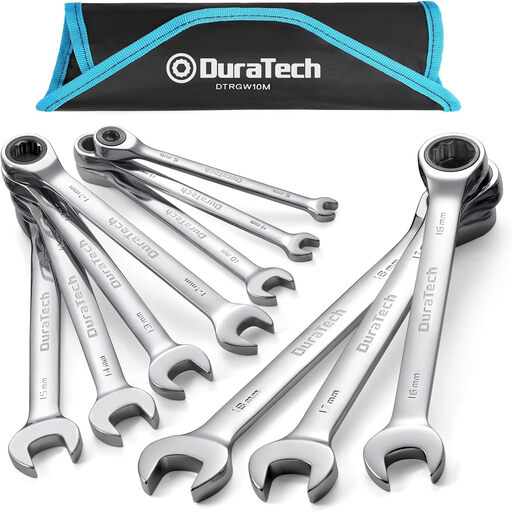
Why this choice suits this profile: This assortment covers 10 sizes from 6 to 18 mm. It's suitable for household repairs, DIY projects and first-time car maintenance.
The product page clearly lists the sizes included, the 72-tooth mechanism and the 5° working arc, rather than just showing a piece count.
Chrome-vanadium steel, 12-point box ends, marked sizes and a roll-up pouch.
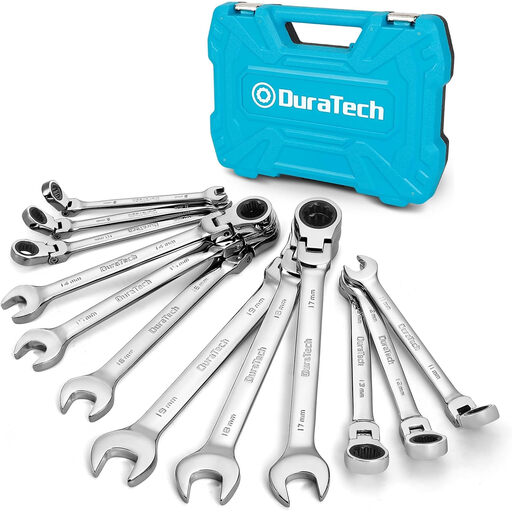
Why this choice suits this profile: The head pivots up to 180°, giving you valuable adjustment when working repeatedly on vehicles or machinery.
Flexibility isn't just about a long handle: the product page mentions the 180° orientation, 72 teeth and 5° arc.
12 consecutive sizes from 8 to 19 mm, treated chrome-vanadium steel and a storage case.
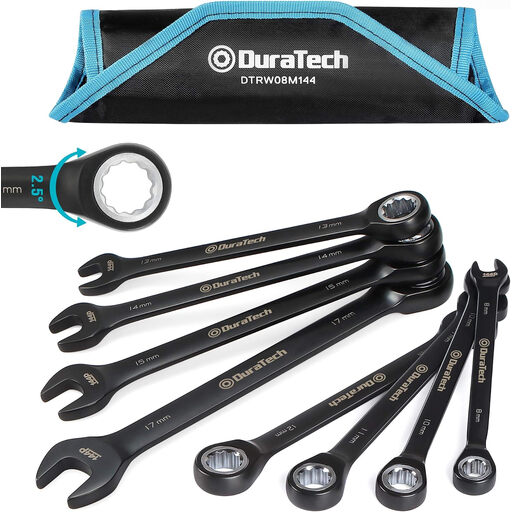
Why this choice suits this profile: With 144 teeth and a stated working arc of 2.5°, this set is aimed at jobs where the spanner has very little room to pivot.
The product page details the low swing arc and the sizes included in the set. You can check compatibility with your fixings before buying.
144-tooth mechanism, black chrome finish and a roll-up pouch with dedicated slots.
A combination spanner set isn't enough for every situation. To reach a nut behind a pipe or deep inside an engine bay, offset box-end spanners can effectively complement your toolkit. The DURATECH double-ring models with a 75° offset are available in 8-piece versions from 6 to 22 mm, or 9-piece versions up to 23 mm.
For oil filter nuts, a dedicated spanner is more suitable than a combination spanner. According to its product page, the WORKPRO model with three adjustable jaws fits filters from 70 to 110 mm. Remember to measure your filter before ordering.
Finally, a 150 mm adjustable spanner can serve as a stopgap for several sizes. However, it requires precise adjustment and doesn't replace a set of fixed sizes for repetitive jobs.
We've put together a comprehensive list, updated in real time, of products that fully meet these strict selection criteria and European safety regulations.
A combination spanner has an open end and a box end. When the box end incorporates a ratchet mechanism, you can turn the fastener without fully removing the tool. A ratchet socket wrench works differently: it uses interchangeable sockets mounted on a drive square.
For everyday jobs, a set covering 8 to 19 mm makes a practical starting point. If you work on small machines, furniture or household equipment, sizes 6 and 7 mm can also prove useful. The best approach is to examine your fixings before choosing.
The flex head makes access easier, but it can be less compact than a fixed head and its joint must stay properly positioned. For heavy tightening, engage the full box end on the nut, follow the manufacturer's instructions and use a torque wrench when a precise torque setting is required.