
Livraison le jour même ou le lendemain

Qualité garantie

Débloquez vos offres de bienvenue: Livraison GRATUITE | Jusqu'à -80 % | 30 jours d'essai gratuits à JoyPlus
Téléchargez l'application
For car maintenance, home repairs or workshop jobs, a metric ratchet spanner set can save you precious time. That is, of course, provided you pick the right sizes and a mechanism that truly works well in tight spaces. A kit that looks good on paper can quickly show its limitations the first time you use it.
Here are the criteria to examine before buying, along with a selection suited to different needs.
A set that boasts a high piece count isn't necessarily the most practical. Some kits pile on accessories you rarely use, while leaving out the most common metric sizes. For working on a car, a bike, a machine or furniture, sizes from 8 to 19 mm already cover most of your needs.
Also check whether the set includes:
A straight spanner can become useless when a nut is tucked behind a hose, near a housing or against a wall. A 180° flex head gives you much more freedom, but it must stay stable enough during tightening.
The number of teeth is also worth your attention. A 72-tooth ratchet generally requires a smaller re-set angle. The product specs for the items shown here state a working arc of 5° — a real advantage when the handle can barely turn.
The term chrome vanadium steel refers to a very common alloy in fastening tools. However, it alone isn't enough to judge the overall quality of a set. You also need to consider the heat treatment, the finish, how readable the markings are, and the design of the mechanism.
For regular use, go for forged and heat-treated construction, plus a chrome-plated finish that makes cleaning easier and limits surface oxidation. That doesn't mean you can skip wiping the tools down after use, especially in a damp garage.
A metric ratchet spanner set should clearly state the sizes supplied. A range of 8, 9, 10, 11, 12, 13, 14, 15, 16, 17, 18 and 19 mm suits many common jobs. For heavily stressed nuts, a 12-point socket head makes positioning easier. A 6-point socket, on the other hand, protects the edges better when it's a perfect fit.
With 72 teeth, the mechanism lets you re-engage the movement over a small arc. That doesn't mean you should force it beyond its intended limits. With a 3-in-1 reversible ratchet handle, check the maximum torque ratings for each drive size before tackling a demanding job.
A well-designed repair tool case keeps every item in its place. A roll-up pouch is lighter and takes up less room in the boot, while a rigid box protects the sockets better and is easier to carry to a job site.
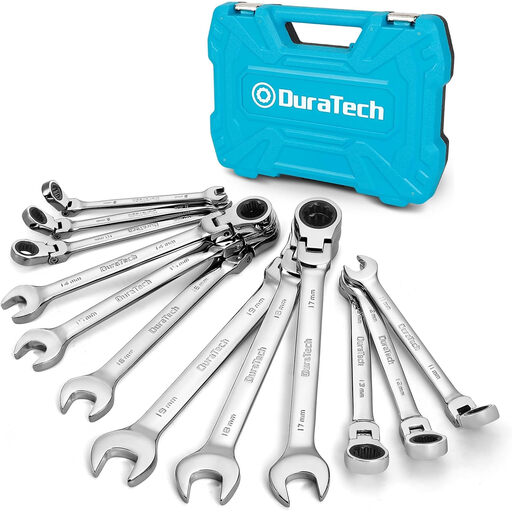
Why this suits this profile: This 12-spanner set covers sizes from 8 to 19 mm and handles everyday repairs without piling on extra accessories.
The sizes are stamped on the spanners, and the flex head makes it easier to reach nuts that a fixed spanner couldn't get to.
Chrome vanadium steel, 180° swivel head, 72-tooth mechanism and storage case included.
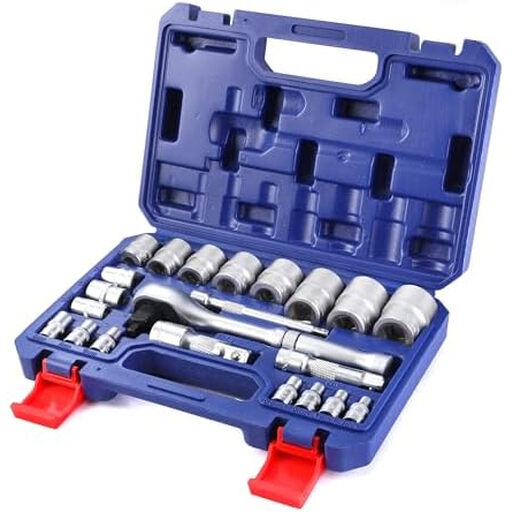
Why this suits this profile: This set combines a single handle with three drive squares and sockets suited to many automotive and household jobs.
The set doesn't rely just on piece count: the sockets are split across 1/4, 3/8 and 1/2 inch drive squares, with three extension bars.
22 pieces, 18 metric sockets, reversible 72-tooth handle and rigid case with dedicated slots.
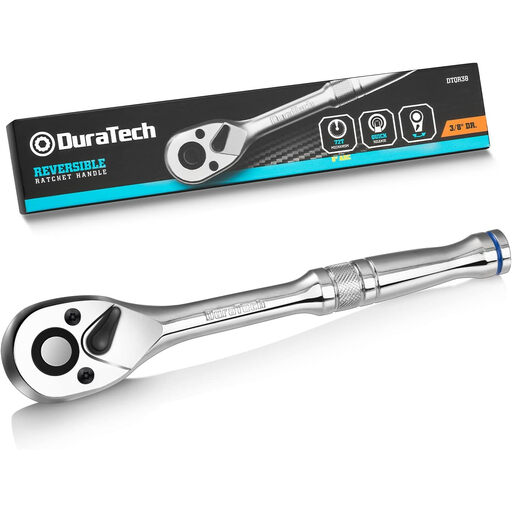
Why this suits this profile: Users who already own sockets, or want to expand their kit, can use a single handle with three different drive sizes.
The maximum torque values are stated for each drive size on the product page, so you can use it within its limits.
Three drive squares, direction reversal without removing the socket, knurled handle and 72-tooth mechanism.
Even a chrome vanadium steel set needs to be used with care. Choose a socket that fits the nut perfectly and avoid using the ratchet as a hammer or an improvised extension bar. For tightening that requires a precise torque value, use a separate torque wrench if the vehicle or machine procedure demands it.
After each job, wipe off any oil residue and put each item back in its place. Don't use a ratchet mechanism to free a seized part if the force might exceed its limits. A penetrating oil and a suitable loosening tool will reduce the strain on the mechanism.
We've put together a full, real-time updated list of products that meet these demanding criteria, while complying with European safety regulations.
A combination ratchet spanner has a polygonal opening built directly into one end. It slips easily around a nut when space is tight. A metric socket set uses a separate handle and generally offers more drive sizes, extension bars and accessories.
Yes. Thanks to its small re-set angle, a 72-tooth mechanism is especially handy for car repairs. However, you must respect the socket size, the direction of rotation and the torque limits stated by the manufacturer. For tightening that needs a precise value, refer to the vehicle manufacturer's instructions.
Clean the tools with a dry or slightly degreased cloth, then dry them before storing. Check the condition of the reversible mechanism regularly and keep the case away from moisture. Replace any socket that shows visible cracks or deformation.