
Livraison le jour même ou le lendemain

Qualité garantie

Débloquez vos offres de bienvenue: Livraison GRATUITE | Jusqu'à -80 % | 30 jours d'essai gratuits à JoyPlus
Téléchargez l'application
A cluttered garage, a difficult-to-organise basement or a workshop where tools routinely end up on the floor can quickly become a serious drain on your time. A metal storage shelf may seem straightforward to choose, but product listings do not always make it easy to assess stability, overall footprint or the load the unit can genuinely support in everyday use.
Before placing your order, take the time to review the following points. This will help you avoid ending up with a structure that bends, takes up too much room or becomes impractical after only a few weeks.
A capacity of several hundred kilograms generally refers to a static load, evenly distributed across each level. It does not mean that an extremely heavy item can be placed on a single corner of a shelf.
For everyday use, check the following in particular:
With a heavy-duty metal shelving unit, place the heaviest items on the lower levels. Irregular or concentrated loads require particular care.
A five-tier garage shelf may look compact in a photograph, yet measure 60 cm deep and 2 m tall. In a basement, utility room or small storage space, a few centimetres can be enough to prevent a door from opening fully or obstruct movement.
Measure the following precisely:
A slot-together system can make assembly easier, but you should still check the alignment, stability and locking of the crossbars. Protective gloves are recommended during assembly, particularly when handling metal components.
For installation in your home, read the instructions and follow the manufacturer’s warnings. If an anti-tip kit is supplied, secure it to a suitable wall. This precaution is especially important in homes with children or in busy professional environments.
A structure made from painted or powder-coated steel will generally withstand impacts and repeated loads better than a lightweight model designed solely for small items. MDF shelves provide a flat, practical surface for boxes, tools and household products. However, they must be protected from excessive moisture.
For a basement or garden shed, check the recommended conditions of use. Some metal models and their panels are not designed to remain permanently in a damp environment.
An adjustable industrial shelf allows you to tailor the height to suit containers, crates, appliances or storage boxes. Adjustable levels help you make better use of vertical space, but you should first check the system used: slot-in fittings, pins or screw fixings.
Even spacing works well for cardboard boxes. Closer-set levels are preferable for paint tins, power tools or heavy equipment.
A shelf that can be divided into two separate units offers greater flexibility in a garage or workshop. For example, it can separate DIY tools from seasonal supplies. This modularity does not remove the need to check the stability of each configuration or the available space around the uprights.
The models below address different requirements. The specifications mentioned correspond to the information available on each product listing.
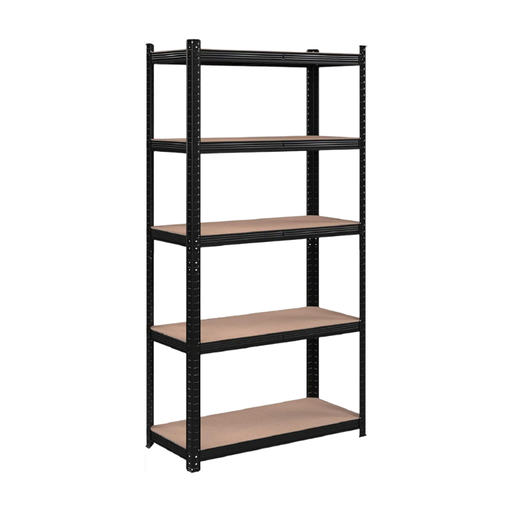
Why this model suits this profile: its 40 × 90 × 180 cm dimensions make it suitable for a garage, kitchen, home office or workshop that needs vertical storage without a substantial depth.
The five adjustable levels prevent wasted space and allow the storage layout to be adapted to items of different heights.
Metal structure, five adjustable shelves, flat-pack design and assembly instructions included.
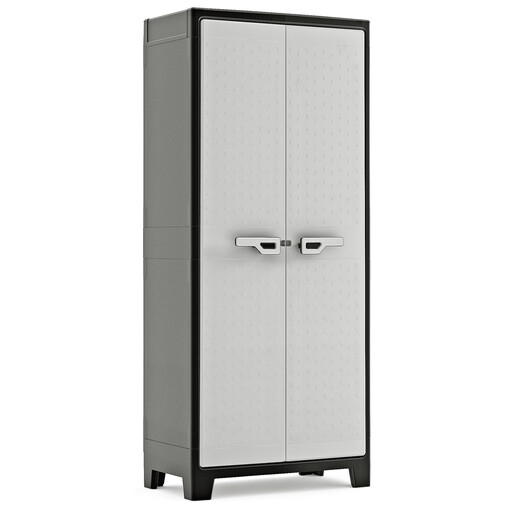
Why this model suits this profile: at 182 cm high, this enclosed cabinet is designed for anyone who wants to conceal household products, provisions or equipment in a utility room, kitchen or garage.
The four adjustable shelves and doors help limit exposure to dust. The provision for a padlock allows you to add an extra layer of security, although the padlock is not included.
Dimensions of 80 × 44 × 182 cm, stated capacity of 70 litres, four adjustable levels and polypropylene construction, with recycled material used in the upper section.
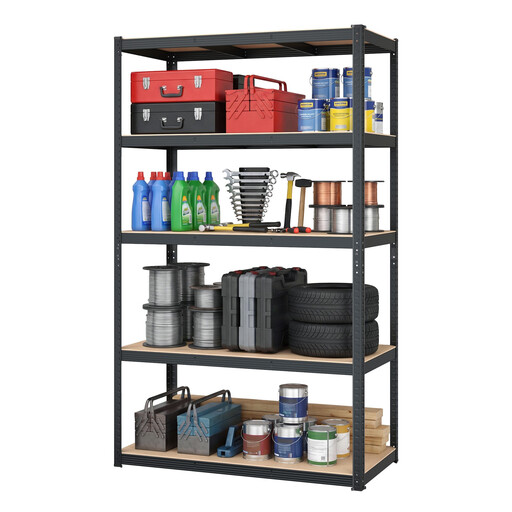
Why this model suits this profile: its 60 × 120 × 200 cm dimensions and stated static capacity make it suitable for storing tools, crates and bulky equipment in a workshop or garage.
The stated load is specified both per level and for the unit as a whole: 150 kg per shelf and 750 kg in total, with reinforcing bars and an anti-tip kit.
Painted steel, five adjustable levels, slot-together assembly and the option to convert the structure into two separate units.
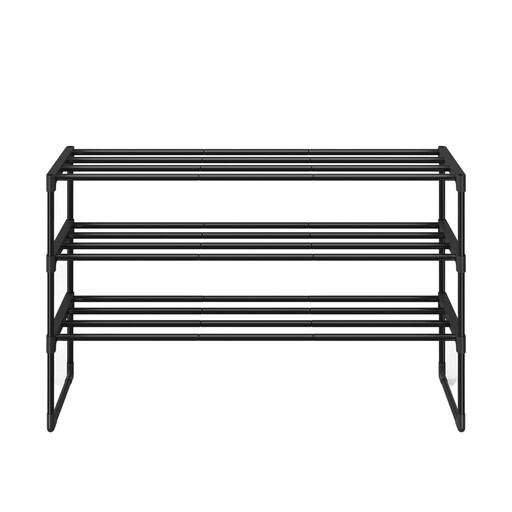
Why this model suits this profile: with a depth of 30 cm and a width of 92 cm, this slim shoe rack is easier to accommodate in an entrance hall, wardrobe or corridor.
Its compact format minimises the floor footprint. The stackable or reversible design allows the layout to be adapted to the available height.
Three levels, metal tubes, plastic connectors, tool-free assembly and a stated total capacity of 30 kg.
We have brought together an up-to-date selection of products to help you compare dimensions, materials and intended uses before making your purchase.
To extend the service life of a shelf designed to support heavy loads:
In a basement or storage room, also leave a gap between the wall and the stored items. This will reduce friction and make it easier to inspect the back of the unit.
It depends entirely on the model and how the weight is distributed. You need to distinguish between the maximum load per level and the total load. A shelf rated at 150 kg per level should not necessarily carry 150 kg concentrated in a small area. Consult the instructions and distribute items across the entire shelf.
Not always. Painted steel may be suitable for a mildly damp space, but prolonged exposure to moisture can damage the metal components and MDF panels. Check the manufacturer’s recommendations, ventilate the room and avoid direct contact with a wet floor.
Shelving provides quick access to tools, crates and equipment. A cabinet offers greater protection from dust and keeps its contents out of sight. For household products, sensitive equipment or a room visible from the living space, a closed cabinet may prove more practical. For a workshop whose needs may change over time, however, the adjustable levels of a shelving unit are easier to adapt.