
Same-day & Next-day Delivery

Quality Guaranteed

Unlock Your Welcome Offers: FREE Delivery | Up to 80% OFF | Free 30-day JoyPlus trial
Download the APP
A cluttered garage can quickly reduce the space available for DIY, parking a car or accessing boxes. A metal garage storage shelving unit can solve the problem, provided you look beyond the capacity shown on the packaging.
Marketing claims such as “heavy-duty”, “industrial” or “easy to assemble” do not tell the whole story. Stability, actual dimensions and how the weight is distributed all have a direct impact on day-to-day use. Here are the criteria to consider before choosing a 5-tier garage shelving unit for a workshop, cellar, garden shed or business premises.
A shelving unit advertised with a capacity of 600 kg, 750 kg or 875 kg does not necessarily mean that a single shelf can support this load. You need to distinguish between:
For example, a model rated at 600 kg with a capacity of 120 kg per tier must not have its entire load placed on one shelf. Containers, tools and boxes should be distributed to limit the strain placed on the structure.
A shelving unit measuring 40 cm deep will not meet the same needs as a 60 cm-deep racking unit. Small tools and boxes will generally fit on a shallower model, while bulky equipment requires more space.
Height must also be checked carefully. A 200 cm model makes effective use of a wall, but it must be compatible with the ceiling height, garage doors and the space needed to handle items. Also allow a few centimetres above the top shelf.
A click-together system makes assembly easier, but you still need to check that the uprights are properly aligned. Assemble the unit on a surface that is as level as possible, wearing protective gloves. For a tall or heavily loaded structure, the anti-tip kit must be secured to the wall in accordance with the instructions.
The stated capacity should be understood as a static load, generally applicable when the weight is distributed evenly. For workshop storage, distinguish between heavy, stable items — boxes of screws, mechanical parts or power tools — and more difficult items to position, such as soft bags or long equipment.
An MDF shelf provides a continuous surface that is particularly practical for boxes and storage bins. However, it must be protected from excessive moisture. In a garden shed or damp cellar, ensure good ventilation, avoid direct contact with the floor and do not store materials that are sensitive to changes in humidity.
A steel frame, particularly with a painted or galvanised finish, is suitable for everyday storage. However, this finish does not turn the shelving unit into equipment designed to remain outdoors all year round. Water splashes, condensation and knocks can accelerate deterioration.
Stability depends on several factors: base width, depth, the rigidity of the crossbars, how level the floor is and whether the unit is fixed to the wall. An industrial shelving unit should be chosen according to its actual environment, not simply its robust appearance.
An adjustable shelving unit allows you to adapt the space between tiers to the height of your items. Adjustment every 5 cm, for example, makes it easier to store crates, paint tins and machinery.
Some models can be converted into two separate units or workbenches with lower storage space. This modular shelving unit can be useful in a garage that changes over time, but check the final configuration and the stability of each element after separation.
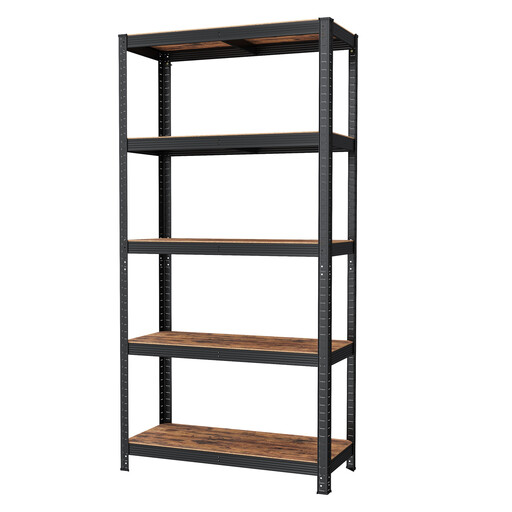
Why this choice suits this profile : measuring 40 × 90 × 180 cm, this model takes up less depth than a 60 cm shelving unit while offering five adjustable tiers for tools, boxes and garage accessories.
The load capacity is clearly broken down: 175 kg per tier and 875 kg in total. This distinction makes it easier to distribute items properly rather than relying on a single overall figure.
Steel frame, five adjustable tiers, the option to separate the structure into two units and an anti-tip kit included.
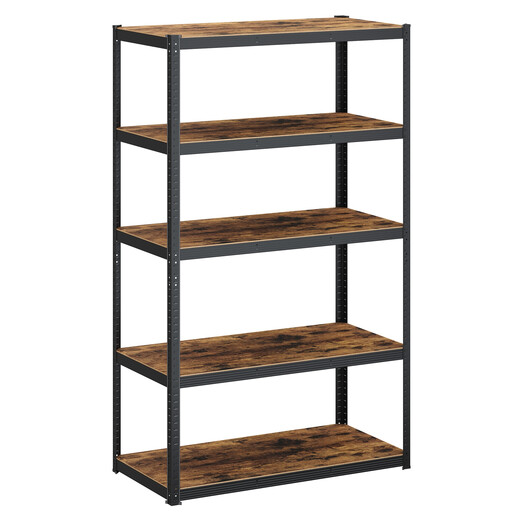
Why this choice suits this profile : its 60 × 120 × 200 cm format provides a generous storage surface for a large garage, workshop or small business premises.
The dimensions and load capacity per shelf are listed separately: 150 kg per tier and 750 kg in total. This makes it easier to compare the model with the space available.
Painted steel, adjustable tiers, conversion into two units and wall-fixing kit supplied.
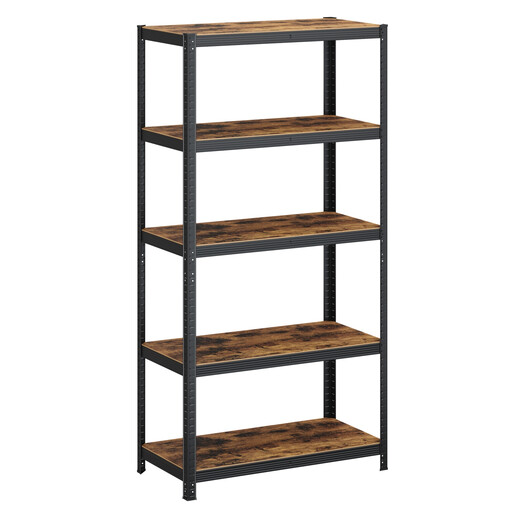
Why this choice suits this profile : its 50 × 100 × 200 cm format is suitable for workshops, cellars and garages that need five tiers without taking up the entire width of the wall.
The click-together assembly requires no tools, but the manufacturer recommends wearing gloves and securing the shelving unit to the wall using the included kit.
120 kg per tier, 600 kg in total, shelves adjustable in 5 cm increments and the option to separate the structure into two units.
Before assembly, measure the available width, depth and height. Identify any obstacles: electrical sockets, doors, pipes and ducts. Place the heaviest items on the lower tiers and reserve the top shelves for lightweight or infrequently used items.
To extend the shelving unit’s service life:
A metal garage storage shelving unit does not use electricity, so its running costs are limited to routine maintenance. The actual budget mainly depends on the purchase price, delivery, storage accessories and any work needed to prepare the wall or floor.
It depends on the model. The products featured are rated for between 120 and 175 kg per tier, with a total capacity of between 600 and 875 kg. These figures refer to an evenly distributed static load. Always follow the instructions and avoid concentrating several heavy items in the same place.
Tool-free assembly makes construction easier, but stability also depends on how level the floor is, whether the parts are properly locked together and whether the unit is secured to the wall. For a tall shelving unit, install the anti-tip kit in accordance with the manufacturer’s recommendations.
A depth of 40 to 50 cm is suitable for boxes and everyday tools while preserving more room for movement. A 60 cm model provides more storage space for bulky items but requires greater clearance. Measure the walkway before placing your order.