
Same-day & Next-day Delivery

Quality Guaranteed

Unlock Your Welcome Offers: FREE Delivery | Up to 80% OFF | Free 30-day JoyPlus trial
Download the APP
A cluttered garage does not necessarily lack space: it often lacks a well-planned organisation system. Tools, boxes, cans, gardening accessories and seasonal equipment end up on the floor, exposed to damp and difficult to find. A metal garage storage shelf can free up space, but some models quickly show their limitations when their specifications are misunderstood.
Before placing your order, here are the main pitfalls to avoid.
A stated capacity of several hundred kilos does not necessarily mean that each shelf can support that weight. Check the difference between the static load per level and the total capacity of the shelving unit. The latter generally refers to a load distributed evenly.
Very heavy items grouped on a single shelf can bend the panels or destabilise the structure. In a workshop or garage, spread the loads out and place the heaviest items on the lower levels.
A tall, shallow metal shelving unit can tip over if the weight is poorly distributed or an item is removed abruptly. A simple adjustable foot is no substitute for suitable wall fixing.
Choose a model supplied with an anti-tip kit, then select fixings compatible with your wall or support: concrete, brick, breeze block or partition wall. Check the hardware supplied before installation: it may not be suitable for every type of wall.
A 180 cm-high shelf may be too large for a low-ceilinged basement, while a depth of 60 cm could obstruct a door or reduce the available passageway. Measure the available area precisely, including skirting boards, and leave enough clearance to handle boxes.
Also consider access. In a narrow garage, two shorter modules may prove much more practical than one large unit.
For heavy-duty shelving, examine the frame material, the thickness of the uprights and whether any reinforcing crossbars are included. Powder-coated steel offers a surface that is easy to clean and is suitable for most dry indoor spaces.
However, this does not turn the product into professional warehouse equipment. In a damp cellar, avoid direct contact with the floor and regularly check for signs of oxidation, particularly around areas exposed to condensation.
An adjustable steel shelf allows you to adapt the height to boxes, tools and appliances of different sizes. Check the adjustment system: the levels must be properly locked into place and remain perfectly horizontal after installation.
A 5-tier metal shelving unit is often suitable for domestic needs, as it offers a good balance between vertical capacity and accessibility. For bulky items, being able to remove or reposition certain shelves may be more useful than having a large number of fixed levels.
MDF shelves provide a flat surface that is practical for boxes and small items of equipment. However, they must be protected from standing water and persistent damp. In a cellar or workshop, keep moisture-sensitive products away from areas where condensation forms and observe the stated load capacity.
Also check the contents of the parcel: number of modules, anti-tip kits, levels, crossbars and assembly instructions. A storage shelf for cellars and workshops should be installed on a sufficiently stable, level floor.
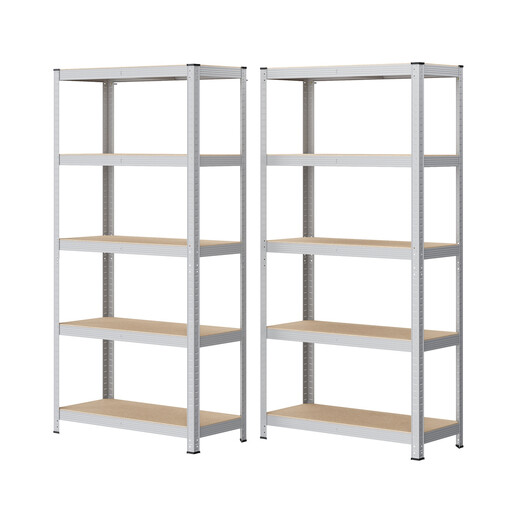
Why this choice suits this profile: This set of two modules allows you to organise a garage, storeroom or utility room by separating storage areas. Each structure measures 40 × 90 × 180 cm and the shelves are adjustable.
The product details state up to 175 kg per level and 875 kg total static load. These figures assume that the weight is distributed evenly and that the unit is wall-mounted using the two included kits.
Set of 2 modules, boltless assembly according to the product details, adjustable levels, powder-coated steel frame and MDF panels.
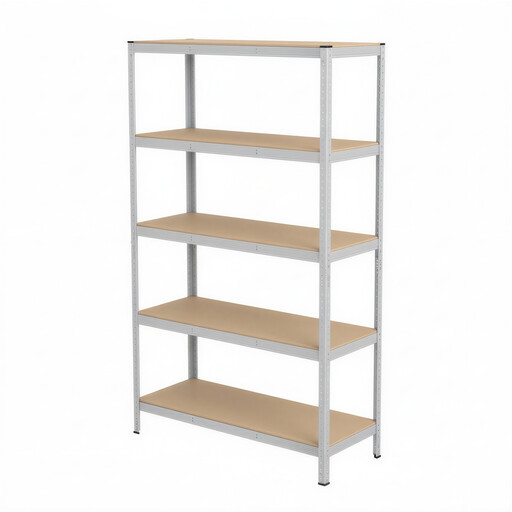
Why this choice suits this profile: Measuring 60 × 120 × 200 cm, it offers generous storage space for a workshop, spacious garage or dedicated storage area.
The stated capacity is clearly broken down: 150 kg per level and 750 kg in total. This makes it easier to compare the usable load with the module’s dimensions, without confusing storage volume with strength.
Five adjustable levels, powder-coated steel, anti-tip kit included and the option to split the structure into two units.
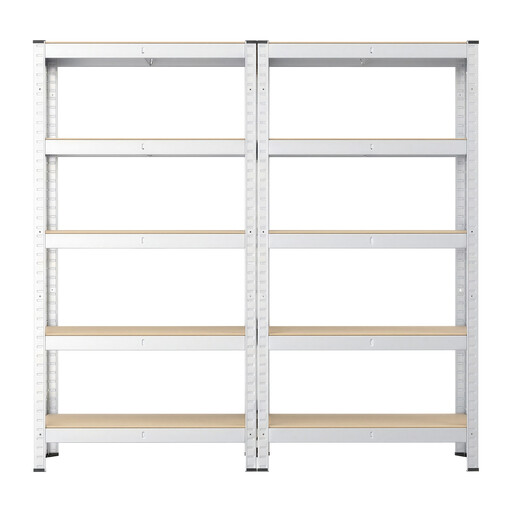
Why this choice suits this profile: With two units measuring 30 × 75 × 150 cm, this format is suitable for cellars, low-ceilinged garages, utility rooms and workshops that require several independent storage areas.
The product details specify a maximum load of 130 kg per level and 650 kg in total. Its low height makes items easier to reach and reduces the need to handle them overhead.
Set of 2 modules, five adjustable levels, metal frame, MDF panels and two anti-tip kits listed in the parcel contents.
We have selected a comprehensive, regularly updated range of products that meet these strict criteria, as well as European safety requirements.
To assemble a metal garage storage shelf, prepare work gloves, a clear working area and a perfectly level floor. First assemble the frame without loading it, check that each level is horizontal, then secure the unit to the wall when the appropriate kit is supplied.
A few simple habits can help extend its lifespan:
Start by estimating the actual weight of the items to be stored, then add a reasonable margin. For boxes, tools and everyday supplies, a clearly stated load per level is generally sufficient. For mechanical parts or heavy bags, compare the static load per shelf and the overall stability of the unit instead.
Install it on a stable floor, distribute heavy loads across the lower levels and use an anti-tip kit. Choose wall plugs suited to the type of wall and check that the fixings are properly tightened after assembly. In an area exposed to knocks, a lower or deeper model may also be preferable.
It can be suitable in a properly ventilated cellar, but persistent damp accelerates corrosion and may damage MDF panels. Raise the structure if necessary, allow air to circulate around the shelving and regularly inspect the metal surfaces.