
Livraison le jour même ou le lendemain

Qualité garantie

Débloquez vos offres de bienvenue: Livraison GRATUITE | Jusqu'à -80 % | 30 jours d'essai gratuits à JoyPlus
Téléchargez l'application
A cluttered garage can quickly become impractical: boxes piled on the floor, tools that are hard to reach, heavy containers placed on shelving that is too flimsy… To free up space, a robust metal garage shelving unit is often the obvious solution. However, you should not be swayed solely by a theoretical maximum capacity or promises of quick assembly.
Before placing your order, there are three pitfalls to avoid:
Here are the criteria to consider when choosing a shelving unit suited to your space and the items you plan to store.
The first detail to check is the maximum static load per shelf. This is the weight supported when the items remain stationary and the load is evenly distributed.
For storing toolboxes, car parts or professional equipment, a heavy-duty steel shelving unit should clearly state the capacity supported by each level. You should also distinguish between:
For example, a shelving unit advertised as supporting 600 kg may support up to 120 kg per level, depending on the model’s specifications. This limit must not be exceeded, particularly if the weight is concentrated in a small area of the shelf.
Measure the available area before ordering: the width between the walls, ceiling height, maximum depth and the space needed to open a door or move around.
A 5-tier industrial shelving unit measuring 200 cm high is suitable for a garage with sufficient headroom, but may prove impractical in a low-ceilinged cellar. Conversely, a 150 or 180 cm model is more likely to fit beneath a mezzanine or in a shed.
The depth should also match the items you want to store. A 60 cm shelf easily accommodates bulky storage boxes, while a depth of 40 or 50 cm is better suited to cartons, tools and cleaning products.
A tool-free adjustable shelving unit allows you to adapt the height of the levels to a wide range of items: small storage boxes, tyres, power tools or bulky cartons. Slot-together systems are convenient, but the instructions must be clear enough to identify the correct orientation of the crossbars and install the braces properly.
Also check whether an anti-tip device or fixing kit is included. This accessory does not replace careful installation: choose wall plugs suitable for the type of wall, check that the structure is level and keep the heaviest items on the lower levels.
MDF shelves provide a flat surface that is practical for everyday storage. However, they do not cope well with persistent moisture. For a cellar and shed shelving unit, avoid placing it directly on a damp floor and allow air to circulate around the structure.
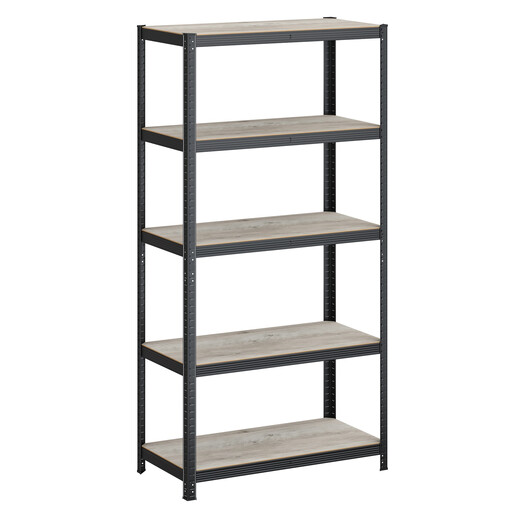
Why this product suits this profile : Measuring 50 × 100 × 200 cm, it is suitable for storing tools, cartons and equipment in a garage or cellar. Its slot-together assembly is designed to require no tools.
The stated capacity is 120 kg per level, for a total static load of 600 kg. The anti-tip kit is supplied, but wall fixing is still essential.
Shelves adjustable every 5 cm, a galvanised steel structure and the option to split the unit into two separate units.
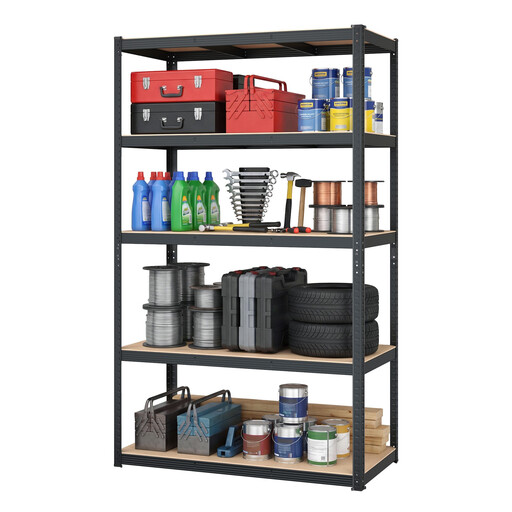
Why this product suits this profile : Its 60 × 120 × 200 cm format provides generous storage space for a workshop, warehouse or garage intended for bulky equipment.
The specifications clearly distinguish between 150 kg per level and 750 kg in total. Reinforced crossbars and the anti-tip kit address the main stability requirements.
A powder-coated steel frame, adjustable levels and the option to divide the structure into two separate units.
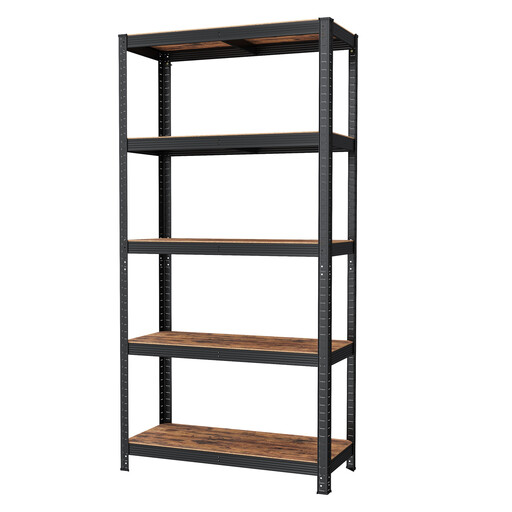
Why this product suits this profile : Measuring 40 × 90 × 180 cm, it is suitable for narrow spaces that still need to accommodate substantial loads, such as a stockroom, workshop or shed.
The stated capacity is up to 175 kg per shelf and 875 kg in total. However, the load must remain evenly distributed and the wall fixing must be used.
Five adjustable levels, a steel structure and a configuration that can be divided into two storage modules.
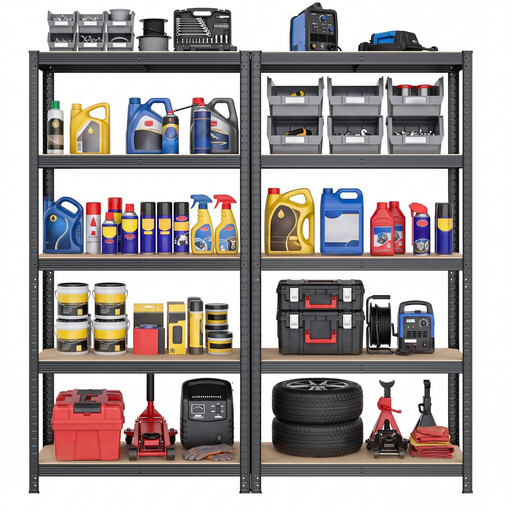
Why this product suits this profile : This set of two metal shelving units makes it easy to distribute tools between the garage, cellar, workshop or storage room.
Each unit has five levels, with a stated capacity of 175 kg per level and an anti-tip device included.
Two 40 × 90 × 180 cm modules, MDF shelves and an adjustable shelf height to suit different items.
We have brought together a complete, real-time updated selection of products that meet these demanding criteria and European safety regulations.
Before starting assembly, make sure the floor is level and clear of anything that could interfere with the process. Work gloves are strongly recommended when handling metal profiles. Once the structure has been assembled:
A workshop storage shelving unit should also remain easy to access. Leave enough room to walk in front of the levels and store small items in labelled boxes. This will reduce unnecessary handling and help you identify incorrectly positioned loads more quickly.
Estimate the weight of the items intended for each level, then allow a safety margin. Always compare this total with the maximum load per shelf, rather than just the stated overall capacity. For particularly heavy equipment, choose a reinforced structure and secure it to the wall.
Yes, provided you take the humidity, ventilation and type of flooring into account. The metal frame can be perfectly suitable for a cellar, but MDF shelves must be kept away from leaks and standing water. Suitable feet or a suitable support can reduce contact with a damp floor.
No. Tool-free assembly makes construction easier, but stability also depends on the components being correctly slotted together, how the loads are distributed, whether the floor is level and whether the unit is secured to the wall. Follow the manufacturer’s instructions and use the anti-tip device when supplied.