
Livraison le jour même ou le lendemain

Qualité garantie

Débloquez vos offres de bienvenue: Livraison GRATUITE | Jusqu'à -80 % | 30 jours d'essai gratuits à JoyPlus
Téléchargez l'application
A cluttered garage, a difficult-to-organise cellar or a workshop where tools are piling up on the floor can quickly become impractical. A sturdy metal shelving unit for your garage can help restore order, provided you do not rely solely on an impressive capacity or a carefully staged photograph.
Before buying heavy-duty metal shelving, there are three potential pitfalls that deserve your full attention :
For shelving designed for heavy loads, the term “total capacity” must be examined carefully. A static load refers to a stationary weight distributed across the shelf according to the manufacturer’s instructions. It does not necessarily take account of impacts, repeated movement or loads concentrated on a small surface area.
For example, a model advertised at 600 kg with 120 kg per level is suitable for organised storage of tools, boxes or small equipment. 750 kg versions may offer 150 kg per level, while some heavy-duty metal shelving units can support 175 kg per level with an advertised total capacity of 875 kg.
In all cases, place the heaviest items on the lower levels and distribute the load across the entire shelf surface.
An adjustable steel shelving unit generally combines a metal frame with MDF shelves. Steel provides the rigidity needed for storing heavy items, while MDF offers a flat surface for boxes, crates and accessories.
In a cellar or basement, take the ambient humidity into account. MDF is not designed to remain exposed to water or persistent condensation. Good ventilation and a position away from leaks will help protect the shelves.
Adjustable levels allow you to adapt the available space for containers, cases, power tools or storage boxes. Some models offer adjustment every 5 cm, making it easier to create compartments of different heights.
A clip-together shelving unit advertised as requiring no tools can reduce installation time. However, it still requires a level surface and careful attention to the instructions. Wear gloves during assembly and check that each crossbar is properly engaged.
Measure the available space before ordering :
Also allow enough room to move around and handle stored items. The supplied anti-tip device must be secured to the wall using a method suited to the type of surface : concrete, brick, breeze block or another material.
The products below suit different usage profiles. The capacities shown are those provided by the manufacturers for a static load.
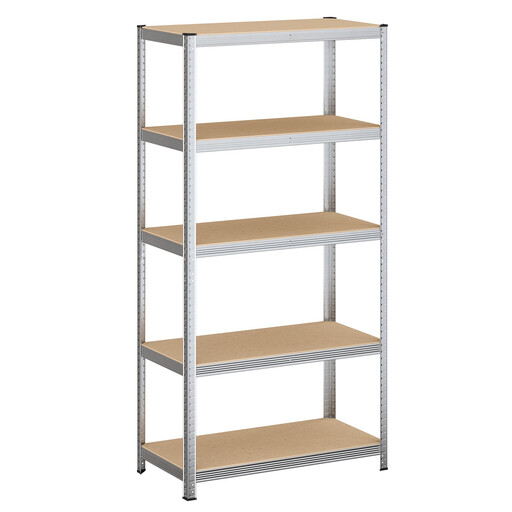
Why this choice suits this profile : Its 50 × 100 × 200 cm dimensions are suitable for a garage, shed or cellar. It offers five adjustable levels and uses a clip-together assembly system, with no tools required.
The product details clearly distinguish the 120 kg per level from the 600 kg total capacity. The anti-tip kit also highlights that stability depends on securing the unit to the wall.
Galvanised steel frame, five levels adjustable in 5 cm increments and the option to split the structure into two units.
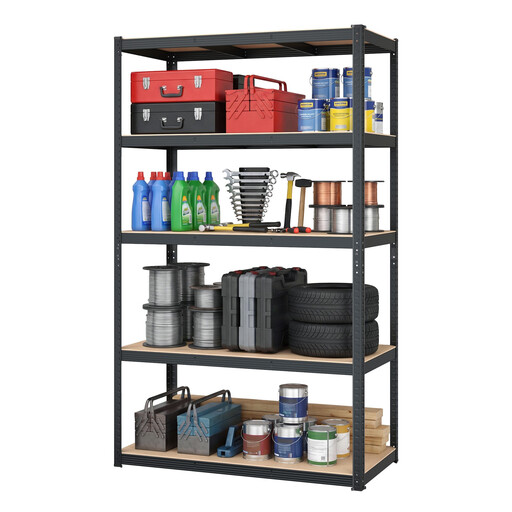
Why this choice suits this profile : Its 200 × 120 × 60 cm format provides plenty of storage space for a workshop, spacious garage or storeroom.
The reinforced crossbars and anti-tip kit address the two points that are often overlooked : the rigidity of the structure and securing it in place.
Advertised total capacity of 750 kg, 150 kg per level, adjustable levels and the option to split the structure into two modules.
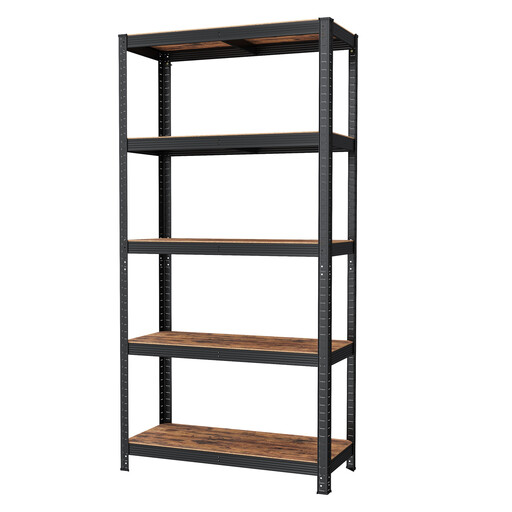
Why this choice suits this profile : Its 40 × 90 × 180 cm format takes up less width while providing suitable space for tools, equipment or heavy boxes.
The maximum load is specified as 175 kg per level, rather than only being shown as a single overall total. Securing the unit to the wall is still recommended.
Advertised total static capacity of 875 kg, five adjustable levels and the option to create two separate units.
We have compiled a complete, real-time updated list of products that meet these demanding selection criteria and European safety standards.
Once the metal shelving is assembled, check that it is level before filling it. Secure it to the wall using the supplied device, then distribute the loads by placing the densest items at the bottom. Do not allow items to protrude over the sides, and never climb onto the shelves.
In a garage or workshop, group items according to how often they are used : keep tools within easy reach, consumables on the middle level and seasonal equipment on the upper levels. Shelving for a workshop or storeroom can also be split into two modules, but each configuration must remain stable and properly anchored.
For boxes, tools and everyday accessories, a total capacity of 600 kg may be sufficient if the load is distributed correctly. For denser or professional storage, compare the 750 and 875 kg models, always checking the maximum load per level.
The clip-together system generally avoids the need for a screwdriver or spanner, but assembly still requires you to follow the instructions, wear gloves and check every connection. A level surface will also make installation easier.
Avoid prolonged exposure to moisture, observe the stated load capacity, distribute the weight and regularly inspect the crossbars, shelves and fixing points. Any deformed or unstable part must be taken out of service before being used again.